1. PURPOSE
To inform airspace users of the progressive implementation of the Performance Based Communication and Surveillance (PBCS) concept within FIR/UIR CANARIAS.
2. PBCS CONCEPT
The PBCS concept, defined by ICAO in Document 9869, establishes performance requirements for communications (RCP – Required Communication Performance), surveillance (RSP – Required Surveillance Performance), and navigation (RNP – Required Navigation Performance) that enable reduced separation, particularly in oceanic regions.
3. TECHNOLOGIES USED
In CANARIAS FIR/UIR, Canarias ACC provides air traffic services (ATS), with the oceanic sector of the CANARIAS FIR/UIR being particularly significant, as it handles traffic between Europe and South America, where the following communication and surveillance services are provided:
Voice communication service over VHF or HF, and via controller-pilot data link communications (CPDLC FANS 1/A) over VHF data link (VDL), satellite (Inmarsat and Iridium) or HF datalink (HFDL)
Automatic Dependent Surveillance Contract (ADS-C FANS 1/A) service using the same communication media as CPDLC FANS 1/A.
(*) CPDLC and ADS-C FANS 1/A over HF do not meet RCP 240 and RSP 180 performance.
4. REQUIREMENTS
To operate in accordance with the PBCS concept, the ATM system, data link systems, airborne systems and operators shall continuously comply with the functional, safety and performance requirements established in the communication and surveillance system specifications, as set out in ICAO Document 9869 – PBCS Manual.
Performance requirements are defined in terms of RCP (Required Communication Performance) and RSP (Required Surveillance Performance), indicating levels of reliability, availability, latency and integrity of communications and surveillance.
Navigation requirements are defined in terms of RNP (Required Navigation Performance), indicating the level of accuracy, integrity, continuity and functionality of navigation systems.
Within the Canarias FIR/UIR, aircraft equipped with and capable of CPDLC FANS 1/A RCP 240, ADS-C FANS 1/A RSP 180, and PBN RNAV 10 (RNP 10) and/or RNP 4 capability shall be eligible for the application of PBCS separations.
For the proper aircraft eligibility, the importance of the correct completion of the flight plan (FPL) by air operators and flight dispatchers is highlighted, in accordance with what is established in ENR 1.10 and in this AIC.
Operators shall include in Items 10 and 18 of the flight plan the annotations indicating that the required equipment and capabilities are available for PBCS operation. For this purpose, they shall:
a) Include in Item 10a (radio communication, navigation and approach aid equipment and capabilities) of the flight plan:
“J5” to indicate CPDLC FANS 1/A SATCOM (INMARSAT) equipment and capability.
“J7” to indicate CPDLC FANS 1/A SATCOM (Iridium) equipment and capability.
“P2” to indicate CPDLC RCP 240 capability.
“R” to indicate PBN (Performance-Based Navigation) approval, whose navigation levels that can be achieved shall be specified in Item 18 after PBN/ indicator. (See letter c) below).
b) Include in Item 10b (surveillance equipment and capabilities):
“D1” to indicate ADS-C equipment with FANS 1/A capabilities.
c) Include in Item 18 (other information):
“PBN/A1” to indicate RNAV 10 (RNP 10) capability.
“PBN/L1” to indicate RNP 4 capability.
“SUR/RSP180” to indicate the specification of the required surveillance performance RSP 180.
It is also reported that aircraft operating with PBCS capability shall also participate in the PBCS monitoring programme, managed by the SATMA Agency (South Atlantic Monitoring Agency), operating under ICAO.
5. BENEFITS
The implementation of the PBCS concept will enable:
reduced horizontal separation minima and future increased capacity in the Oceanic Sector of the FIR/UIR CANARIAS;
greater efficiency and flexibility in traffic management;
route and flight level optimization;
reduced fuel consumption, emissions, and operating costs;
maintenance of high levels of operational safety.
6. HORIZONTAL SEPARATION MINIMA
The applicable horizontal separation minima in the CANARIAS FIR/UIR will be as follows1:
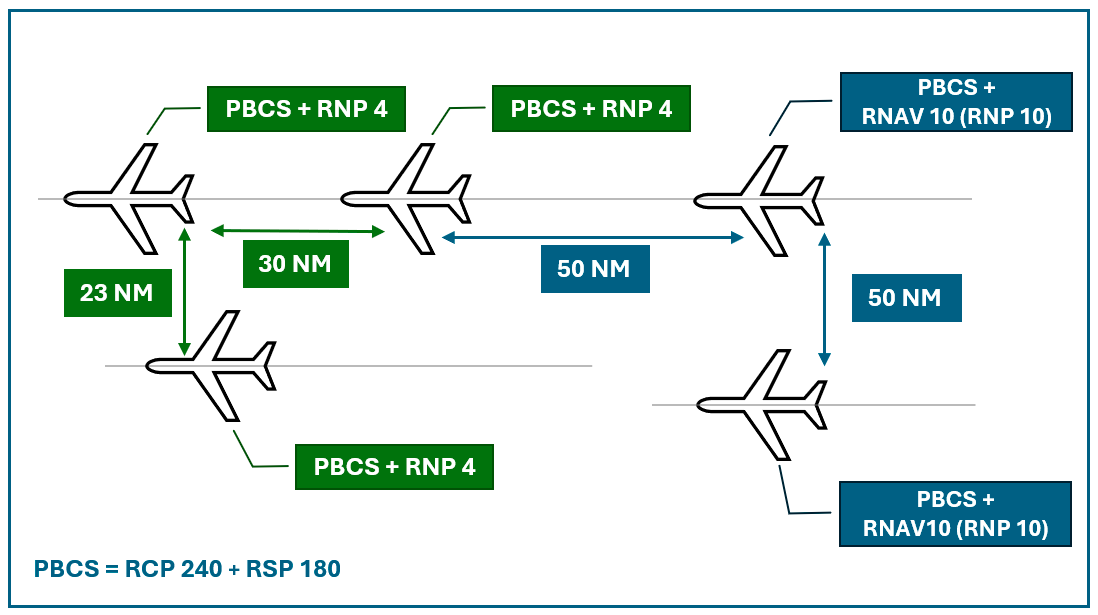
Both PBCS2 and RNP 4 aircraft. Separation: 30 NM longitudinal and 23 NM lateral.
Both PBCS2 aircraft, one of them RNAV 10 (RNP 10) or RNP 4 and the other RNAV 10 (RNP10). Separation: 50 NM longitudinal and 50 NM lateral.
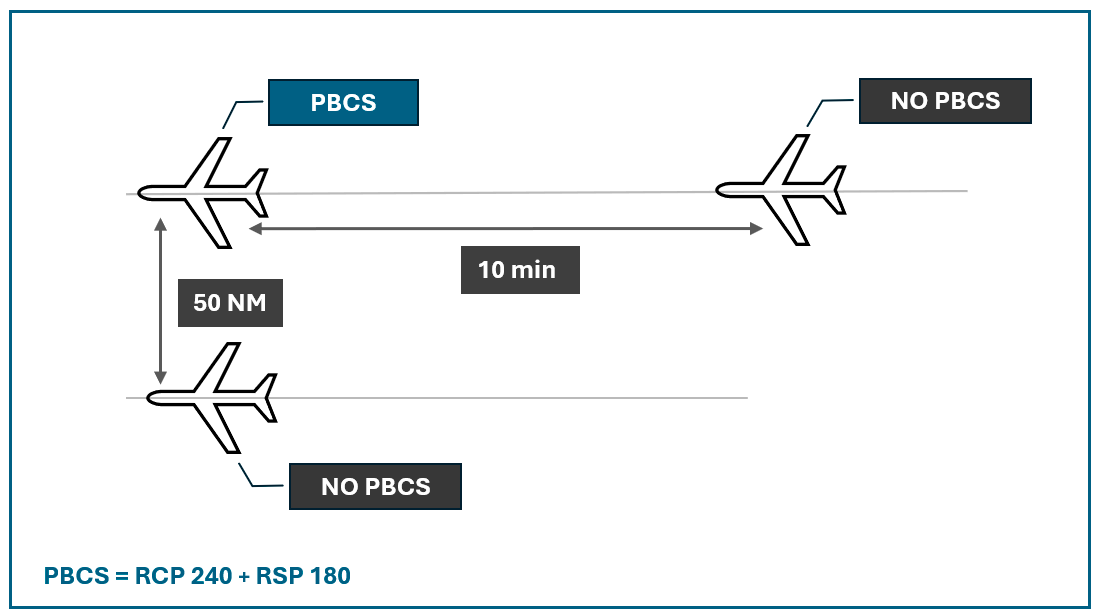
At least one non PBCS2 aircraft. Separation: 10 minutes longitudinal and 50 NM lateral.
1Hasta el 15 de abril de 2027 se aplicará una separación mínima de 50 NM longitudinal y lateral entre las aeronaves que transiten por el corredor EUR/SAM en sentido sur.
2 aeronaves con capacidad RCP 240 Y RSP 180.
DATES | PBN / PBCS | HORIZONTAL | ||||
ACFT 1 | ACFT 2 | LONG SEP | LAT SEP | |||
PBN | PBCS | PBN | PBCS | |||
BEFORE | ANY | NOT APPLICABLE | ANY | NOT APPLICABLE | 10 min | 50 NM |
FROM | ANY | NO PBCS | ANY | ANY | 10 min | 50 NM |
RNAV 10 (RNP 10) | RCP 240 & RSP 180 | RNAV 10 (RNP 10) or | RCP 240 & RSP 180 | 50 NM | 50 NM | |
RNP 4 | RCP 240 & RSP 180 | RNP 4 | RCP 240 & RSP 180 | 30 NM | 23 NM | |
Table 1 – Applicable horizontal separation minima according to PBN and PBCS capability.