GCXO AD 2 AERODROME DATA
AERODROME LOCATION INDICATOR AND NAME
GCXO - TENERIFE NORTE/Ciudad de La Laguna
AERODROME GEOGRAPHICAL AND ADMINISTRATIVE DATA
ARP | 282858N 0162030W. See AD 2-GCXO ADC. | |
Distance and direction from the city | 13 km W. | |
Elevation | 633 m / 2076 ft. | |
Geoid undulation | 45.00 ± 0.10 m (1). | |
Reference temperature | 26C. | |
Low average temperature | 13°C. | |
Magnetic variation | 4°W (2025). | |
Annual change | 9.8’E. | |
AD administration | Aena S.M.E., S.A. | |
| AFTN | GCXO. |
Approved traffic | IFR/VFR (2). | |
| Remarks | (1) For all AD points. |
OPERATIONAL HOURS
Airport | Operational hours for arrivals: V: 0600-2200, I: 0700-2300; PS 1 HR PPR. | |
Customs and Immigration | HR AD. | |
| Health and Sanitation | See GEN 1.4. |
AIS/ARO | H24 (2). | |
MET briefing | V: 0500-2200, I: 0600-2300; PS 1 HR PPR. | |
ATS | V: 0545-2220; I: 0645-2320. | |
Fuelling | HR AD. | |
Handling | HR AD. | |
Security | HR AD. | |
De-icing | No. | |
| Remarks | Airport hours of activity: TEL: +34-918 603 570; +34-672 344 494 (only for communications contingency). E-mail: arocentralizada@enaire.es AFTN fligh plan management GCXO: GCXOZPZX. Centralised AIO Office - International NOTAM Office TEL: +34-913 213 137/138 E-mail: unof@enaire.es |
HANDLING SERVICES AND FACILITIES
Cargo facilities | No limitations. | |
Fuel types | JET A-1; AVGAS 100LL. | |
Oil types | No. | |
Refuelling capacity | No limitations. | |
De-icing facilities | No. | |
Hangar space | No. | |
| Repair facilities | No. |
Remarks | Contracting handling services is mandatory except for operations of either military aircraft accessing apron through Sector Aéreo or flying club, and in either case, only for their own operations and when the necessary means for the appropriate separation with from commercial aviation flows are earmarked. Commercial and General Aviation ramp agents: E-mail: tfncicops@southeu.com SITA: TFNKQIB - MENZIES GROUND SERVICE TENERIFE NORTE TEL: +34-639172168 E-mail: ramp.tfn@menziesaviation.com SITA: TFNMA7X - AVIAPARTNER AVIAVIP SPAIN, S.A TEL: +34 661 749 917 (Operations) E-mail: GCXO@aviavip.com General aviation ramp agents: - GERARDO MELÉNDEZ, S.L. TEL: +34-922 392 064 E-mail: tfnops@gmelendez.com SITA: HDQGMXH - BROK-AIR-FBO TEL: +34-922 397 105 FAX: +34-922 397 132 E-mail: gcxo@brok-air.com / ops@brok-air.com SITA: Information not available Fuel: - TERMINALES CANARIOS TEL: +34 922 251 181 E-mail: supervisor.tfn@tcanarios.com - CEPSA TEL: +34 922 266 488 E-mail: maria.medina.h@cepsa.com |
PASSENGER FACILITIES
Hotels | No. | |
Restaurant | Yes. | |
Transportation | Buses, taxis and hire cars. | |
Medical facilities | First aid on limited schedule. | |
Bank/Post Office | Cash dispenser /No. | |
Tourist information | Yes. | |
Remarks | None. |
RESCUE AND FIREFIGHTING SERVICES
Fire category | 9. | |
Rescue equipment | In accordance with the fire category published. | |
Removal of disabled aircraft | Dragging bars and push-back of the AD handling agents.
| |
Remarks | The response time of the rescue and fire fighting service is less than 3 minutes, with an operational objective of less than 2 minutes. |
RUNWAY SURFACE CONDITION ASSESSMENT AND REPORTING, AND SNOW PLAN
Types of clearing equipment | Not applicable. | |
Clearance priorities | Not applicable. | |
Use of material for movement area surface treatment | Not applicable. | |
Specially prepared winter runways | Not applicable. | |
Remarks | Runway surface condition assessment and reporting in accordance with the Global Reporting Format (GRF) methodology described in AD 1.2.2. |
APRONS, TAXIWAYS AND CHECK LOCATIONS/POSITIONS DATA
Apron | Commercial aviation: Surface: Concrete. EXC PRKG 2 to 7: leaching asphalt. General aviation 1: General aviation 2: | |
| Taxiways | Width: 22.5 m: R, F, Z, E-3 and E-4. |
| Check locations | Altimeter: Apron: ELEV 628 m / 2060 ft EXC PRKG: 8, 9 and 10: 624 m / 2047 ft. |
| Remarks | The use of TWY E-3 is not allowed to aircraft with a wingspan larger than 30 m. TWY centre line: see INSIGNIA and Data Set. |
SURFACE MOVEMENT GUIDANCE AND CONTROL SYSTEM AND MARKINGS
Taxiing guidance system | Horizontal and vertical markings in all TWY and RWY intersections, runway-holding positions, intermediate holding position, informative and NO ENTRY boards, apron safety border line (ABL), stand positions, intermediate holding position lights. | |
RWY markings | Designators, threshold, centre line, side stripe, touchdown zone and aiming point. | |
TWY markings | R: Centre line and side stripe, F and Z: Centre line. | |
Remarks | None. |
AERODROME OBSTACLES
Obstacles which penetrate Approach, Take-Off Climb, Conical, Inner Horizontal, Transitional, Inner Transitional and Balked Landing Surfaces established in ICAO Annex 14; and the areas 2A and 3 established in ICAO Annex 15. Those penetrate these surfaces are identified in the CSV file as "Relevante_Relevant = Si/Yes" | See Item 10 and Digital data. | |
Remarks | See AD 2-GCXO AOC. |
METEOROLOGICAL INFORMATION PROVIDED
MET office | Tenerife Norte EMAe. | |
HR | V: 0500-2200; I: 0600-2300; PS 1 HR PPR. Outside this schedule, a half-hourly METAR AUTO will be issued. | |
METAR | Half-hourly. | |
TAF | 24 HR. | |
TREND | Yes. | |
Briefing | By telephone. | |
Flight documentation/Language | Charts and plain language / Spanish. | |
Charts | Significant forecasted and wind and temperature at altitude maps. | |
Supplementary equipment | Basic airport weather data display terminal. | |
ATS unit served | TWR, APP. | |
Additional information | Las Palmas OMAe (GCGC); H24; TEL: +34-928 430 603. | |
Meteorological observatory | Tenerife Norte at THR 30: HR AD; TEL: +34-922 312 037. | |
Remarks | Aerodrome climatological summary available. Aerodrome warnings available. |
RUNWAY PHYSICAL CHARACTERISTICS
RWY | Orientación | DIM (m) | THR PSN | THR ELEV TDZ ELEV | SWY (m) | CWY (m) | Franja (m) | OFZ | RESA (m) | RWY/SWY SFC |
|---|---|---|---|---|---|---|---|---|---|---|
12 | 110.57° GEO | 3171 x 45 | 282915.92N | THR: 628.6 m / 2062 ft | No | 193 x 150 | 3291 x 150 (2) | No | 133 x 150 (2) | RWY: ASPH PCN 53/F/C/W/T |
30 | 290.59° GEO | 3171 x 45 | 282839.71N | THR: 611.6 m / 2007 ft | No | No | 3291 x 150 (2) | Sí // Yes | 90 x 90 (2) | RWY: ASPH PCN 53/F/C/W/T |
Observaciones: (1) Los designadores de pista no se corresponden con las orientaciones magnéticas. Los trabajos para el cambio de designadores están pendientes de ejecución por parte del aeropuerto. (2) Terreno vegetal.
(1) Runway designators do not correspond to the magnetic orientations. Works to change the designators are pending implementation by the airport. (2) Grass soil | ||||||||||
Perfil
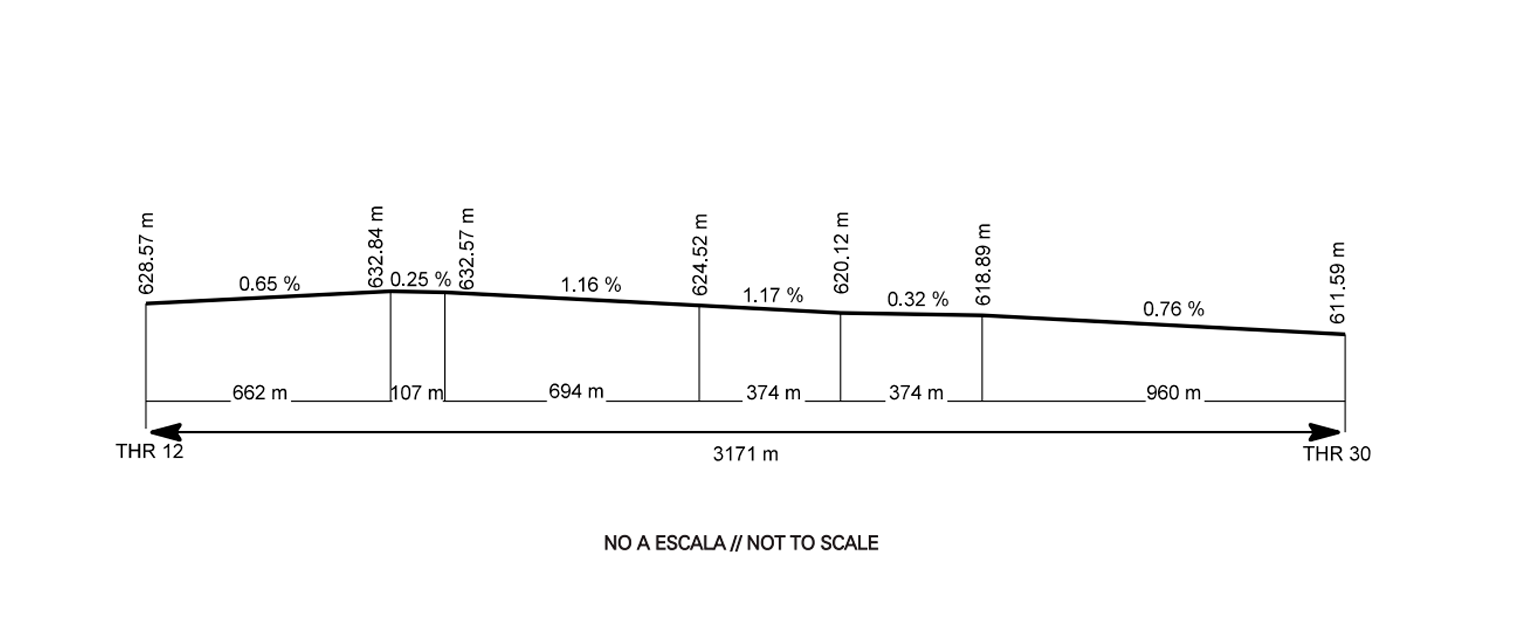
DECLARED DISTANCES
RWY | TORA (m) | TODA (m) | ASDA (m) | LDA (m) |
|---|---|---|---|---|
12 | 3171 | 3364 | 3171 | 3171 |
30 | 3171 | 3171 | 3171 | 3171 |
12 INT E-2 | 2546 | 2739 | 2546 | - |
30 INT E-4 | 1906 | 1906 | 1906 | - |
APPROACH AND RUNWAY LIGHTING
Runway | 12 | |
Approach | Reduced precision CAT I, 420 m. LIH. | |
PAPI (MEHT) | 3° (17.39 m / 57 ft). (1) | |
Threshold | Green, with wing bar. | |
Touchdown zone | No. | |
Runway centre line | 3171 m: 2271 m white+600 m white and red+300 m red. LIH. | |
Runway edge | 3171 m: 2571 m white + 600 m yellow. LIH. | |
Runway end | Red. LIH. | |
Stopway | No. | |
Remarks | (1) Right wing bar only. Not usable by code letter E aircraft. |
Runway | 30 | |
Approach | Precision CAT II/III, reduced 420 m. LIH. | |
PAPI (MEHT) | 3° (16.12 m / 53 ft). (1) | |
Threshold | Green, with wing bar. | |
Touchdown zone | 900 m white. | |
Runway centre line | 3171 m: 2271 m white+600 m white and red+300 m red. LIH. | |
Runway edge | 3171 m: 2571 m white + 600 m yellow. LIH. | |
Runway end | Red. LIH. | |
Stopway | No. | |
Remarks | (1) Not usable by code letter E aircraft. |
OTHER LIGHTING, SECONDARY POWER SUPPLY
ABN/IBN | No. | |
WDI | 1 near THR 12 LGTD, 1 near THR 30 LGTD. | |
TWY lighting | Edge and centre line. EXC TWY F and Z centre line. (1) | |
Apron lighting | Edge. | |
Secondary power supply | Continuity system (UPS) in all approach, RWY and TWY lighting systems that provide a maximum switch-over (light time of 1 s. Emergency generators for the rest of lighting systems that provide a maximum switch-over (light) time of 15 s. | |
Remarks | (1) LED lighting. |
HELICOPTER LANDING AREA
Position | - Geoid undulation: see item 2. | |
Elevation | - FATO: RWY 12/30. Elevation THR 12 and THR 30, see item 12. | |
Dimensions, surface, maximum weight, marking | - FATO: RWY 12/30, see item 12. | |
Direction | No. | |
Declared distances | FATO: RWY 12/30, see item 13. | |
Lighting | see items 14 and 15. | |
Remarks | Helicopters operating with a letter of exemption should consult item 20 for further information. |
AIR TRAFFIC SERVICES AIRSPACE
Designation | CTR TENERIFE NORTE | |
Lateral limits | 282828N 0162751W, arc or radius 6.5 NM centred on ARP, 282410N 0161530W, 282600N 0161832W, 282811N 0162506W, 282828N 162751W. | |
Vertical limits | SFC - 4500 ft AMSL | |
Airspace class | D. | |
Unit Language | TENERIFE NORTE APP | |
Transition altitude | 1850 m/6000 ft | |
| Hours of applicability | -H24 |
| Remarks: | (1) Or the ground visibility, whichever is lower. |
Designation | ATZ TENERIFE NORTE | |
Lateral limits | 282812N 0162519W, arc of radius 8 km centred ARP, 282527N 0161737W, 282600N 0161832W, 282811N 0162506W, 282812N 0162519W. (1) | |
Vertical limits | SFC - 3000 ft HGT (2) | |
Airspace class | D. | |
Unit Language | TENERIFE NORTE TWR | |
Transition altitude | - | |
| Hours of applicability | -H24 |
| Remarks: | (1) Or the ground visibility, whichever is lower. |
AIR TRAFFIC SERVICES COMMUNICATION FACILITIES
Servicio Service | Distintivo llamada Call sign | FREQ | HR | Observaciones Remarks |
|---|---|---|---|---|
APP | Tenerife Norte APP | 124.800 MHz | HR ATS | APP |
TWR | Tenerife Norte TWR | 118.700 MHz | HR ATS | Secundaria // Secondary |
ATIS | Tenerife Norte Information | 118.575 MHz | HR ATS | |
D-ATIS | Tenerife Norte Information | NIL | HR ATS | Provision of ATIS information via data link. |
RADIO NAVIGATION AND LANDING AIDS
Facility (VAR) | ID | FREQ | HR | Coordinates | ELEV DME | Remarks |
|---|---|---|---|---|---|---|
DVOR (4° W) | TFN | 117.700 MHz | H24 | 283212.6N 0161607.6W | R-151 a FL100 Possible signal oscillations greater than ±2° BTN 41 NM & 46 NM. | |
DME | TFN | CH 124X | H24 | 283212.9N 0161607.2W | 1020 m | |
DVOR (4° W) | LRO | 116.200 MHz | H24 | 282905.7N 0162105.6W | 641 m | At 40 NM AVBL BTN: |
DME | LRO | CH 109X | H24 | 282905.2N 0162105.8W | 640 m | At 18 NM possible signal losses BTN R-040 & R-080 BLW FL70. |
LOC 12 (4° W) ILS CAT I | INOR | 108.700 MHz | H24 | 282837.1N 0161928.0W | 114° MAG / 225 m FM THR 30; COV 25 NM AVBL BTN ±10° at 5000 ft AMSL. | |
GP 12 | 330.500 MHz | H24 | 282909.3N 0162116.3W | 3°; RDH 15.7 m; a // at 289 m FM THR 12 & 110 m FM RCL on the right in the APCH direction. REF DME THR 12. | ||
ILS/DME 12 LOC 30 (4° W) ILS CAT I | INOR / ITF | CH 24X / 110.300 MHz | H24 | 282909.3N 0162116.3W | 636 m | 294° MAG/494 m FM THR 12; COV 25 NM. |
GP 30 | 335.000 MHz | H24 | 282839.8N 0161946.5W | 3°; RDH 16.90 m; at 276 m FM THR 30 & 102 m FM RCL on the left in the APCH direction. REF DME THR 30. | ||
ILS/DME 30 | ITF | CH 40X | H24 | 282839.8N 0161946.5W | 618 m | COV 17 NM; AVBL BTN -32° & +35° FM RCL at 4100 ft AMSL. |
LOCAL AERODROME REGULATIONS
STANDARD TAXIING PROCEDURES
START-UP OF ENGINES/TURBINES
A. Pilots shall request start-up and taxiing clearance to CLR on the corresponding frequency or via DCL. When this clearance is requested, the ACFT must be fully ready to start up, taking into account that the ACFT must leave the parking stand 10 minutes before the CTOT.
B. Clearance will be granted as soon as it is requested, unless delays of more than 15 minutes are envisaged, in which case ATC shall indicate the time at which start-up may take place. ATC clearance will be granted at that time.
Request for ATC clearance and start-up via datalink.
DCL procedures are in place at Tenerife Norte/Ciudad de La Laguna Airport for ATC clearance and start-up services. For more information on the DCL service, see AIP ENR 1.5, Section 3, Departing Flights, ATC Clearance and Start-up via Datalink.
In the event of discrepancies, voice communication shall prevail over the datalink.
The pilot may request ATC clearance via DCL up to 30 minutes prior to the EOBT.
The pilot shall request ATC clearance and start-up jointly via RCD. The RCD message must contain the following information:
Aircraft call sign according to flight plan filed (FPL).
Aerodrome of origin.
Parking position.
Destination aerodrome.
Letter corresponding to ATIS information received.
ICAO designator of aircraft type.
Free text included in the RCD by the pilot shall not be considered by the
ATC. Special requirements must always be communicated by voice.
The pilot will receive either an acceptance message ("RCD RECEIVED") or a cancellation message ("RCD REJECTED").
If accepted, ATC will transmit a CLD message containing the corresponding required fields:
Aircraft call sign.
Destination aerodrome.
Runway assigned for departure.
Departure procedure (SID). Note: The initial altitude shall correspond to the published SID.
Mode A SSR code (SQUAWK).
ADT (Approved Departure Time). Note: ADT = CTOT of flight, if available.
Next frequency.
Letter of the valid ATIS information.
Additional information, including the start-up clearance or instructions to request said clearance in the event that the start-up clearance parameters are not fulfilled according to the EOBT.
When an RCD message is sent within the valid EOBT range, ATC and start-up clearance will be given. If not ready for start-up, the pilot shall not accept the clearance and shall contact the air controller by voice when ready.
When an FSM message "REVERT TO VOICE PROCEDURES" is received, the datalink communication shall be terminated and the switch to voice procedure shall apply.
When the CLD message is received, the pilot shall act as follows: A. If any inconsistency in the received message is detected, the
If any inconsistency in the received message is detected, the pilot will switch to voice to request a new clearance.
If the CLD message clearance is deemed correct, the pilot will respond.
If the ATC system does not receive a CDA message within the holding time, or a CDA inconsistent with the previous CLD message is received, the datalink communication will be terminated and a "CDA REJECTED" message will be received on the FMS.
When a successful CDA message is received, the ATC system will transmit a "CLEARANCE CONFIRMED" message on the FMS to the aircraft and terminate the datalink communication.
DATA EXCHANGE WITH NMOC - ADVANCED ATC TWR
Tenerife Norte/Ciudad de La Laguna Airport exchanges information for departing flights using Advanced ATC TWR procedures.
The message exchange between the local ATC system and the ATM network uses the European standard for A-CDM airports, using the following message types:
A-DPI for all instrument flight departures.
C-DPI, when required.
Once the start-up is cleared and when the aircraft starts to exit the parking stand, the target take-off time (TTOT) is calculated and transmitted to NMOC via an A-DPI message.
The use of the actual off-block time (AOBT) instead of the EOBT from the flight plan, together with the variable taxiing time, will increase the precision of the take-off time. From the time of receipt of the A-DPI, no DLA or CHG messages modifying the flight plan data will be accepted. If regulated, the CTOT assigned prior to receiving the A-DPI will be maintained.
Should an aircraft need to stop taxiing and return to the parking stand for technical reasons, the flight will be cancelled in the ATM network by sending a C-DPI message.
As a result of said C-DPI, the flight plan will be suspended and the operator will be informed via an FLS message with the remark "Suspended by departure airport". The flight plan may be reactivated by updating the EOBT with a DLA or CHG message.
SURFACE MOVEMENT (DEPARTURES)
Pilots shall request permission for push-back and taxiing from Tenerife Norte GMC on the corresponding frequency.
Tenerife Norte GMC is responsible for issuing authorisations and instructions for towed push-back, power-back and aircraft taxiing.
Manoeuvres in the autonomous exit parking positions to TWY R (PRKG 28, 30, 32 and 34), to TWY F (PRKG 17 and 19), to TWY Z (PRKG 35, 36, 37 and 38) and to TWY Y (PRKG AG1, AG2 and AG3) shall be carried out under minimum power and so that idling power is not exceeded when making the turn.
The push-back and power exit manoeuvres from the parking positions of the commercial apron shall be carried out up to the centre line of corresponding TWY. All intersections between apron boundaries (defined by the ABL) and direct parking stand accesses from TWY R are considered transfer of control points.
Aircraft exiting PRKG 17 and 19, following ATC clearance, enter TWY R via TWY F at F1 point. When the aircraft overruns F1, it will be considered as transferred from apron to taxiing.
Aircraft exiting PRKG 26, 27, 29, 31, 33 and autonomous departures from PRKG 35, 36, 37 and 38 shall, following ATC clearance, enter TWY R via TWY Z at Z1 point. When the aircraft overruns Z1, it will be considered as transferred from apron to taxiing.
Push-backs to TWY Z from PRKG 28, 30, 32 and 34 will be permitted, but priority will be given to autonomous exits from these stands to TWY R.
Power-back manoeuvres must cleared in advance by the Airport Management and shall be performed under the full responsibility of the aircraft operator. This type of operation is only permitted for:
Turboprops of dimensions less than or equal to AT72; the request and clearance shall be handled in real time.
Turboprops of dimensions greater than AT72; the representative of the air carrier must request clearance for the operation sufficiently in advance, to the email address: tfn.ops@aena.es. The airport will study the safety of the operation and the noise pollution generated by it.
The exit from the parking positions of the General Aviation 1 (APN AG 1) apron shall be carried out via TWY Y to access TWY R after receiving the appropriate authorisation from ATC. Between sunrise and during the application of LVP, the exit shall be carried out under guidance of the “FOLLOW ME” vehicle. Aircraft shall request guidance from ATC when they report that they are ready to taxi. When the aircraft overruns Y1, it will be considered as transferred from apron to taxiing.
The exit from the parking positions of the General Aviation 2 (APN GA 2) apron shall be carried out by towing to the centre line of TWY W. Access to TWY R shall be carried out via TWY W after receiving appropriate authorisation from ATC. When the aircraft overruns W1, it will be considered as transferred from apron to taxiing. From sunset to sunrise, and during the implementation of LVPs, when only the use of PRKG N4 and N5 is permitted, exit shall be guided by a “FOLLOW ME” vehicle. Aircraft shall request guidance from ATC at the moment they report ready to taxi.
TWY E-2 and E-4 can be used for take-off from the intersection.
SURFACE MOVEMENT (ARRIVALS)
The use of TWY E-3 is not allowed to aircraft with a wingspan larger than 30 m and its use is subject to prior authorisation from ATC. The use of TWY E-3 is restricted if push-backs have been authorised in the commercial apron, unless this does not affect departures via E3 in the taxiing route and until the aircraft has been parked.
Aircraft that land via RWY 30 shall leave it via TWY E-1 or E-2, unless ATC authorises the use of another exit.
Aircraft that land via RWY 12 shall leave it via TWY E-4 or E-5, unless ATC authorises the use of another exit.
To reduce the go-around, reduce the occupation time of the runway and therefore make the maximum use of the runway, pilots should exit the runway via the exit authorised by ATC as soon as possible without this involving any hazard to safety and normal aircraft operations.
Entries into the parking positions 2 to 16, 20 to 24 and 35 to 38 shall be carried out under the guidance of the “FOLLOW ME” vehicle, which shall wait for the aircraft in the intersection of the ABL with the position notified by TWR. When the aircraft overruns the ABL, it will be considered as transferred from taxiing to apron.
Entry to parking stands 17 and 19 will be guided by the "FOLLOW ME" vehicle awaiting the aircraft at F1. When the aircraft overruns F1 point, it will be considered as transferred from taxiing to apron.
Entry to parking stands 25 to 34 will be guided by the "FOLLOW ME" vehicle awaiting the aircraft at Z1 point. When the aircraft overruns Z1, it will be considered as transferred from taxiing to apron.
LIMITATIONS ON TAXIING
B757-300, B767-300 and B767-400 aircraft need to perform the oversteering manoeuvre on their taxiing routes via TWY E-2.
The use of TWY E-3 is not allowed to aircraft with a wingspan larger than 30 m. There is also a NO ENTRY sign that prohibits access to the runway via this TWY.
The use of TWY E-3 is restricted when push-backs have been cleared on the commercial apron, unless this does not affect departures via E3 in the taxiing route and until the aircraft has been parked.
TWY F is limited to MAX SPAN 28 m.
TWY W is limited to a MAX SPAN 26 m from the entrance to entrance to PRKG N5 and to a MAX SPAN 14 m in the rest of its length.
TWY Y is limited to a MAX SPAN 26 m up to PRKG AG1 and to a MAX SPAN 17 m in the rest of its length.
Simultaneously operating two aircraft with category D or above code is not permitted on the manoeuvring area.
As a general rule, backtrack manoeuvres on the runway or 180º turns on the runway or on TWY R, Y and W are not permitted.
The use of the General Aviation apron 2 shall be restricted from sunset to sunrise, as well as when LVP are in force, with the exception of PRKG N4 and N5.
CHARACTERISTICS OF THE PARKING POSITIONS
See AD 2-GCXO PDC 1.3
RESTRICTIONS ON PARKING POSITIONS
In PRKG: 11, 12, 13, 14, 22, 23, 24 and 25:
Use of the 400 Hz or 28 Vcc facilities is mandatory.
Use of the Auxiliary Power Unit (APU) of the aircraft is prohibited in these positions within a period from 2 minutes after wheel chocks to 5 minutes before chocks-off.
The aircraft APU can only be used when the fixed 400 Hz or 28 Vcc units are not operative and the mobile units are unavailable.
Refuelling is not permitted in PRKG 2, 5 and 8 on left wing 8 when PRKG 4, 7 or 10 (respectively) are occupied.
Refuelling is not permitted in PRKG 4, 7 or 10 on right wing when PRKG 2, 5 and 8 (respectively) are occupied.
Refuelling by left wing in PRKG 11 and 23 is not permitted if 13 and 25, respectively are occupied.
Refuelling by right wing in PRKG 13 and 25 is not permitted if 11 and 23, respectively are occupied.
Start-up, entry and/or exit from the parking positions are not permitted while boarding/debarkation procedures on foot are taking place in the parking positions alongside.
The incompatibilities between parking positions are shown in AD 2-GCXO PDC.
The MAX ACFT restrictions on aircraft parking of the commercial apron are defined by the maximum wingspan permitted in the parking space, where longer aircraft may be parked as long as their wingspan is equal to or less than that of the indicated aircraft.
The parking of turbojet aircraft with a fuselage of more than
RESTRICTIONS ON SIMULTANEOUS PUSH-BACKS
ATC shall apply restrictions to simultaneous push-backs according to the parking positions and the aircraft that push back as per local regulations.
OPERATION OF MODE S TRANSPONDER WHEN THE AIRCRAFT IS ON THE GROUND
To enable the cooperation necessary with the Advanced Surveillance System based on Mode S, aircraft operators who intend to utilize Tenerife Norte/Ciudad de La Laguna Airport shall ensure that the Mode S transponder is available for operation while the aircraft is on the ground.
Pilots must:
Select AUTO Mode and the assigned Mode A code.
Should AUTO Mode be unavailable, select ON (for example, XPDR) and the Mode A code assigned:
From the pushback or taxiing request, whichever comes first.
After landing, and uninterruptedly until the aircraft is completely parked on its stand.
When the aircraft is completely parked, STBY shall be selected.
Provided that the aircraft is capable of reporting its Aircraft Identification, such as the call sign used during the flight, this information shall be entered using the Flight Management System (FMS) or the Transponder Control Panel from the moment a pushback or taxiing request is made, whichever occurs first. The flight crew shall ensure that the Aircraft Identification is entered in the ICAO-prescribed format, for example BAW123 or AFR6380.
To ensure that the operation of systems using SSR frequencies, including TCAS equipment and SSR transponders, is not adversely affected, TCAS shall not be selected before receiving clearance to line up on the runway. After vacating the runway following landing, TCAS shall be deselected in accordance with operational procedures.
Aircraft taxiing without an associated flight plan shall select Mode A code 1000. This code enables appropriate surveillance identification by air traffic control systems while the aircraft is operating on the movement area of the aerodrome.
OPERATION OF HELICOPTERS
GENERAL
Helicopters operating without a letter of exemption shall be treated as fixed-wing aircraft. For landing and take-off, they shall use the FATO defined on RWY 12/30.
Helicopters holding a letter of exemption may request ATC clearance to operate from the virtual FATO R1 and R7 defined on TWY R, in accordance with local procedures. These FATO may only be used under VMC conditions.
Helicopters shall use air taxiing or ground taxiing, depending on the helicopter type, via the taxiways designated for fixed-wing aircraft.
STANDS
PRKG | MAX ACFT | OBSERVACIONES / REMARKS |
|---|---|---|
2, 4, 5, 7, 8, 10, 37, 38 | S61 | — |
N4 | EC35 | — |
N5 | EC35 | INCOMP. AG7 |
Access to and departure from parking stands N4 and N5 shall be carried out under the guidance of a “FOLLOW ME” vehicle. In addition, these stands may be used during night operations or under Low Visibility Conditions (LVC).
OPERATIONAL RESTRICTIONS
TWY E-3 is a runway exit taxiway and therefore shall not be used for access to the runway.
Under IMC or LVC, the virtual FATO R1 and R7 may not be used.
DESCRIPTION OF OPERATION
RWY 12 IN USE
DEPARTURES: Helicopters shall perform air taxiing or ground taxiing, as applicable, and access the runway via TWY E1 or TWY E2, as instructed by ATC.
ARRIVALS: Helicopters shall complete the final approach to the runway and vacate it via the taxiway assigned by ATC.
RWY 30 IN USE
DEPARTURES: Helicopters shall perform air taxiing or ground taxiing, as applicable, and access the runway via TWY E4 or TWY E5, as instructed by ATC.
ARRIVALS: Helicopters shall complete their final approach to the runway and vacate it via TWY E1, E2 or E3, as instructed by ATC, proceeding to the designated stand.
OPERATIONAL SAFETY REPORTS
Pilots and aircraft operators shall notify the airport as soon as possible of any accident, incident, occurrence or event in which they have been involved or which they have witnessed, whenever it may have a potential impact on operational safety.
The purpose of these reports is to collect information that contributes to the improvement of operational safety, independently of any mandatory occurrence report that must be submitted to the relevant aeronautical authority. Information may be provided in any format, provided that it includes, at a minimum, the necessary details regarding the event.
• Date and time.
• Place.
• Parties (data identifying the vehicles, ACFT... involved)
• Companies involved.
• Description of the facts.
• Any other information considered relevant (for instance: lighting conditions, weather, phase of operation such as take-off / landing / stopover, state of pavement...)
The contact email address of the airport for the reception of operational safety reports is:
tfn.seguridadoperacional@aena.es
In addition to notifying the airport through the established reporting system, pilots and operators shall also provide at least the basic details of the accident, incident, occurrence or event to the air traffic control services provider (ATC).
For safety reports specifically related to the air traffic control services provider, including those concerning the manoeuvring area, phases of flight or ATS airspace, the information may be submitted via the designated email address.
canariassafetymanagement@enaire.es
OPERATION OF HIGHER CODE LETTER AIRCRAFT
GENERAL
The Tenerife Norte/Ciudad de La Laguna Airport reference code is 4-D.
Any Code Letter E aircraft intending to operate at Tenerife Norte/Ciudad de La Laguna Airport shall obtain prior explicit clearance from the Airport Operational Centre, either directly or through the Handling Agent, indicating the aircraft type and the requested date and time of operation. Such clearance must be issued by Airport Management.
OPERATIONAL RESTRICTIONS
Code Letter E aircraft shall taxi at low speed with engines at idle thrust and, whenever possible, four-engine aircraft shall operate with the outer engines switched off.
PAPI indications shall not be used by Code Letter E aircraft.
Code Letter E aircraft shall enter and vacate the runway via TWY E-1 or TWY E-5, depending on the runway in use. TWY E-2, E-3 and E-4 are not available for use by this type of aircraft.
When the RVR is less than 800 m and Low Visibility Procedures (LVP) are in force, only the Code Letter E aircraft in operation shall be permitted within the manoeuvring area.
STANDS
The airport operator may assign PRKG 3, 6, 9, 12 and 24 for the parking of code letter E aircraft.
DESCRIPTION OF THE OPERATION
ARRIVAL
LANDING ON RWY 12: The aircraft shall vacate the runway via TWY E-5 and taxi via TWY R to the assigned stand.
LANDING ON RWY 30: The aircraft shall vacate the runway via TWY E-1 and taxi via TWY R to the assigned stand.
DEPARTURE
TAKE-OFF ON RWY 12: The aircraft shall taxi from the assigned stand via TWY R and enter RWY 12 through TWY E-1.
TAKE-OFF ON RWY 30: The aircraft shall taxi from the assigned stand via TWY R and enter RWY 30 through TWY E-5.
AIRPORT EMERGENCY PLAN
See AIP AD 1.1-5 Emergency management item 1.3.1.7.
NOISE ABATEMENT PROCEDURES
No.
FLIGHT PROCEDURES
ATS SURVEILLANCE SYSTEMS
ATS surveillance systems may be used in the provision of the aerodrome control service, to perform the following functions:
Flight path monitoring of aircraft on final approach.
Flight path monitoring of other aircraft operating in the vicinity of the aerodrome.
Establishing the separation specified in Article 4.6.7.3 of the R.C.A. between consecutive departing aircraft.
Providing navigation assistance to VFR flights.
The provision of functions related to the monitoring of other aircraft operating in the vicinity of the aerodrome and the provision of navigation assistance to VFR flights is not guaranteed within the ATZ below 2200 ft AMSL.
Depending on the availability of ATS surveillance systems, the altitude from which the aforementioned functions can be provided may be affected or the services may be suspended altogether. In such cases, the affected aircraft will be informed through the available aeronautical information services.
SPEED CONTROL
Speed control is essential to ensure safe and efficient operations, particularly during periods of high traffic density and throughout the final approach phase.
Aircraft spacing is designed to maximize runway utilization while maintaining the minimum required separation standards, including wake turbulence separation requirements.
The speed restrictions established for Tenerife Norte/Ciudad de La Laguna Airport are mandatory and are intended to ensure adequate aircraft separation and the consistent application of standardized approach procedures.
Unless otherwise instructed by Air Traffic Control (ATC), pilots shall comply with the speed restrictions specified below.
For ILS and LOC manoeuvres
IAS 210 kt at 12.0 DME ILS.
IAS 185 kt at 9.0 DME ILS.
IAS 160 kt at 4.0 DME ILS;
O distancia equivalente a umbral en caso de DME ILS U/S.
For the remaining manoeuvres, the speed restrictions are shown on the appropriate chart.
All the speed restrictions must be flown with the greatest precision possible.
Aircraft that are unable to comply with the prescribed speed restrictions due to weather conditions, aircraft performance limitations or other operational reasons shall inform ATC immediately and advise the speeds that can be maintained.
The issuance of a new ATC clearance that is not related to speed does not cancel or modify any previously assigned speed restriction. Pilots shall continue to comply with the last speed instruction received unless specifically advised otherwise by ATC.
Failure to comply with speed control instructions may require the aircraft to be removed from the planned approach sequence in order to maintain safe and orderly traffic flow.
LOW VISIBILITY PROCEDURES (LVP)
GENERAL
A. RWY 12/30 are approved for take-offs under low visibility conditions.
B. In addition to the general procedures, Low Visibility Procedures (LVP) shall be applied when the RVR value of any transmissometer is lower than 800 m or the general visibility (VVVV) is lower than 800 m when all the transmissometer are out of service.
C. The ATC unit shall notify pilots that the Low Visibility Procedures are in force. The ATIS shall broadcast the following message: “LVP in force”.
D. Any incident reported or detected that might impinge upon the LVP, as well as the changes in operational minima, shall be communicated immediately to the aircraft and ATC units concerned.
E. The RWY visual range values shall be obtained from the RVR sets located close to the touchdown zone, at the RWY mid-point, and near end of RWY, and shall be broadcast to the aircraft by ATIS.
F. The ATC unit shall supply the RWY visual range values in the format:
RVR TDZ: Transmissometer reading obtained from the touchdown zone.
RVR MID: Transmissometer reading obtained from the runway midpoint.
RVR END: Transmissometer reading obtained from the runway end.
G. For RVR values lower than 600 m, or VVVV lower than 800 m when all the transmissometer are out of service, the criterion of “only one aircraft or vehicle stay in the manoeuvring area” shall be followed
H. The Low Visibility Procedures shall be cancelled when the weather conditions are the following:
The latest METAR TREND forecast, or forthcoming one is for RVR values 1500 m or greater at all transmissometers.
The latest METAR TREND forecast is for meteorological Visibility 1500 m or above, or forthcoming one when all the transmissometers are out of service.
GROUND MOVEMENT
Pilots shall proceed to monitor the location of the aircraft at all times, especially at intersections, and ensure that taxiing takes place in complete safety conditions. The access to the perimeter road will be closed and the vehicle access to the maneuvering area will be restricted. In case of a vehicle has the exceptional needed to access to the maneuvering area it must be made with a “FOLLOW ME” vehicle guidance. The vehicle traffic in the apron will be reduced to a minimum.
ARRIVALS
A. Aircraft that have landed must vacate the RWY in use by the end, unless instructed otherwise by ATC.
B. Aircraft that have landed are obliged to report RWY vacated as indicated in the board and the yellow-green lights in the TWY.
C. The exit of arrival aircraft by TWY E-3 shall not be allowed except prior ATC clearance, in accordance with that is stablished in local procedures.
D. Aircraft after vacating the RWY, shall proceed to taxi up to the ABL where they will wait the “FOLLOW ME” vehicle and will keep on guided up to the assigned stand in the apron notified by ATC. When the aircraft overruns the ABL F1 or Z1 (as appropiate), it will be considered as transferred from taxiing to apron. In the case of general aviation aprons APN GA 1 and APN GA 2, when the aircraft overruns Y1 and W1 respectively, it will be considered as transferred from taxiing to apron. Aircraft may request ATC for guidance by a “FOLLOW ME” vehicle from any point in the manoeuvring area.
E. The aircraft, arriving to the stand, shall notify the assigned stand and frequency out.
DEPARTURES
Start-up of engines/jets.
A. Pilots shall request clearance to start up their engines/jets on the corresponding frequency. When this clearance is requested, the aircraft must be completely ready to start-up.
B. When requesting start-up, pilots shall notify the Aircraft Identification and the stand occupied to ATC.
C. Permission shall be issued as soon as it is requested, unless delays of more than 15 minutes are envisaged, in which case ATC shall indicate the time at which start-up may take place.
Pushback manoeuvre.
A. Aircraft must be totally ready for (towed or self-propelled) pushback and start taxiing following receipt of the corresponding clearance. The pilot must inform ATC should this not be the case.
B. No simultaneous aircraft pushbacks will be cleared.
C. Pushback in the apron shall not been allowed if an arriving ACFT has been cleared to vacate by the exit TWY E-3.
D. Exit by exit TWY E-3 will not be allowed if pushback in the apron has be allowed.
E. When the aircraft, in its push-back, overruns the ABL, F1 or Z1 (as appropiate) it will be considered as transferred from apron to taxiing. For general aviation platforms APN GA 1 and APN GA 2, when the aircraft overruns Y1 and W1 respectively, it will be considered as transferred from apron to taxiing.
Taxiing routes.
A. The RWY may only be accessed by TWY E-1 or E-5, as shall be instructed by ATC.
COMMUNICATIONS FAILURE AND ABNORMAL SITUATIONS IN THE MANOEUVRINGS AREA
COMMUNICATIONS FAILURE
In the event that an aircraft or vehicle operating in the manoeuvring area should experience a communications failure, it shall proceed as follows:
A departing aircraft, taking extreme care, shall continue taxiing to the clearance limit, hold position, and await a “FOLLOW ME” vehicle to guide it to the appropriate stand.
An arriving aircraft, once the RWY vacated, shall hold its position upon entering the taxiway, and await a “FOLLOW ME” vehicle to guide it to the appropriate stand.
The “FOLLOW ME” vehicle shall confirm ATC that the aircraft is stablished in the TWY and the RWY is vacated.
If the aircraft already has ATC taxiing clearance, it will continue by the designated route until stopping at the limit of the ATC clearance, exercising extreme caution, where it hold position and wait for the arrival of an attendance vehicle.
ABNORMAL SITUATIONS IN THE MANOEUVRINGS AREA
Uncertainty about the position in the manoeuvring area.
Except as provided in the paragraph below, if a pilot has doubts as to the position of the aircraft in relation with the manoeuvring area, he/she shall immediately stop the aircraft and notify ATC of this circumstance (including the last known position).
In situations where the pilot has doubts as to the position of the aircraft in the manoeuvring area, but recognises that the aircraft is on a RWY, the pilot shall immediately notify ATC (including the last known position), vacating the RWY as soon as possible, if he/she is able to locate a suitable nearby TWY, unless stated otherwise by ATC; and will then stop the aircraft. In situations where ATC notice that an aircraft o a vehicle has lost the it´s position in the maneuvering area, or has doubts as to the position, the appropriate measures will be taken to safeguard the operations and help the aircraft or vehicle to determine its position.Loss of visual contact between mobile vehicles.
In the event of loss of visual contact with another aircraft or with a vehicle with which it maintains a separation, ATC will be informed immediately and the aircraft will stop. ATC will take the measures it deems appropriate.Aircraft breakdown.
Will notify ATC of the situation and await the arrival of assistance. If you are on a RWY, if possible and unless indicated otherwise by ATC, the aircraft shall vacate it.
AD TRAFFIC CIRCUIT
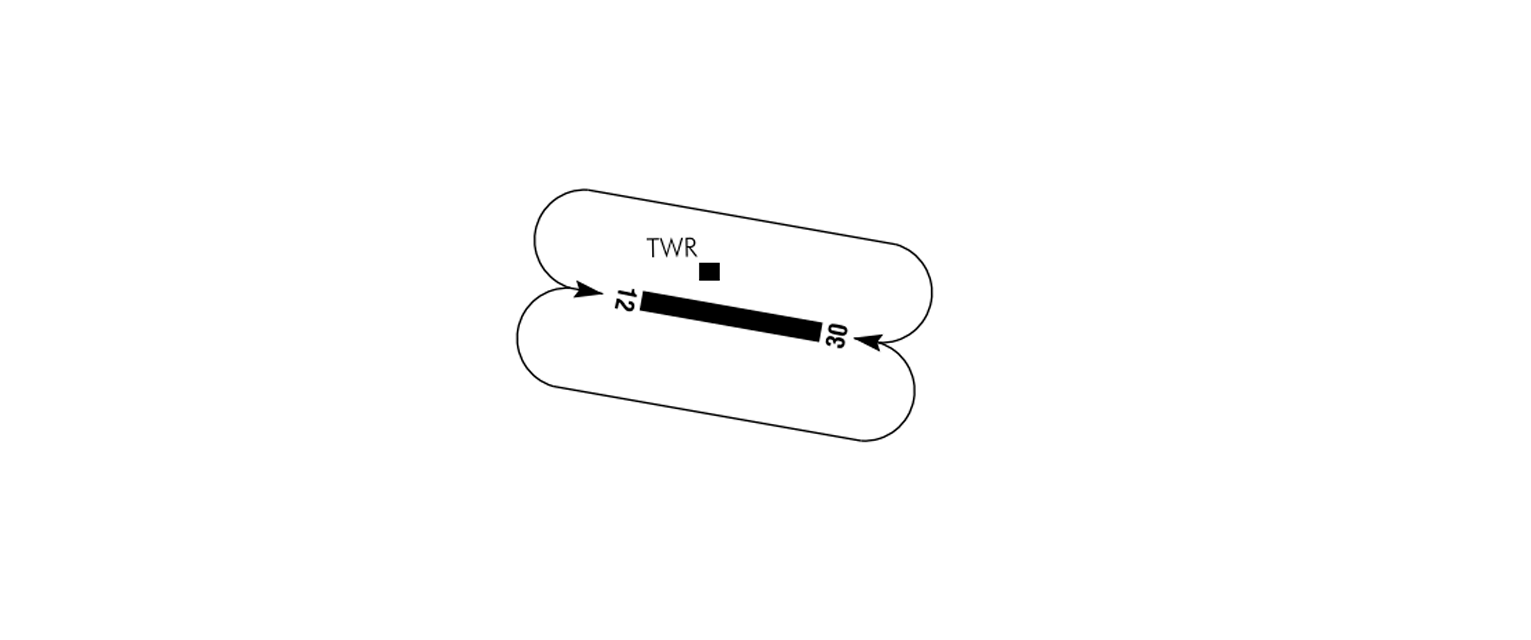
Special features of the tailwind segment of the North Circuit:
Maintain minimum 1000 ft AGL.
Limited visibility from TWR.
Special features of the tailwind segment of the South Circuit:
Avoid overflying the Tenerife Norte/Los Rodeos Air Base (GCXM).
VFR NIGHT FLIGHTS
VFR night flights are permitted at Tenerife Norte/Ciudad de La Laguna airport are permitted in accordance with the regulations on cloud ceiling and visibility.
The captain of the aircraft shall be responsible for the VFR operation and shall be responsible for avoiding collisions with obstacles and other aircraft.
As a result of the features of the general aviation apron, the following actions are established for carrying out VFR night flights.
DEPARTURES
Any aircraft that habitually park on the general aviation apron or that are parked there and that need to carry out a VFR night operation should be located on the commercial apron before night time conditions at the airport.ARRIVALS
Aircraft that carry out nocturnal VFR operations for arrival at Tenerife Norte/Ciudad de La Laguna airport should park on the Commercial Apron with guidance from the “FOLLOW ME” vehicle in the assigned stand.
TAKE-OFFS ON A RUNWAY OPPOSITE THE RUNWAY IN USE
In conditions of calm air conditions and with prior authorisation from ATC, an aircraft can request take-off from a runway opposite the runway in use.
The non-compliance of the visible distance on the line due to the topography of its profile means that the following conditions should be respected.
With RWY 30 in use
If an aircraft requests clearance to operate via RWY 12 (opposite runway) it should do so from the intersection of RWY 12 with TWY E2. If the aircraft declares that the TORA is not sufficient for operations, it shall be notified that to use RWY 12 while RWY 30 is in service, it should wait until no other aircraft is in the manoeuvring area. If this condition is not accepted, it shall be instructed to operate on RWY 30 (in use).With RWY 12 in use
If an aircraft requests clearance for take-off from RWY 30 (opposite runway), the other aircraft should use RWY 12 from the intersection with TWY E2. If an aircraft declares that the TORA is not sufficient for operations, the aircraft requesting clearance to use RWY 30 (opposite runway) shall be notified that it cannot use this runway until no other aircraft is in the manoeuvring area. If this condition is not accepted, it shall be instructed to operate on RWY 30 (in use).ATC also has a backup procedure for communications with crews involved that is based on the situational awareness of pilots in situations of calm winds and the use of authorisations for opposite runways.
ADDITIONAL INFORMATION
Precaución debido a la presencia de aves en la RWY 12/30.
BIRD CONCENTRATION ZONES
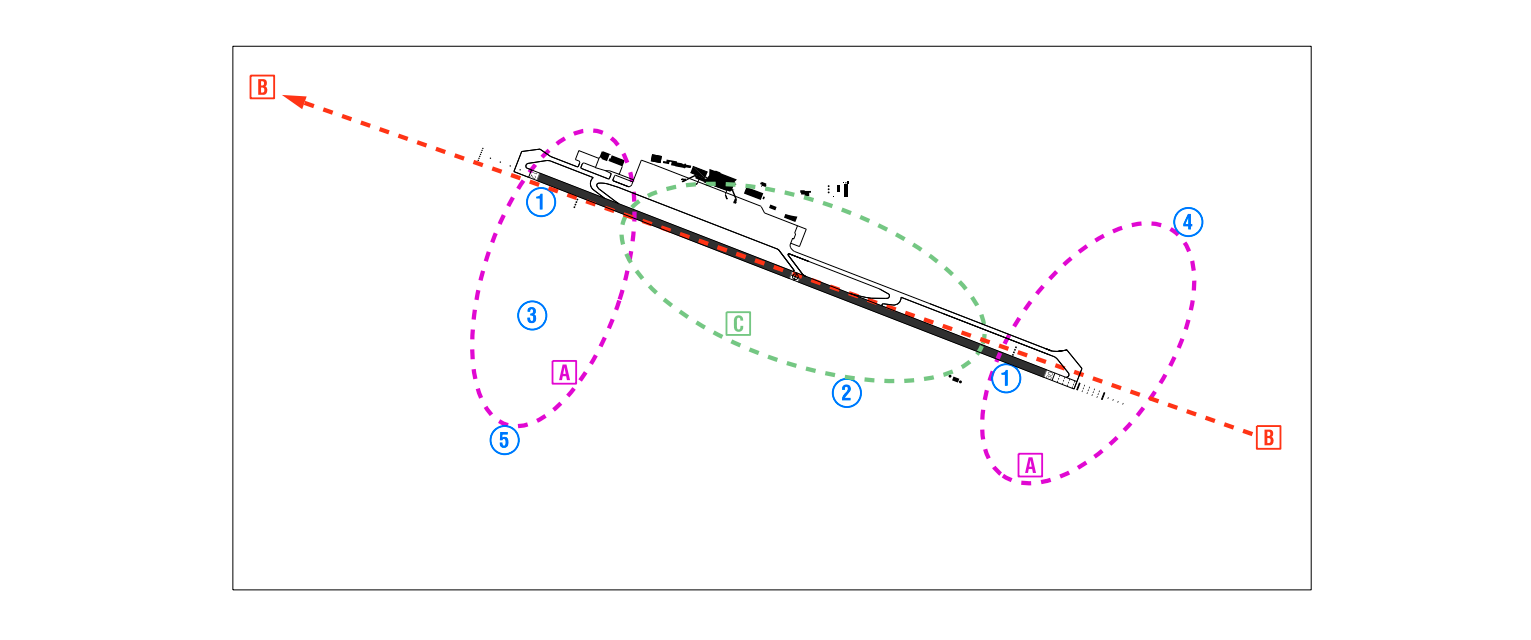
The following bird concentration zones and bird crossing areas are located close to the airport grounds:
Zone 1: Grasslands around the runway (at 0 NM).
Zone 2: Crop fields of Llanos de Los Rodeos (at 0.1 NM).
Zone 3: El Ortigal feed silos and flour factory (at 0.5 NM).
Zone 4: City of La Laguna (at 0.2 NM).
Zone 5: Los Rodeos cattle farm (at 0.83 NM).
BIRD MOVEMENTS
Movement A: movement of wild rock doves. This species is permanently present in the zone.
Movement B: movement of sporting rock doves. During the pigeon racing and training season, mainly from January to April.
Movement C: concentrations of swifts flying over the airfield. During the spring and summer months, mainly in calm wind conditions.
During the year, other species can also be detected without specific movements or months in which their presence may be foreseen, such as: grey heron, common kestrel, buzzard, long-eared owl, barn owl, ptarmigan, etc.
WIND PHENOMENA
Orographic conditions on Tenerife island and the airport location contribute to the appearance of windshear and turbulence phenomena under certain circumstances.
With northerly winds (between 320º and 360º) with an intensity of more than 12 kt, there is the possibility of strong turbulence and windshear on the approach (short final position) and THR 30.
With winds with directions between 150º and 210º and an intensity of more than 20 kt, there is the possibility of turbulence on the approach to RWY 12.
With westerly and south-westerly winds above 10000 ft, turbulence areas originating from the Mount Teide are very likely to exist. This kind of turbulence usually appears in a sudden, violent and short way.
VISIBILITY
The geographic location of Tenerife Norte/Ciudad de La Laguna airport causes a concentration of wet air masses which reach condensation at the airport elevation.
Due to this, cloud masses form over the RWY reducing the visibility. It is not unusual for a sector of the RWY to be completely clear while visibility is almost nil on the rest of the RWY.
This kind of cloud masses passing over the airport is more frequent in the months between April and October.
LOCALIZER ILS RWY 12
Those aircraft vacating RWY via the end of RWY 12 (TWY E-5) invade the localizer critical area, causing the loss of the signal of this subsystem until the aircraft moves 60 m away from the RWY centre line.
VISIBLE DISTANCE IN RWY
Because of the RWY longitudinal profile, starting the take-off from the threshold of RWY 12, it is possible to lose the visual references in relation to the RWY end.
SLOPE IN APRON
The transverse slope in the apron exceeds 1% at PRKG 8, 9, 10 and 11.
DISTANCE BETWEEN CENTRE LINES
The distance between the RWY centre line and the center line of the TWY parallel to the RWY is 120 m.
OBST | LAT | LONG | HGT (ft) | ELEV (ft) |
|---|---|---|---|---|
Spot elevation | 282915.3N | 0162127.8W | 0 | 2067 |
Antenna | 282919.5N | 0162130.5W | 29 | 2084 |
CHARTS RELATED TO THE AERODROME
The list of charts related to the aerodrome can be found on the link below:
https://aip.enaire.es/AIP/#GCXO
VISUAL SEGMENT SURFACE (VSS) PENETRATION
The instrument approach procedures affected can be found below:
IAC 1 - RNP Z (LPV ONLY) RWY 12: LPV.
IAC 2 - RNP Y RWY 12: LNAV, LNAV/VNAV.
IAC 3 - ILS Z RWY 12: Direct approach.
IAC 4 - ILS Y RWY 12: Direct approach.
IAC 5 - LOC RWY 12: Direct approach.
IAC 9 - ILS Y RWY 30: Direct approach.