LEGR AD 2 AERODROME DATA
AERODROME LOCATION INDICATOR AND NAME
LEGR – Federico García Lorca. Granada-Jaén
AERODROME GEOGRAPHICAL AND ADMINISTRATIVE DATA
| ARP | 371119N 0034638W. See AD 2-LEGR ADC. | |
| Distance and direction from the city | 17 km W. | |
| Elevation | 567 m / 1860 ft. | |
| Geoid undulation | 48.25 m ± 0.05 m (1). | |
| Reference temperature | 35°C. | |
| Low average temperature | 6ºC. | |
| Magnetic variation | 0º (2020). | |
| Annual change | 7.5' E. | |
| AD administration | Aena. | |
| Address | Aeropuerto Federico García Lorca. Granada-Jaén, Carretera A-4075 Aeropuerto, Km. 2,2. 18330 Chauchina, Granada. | |
| TEL | +34-958 245 247 | |
| FAX | +34-958 245 247 | |
| AFTN | LEGR | |
| grx.cecoa@aena.es | ||
| Approved traffic | IFR/VFR. (2) | |
| Remarks | (1) For all AD points. (2) See item 20. Business and general aviation. |
OPERATIONAL HOURS
| Airport | V: 0430–2115, PS 1 HR 45 MIN PPR. I: 0530–2215, PS 1 HR 45 MIN PPR. |
|
| Customs and Immigration | HR AD. (1) | |
| Health and Sanitation | No. | |
| AIS | H24 (2). | |
| ARO | HR AD (3). | |
| MET briefing | HR AD PS 45 MIN BFR. | |
| ATS | V: 0415–2135, I: 0515–2235. In case of expediting PPR: V: 0415–2320, I: 0515–0020. | |
| Fuelling | HR AD. | |
| Handling | HR AD. See item 2. Approved traffic. | |
| Security | H24. | |
| De-icing | HR AD. | |
| Remarks | Airport hours of activity: V: 0415-2135, I: 0515-2235. In case of expediting PPR: V: 0415-2320, I: 0515-0020. General and Business Aviation traffic (IFR/VFR) is conditional on declared capacity. Slots must be requested 4 HR to CECOA LEGR.
The aircraft type, registration number, operator and ground handling agent, departure and arrival aerodromes, as well as the date/time of ETA and ETD must be included. (1) Frontier Inspection Schedule (document control): V: 0600-2000, I: 0700-2100. For Non-Schengen operations outside these hours, contact the Airport by telephone, at least 1HR in advance for modifying the closing time, and at least 12HR in advance for modifying the opening time. (2) Centralised AIO Office - International NOTAM Office.
(3) ARO service provided from the operations office of the airport. |
HANDLING SERVICES AND FACILITIES
| Cargo facilities | Up to 4250 kg. | |
| Fuel types | 100LL (1), JET A-1. | |
| Oil types | No. | |
| Refuelling capacity | (2) 100LL: 2 trucks and 1 tank, 38 000 L, 3 L/s. JET A-1: 3 trucks and 4 tanks 285 000 L, 56.93 L/s. | |
| De-icing facilities | Yes. See AD 2-LEGR ADC. | |
| Hangar space | No. | |
| Repair facilities | No. | |
| Remarks | (1) Refuelling operations with AVGAS (100LL) or highly-volatile Jet B-type
fuel or similar, or if these fuel types are mixed are not permitted when
passengers are on board, boarding or disembarking.
SOUTH EUROPE GROUND SERVICES
Ramp agents sole for General Aviation: GENERAL AVIATION SERVICE S.L.
UNITED AVIATION SERVICES S.L.
UNIVERSAL AVIATION SPAIN S.A.
AVIAPARTNER EXECUTIVE SPAIN S.A. (AVIAVIP) Handling for General and Executive Aviation
|
PASSENGER FACILITIES
| Hotels | No. | |
| Restaurant | Yes. | |
| Transportation | Taxis, buses and hire cars. | |
| Medical facilities | No. | |
| Bank/Post Office | Cash dispenser / Mailbox. | |
| Tourist information | Yes. | |
| Remarks | None. |
RESCUE AND FIREFIGHTING SERVICES
| Fire Category | 7 (1). | |
| Rescue equipment | In accordance with the fire category published. | |
| Removal of disabled aircraft | The Airport has the following own equipment for the recovery of disabled aircraft:
|
|
| Remarks | The response time of the rescue and fire fighting service is less
than 3 MIN, with an operational objective of less than 2 MIN. (1) CAT 9 on demand, according to the procedure (see item 20. Local regulations: procedure for the request of rescue protection level and fire fighting category on demand) |
RUNWAY SURFACE CONDITION ASSESSMENT AND REPORTING, AND SNOW PLAN
| Types of clearing equipment | Urea spreader, snowplough, sweeper truck with snowplough blade. | |
| Clearance priorities | Runways, taxiways E2, E5, T1 and T2, apron taxiways, aircraft stands according to schedule, rapid exit taxiways and rest of the movement area. | |
| Use of material for movement area surface treatment | Potassium acetate (KAC) and urea (UREA). | |
| Specially prepared winter runways | Not applicable. | |
| Remarks | Period of application of snow plan: 1-DEC to 31-MAR. Runway surface condition assessment and reporting in accordance with the Global Reporting Format (GRF) methodology described in AD 1.2.2. Aerodrome in service during all seasons of the year. |
APRONS, TAXIWAYS AND CHECK LOCATIONS/ POSITIONS DATA
| Apron | Surface: Concrete. Strength: PCN 66/R/A/W/T, EXC: PRKG 1, 10, 10A, 10B, 10H, 11, 11A, 11B, 11H: PCN 45/R/A/W/T; PRKG 1B, 2, 4, 5, 7, 7D, 7H, 8: PCN 37/R/A/W/T; PRKG 9, 9H, 11C, 20-45: PCN 51/R/A/W/T. |
|
| Taxiways | Width: T1, T2: 23 m; E1, E2, E5, E6: 26 m; E3, E4: 28 m. Surface: Asphalt. Strength: E1, E2, E5, E6, T1, T2: PCN 69/F/A/W/T; E3, E4: PCN 119/F/A/W/T. |
|
| Check locations | Altimeter: Apron ELEV 568 m / 1864 ft. VOR: No. INS: See AD 2-LEGR PDC. |
|
| Remarks | None. |
SURFACE MOVEMENT GUIDANCE AND CONTROL SYSTEM AND MARKINGS
| Taxiing guidance system | Lighted boards (1). Runway-holding positions, stop bars, stop bars on TWY E1, E2, E5 and E6 to access to RWY 09/27 only under low visibility conditions, runway guard lights, NO ENTRY boards and stands. | |
| RWY markings | Designators, threshold, centre line, side stripe, aiming point and touchdown zone. | |
| TWY markings | Centre line and side stripe. | |
| Remarks | (1) Some boards have LED lighting. |
AERODROME OBSTACLES
Obstacles in Approach, Take-Off Climb, Conical, Inner Horizontal, Transitional, Inner Transitional and Balked Landing Surfaces established in ICAO Annex 14; and the areas 2A and 3 established in ICAO Annex 15. Those penetrating these surfaces are identified in the CSV file as “Relevante_Relevant = Si/Yes”. |
See Item 10 and Data Set. |
|
Remarks |
See AD 2-LEGR AOC. |
METEOROLOGICAL INFORMATION PROVIDED
| MET office | Granada EMAe. | |
| HR | HR AD PS 45 MIN BFR. Outside this schedule, a half-hourly METAR AUTO will be issued. | |
| METAR | Half-hourly. | |
| TAF | 24 HR. | |
| TREND | No. | |
| Briefing | In person and by telephone. | |
| Flight documentation / Language | Charts and plain language / Spanish. | |
| Charts | Significant forecasted, wind and temperature in altitude maps. | |
| Supplementary equipment | Clouds and lightning image and radar information display. | |
| ATS unit served | TWR, APP. | |
| Additional information | Sevilla OMAe (LESV): H24
Granada EMAe: HR AD
|
|
| Remarks | Aerodrome climatological summary available. Aerodrome warnings available. |
RUNWAY PHYSICAL CHARACTERISTICS
| RWY | Direction | DIM (m) | THR PSN | THR ELEV | SWY (m) | CWY (m) | Strip (m) | OFZ | RESA (m) | RWY/SWY SFC – PCN | |
|---|---|---|---|---|---|---|---|---|---|---|---|
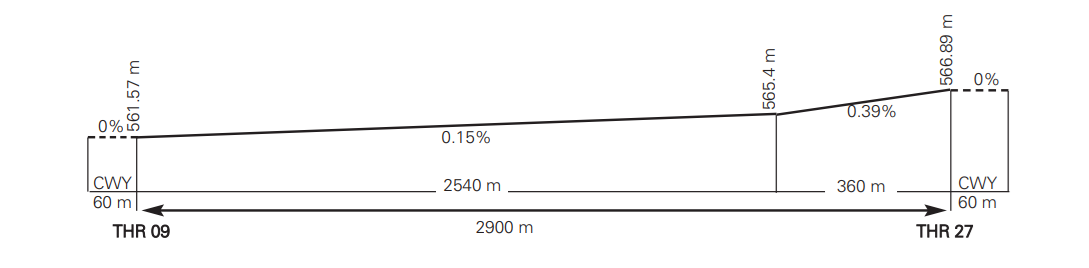
| 09 | 089.46° GEO / 090° MAG | 2900 × 45 | 371119.01N 0034737.25W | THR: 561.6 m / 1842 ft TDZ: 562.9 m / 1847 ft |
No | 60 × 150 | 3020 × 280 (1) | No | 184 × 130 | RWY: (2) SWY: No |
|
| 27 | 269.48° GEO / 270° MAG | 2900 × 45 | 371119.89N 0034539.68W | THR: 567 m / 1860 ft TDZ: No |
No | 60 × 150 | 3020 × 280 (1) | No | 150 × 150 | RWY: (3) SWY: No |
|
Remarks: (1) Last 10 m of right side of RWY 27: strip decreases up to 90 m. TThe surface of the strip consists of asphalt in its central section, coinciding with the runway, of length 3020 m and width of 60 m, with the rest (110 m beyond each side of the strip) being natural terrain. (2) First 170 m from THR 09, CONC PCN 37/R/A/W/T; next 1260 m, ASPH PCN 98/F/A/W/T; next 1300 m, ASPH PCN 66/F/A/W/T; last 170 m, CONC PCN 37/R/A/W/T. (3) First 170 m from THR 27, CONC PCN 37/R/A/W/T; next 1300 m, ASPH PCN 66/F/A/W/T; next 1260 m, ASPH PCN 98/F/A/W/T; last 170 m, CONC PCN 37/R/A/W/T. |
|||||||||||
Profile:
DECLARED DISTANCES
| RWY | TORA (m) | TODA (m) | ASDA (m) | LDA (m) |
|---|---|---|---|---|
| 09 | 2900 | 2960 | 2900 | 2900 |
| 27 | 2900 | 2960 | 2900 | 2900 |
Remarks: None.
APPROACH AND RUNWAY LIGHTING
| Runway | 09 | |
| Approach | Precision CAT I, 900 m. LIH. | |
| PAPI (MEHT) | 3º (INFO NO AVBL). (2) | |
| Threshold | Green, with wing bars. | |
| Touchdown zone | No. | |
| Runway centre line | 2900 m: 1095 m white + 1200 m white and red + 605 m red. LIH. Distance between lights: 15 m. (1) | |
| Runway edge | 2900 m: 2300 m white + 600 m yellow. LIH. Distance between lights: 50 m. | |
| Runway end | Red. | |
| Stopway | No. | |
| Remarks | Rapid exit taxiway indicator lights E4. (1) (1) Runway centre line lights and rapid exit taxiway E4 lights are operational whenever the runway visual range (RVR) is lower than or equal to 550 m. (2) PAPI is not usable by code letter E ACFT. |
| Runway | 27 | |
| Approach | Simple, 420 m. Threshold identification lights. LIH. | |
| PAPI (MEHT) | 3º (INFO NO AVBL). (2) | |
| Threshold | Green, with wing bars. | |
| Touchdown zone | No. | |
| Runway centre line | 2900 m: 1095 m white + 1200 m white and red + 605 m red. LIH. Distance between lights: 15 m. (1) | |
| Runway edge | 2900 m: 2300 m white + 600 m yellow. LIH. Distance between lights: 50 m. | |
| Runway end | Red. | |
| Stopway | No. | |
| Remarks | Rapid exit taxiway indicator lights E3. (1) (1) Runway centre line lights and rapid exit taxiway E3 lights are operational whenever the runway visual range (RVR) is lower than or equal to 550 m. (2) PAPI is not usable by code letter E ACFT. |
OTHER LIGHTING, SECONDARY POWER SUPPLY
| ABN/IBN | No. | |
| WDI | 1 near THR 09 and 1 near THR 27. No LGTD. | |
| TWY lighting | Edge. | |
| Apron lighting | Edge. | |
| Secondary power supply | Uninterrupted power system (UPS) with 0 seconds of switch-over time (light), supported by power generators with a maximum time of response of 15 seconds. | |
| Remarks | None. |
HELICOPTER LANDING AREA
| Position | FATO: RWY 09/27. Coordinates THR 09 and THR 27, see item 12. Coordinates THR 09 and THR 27, see item 12. |
|
| Elevation | FATO: RWY 09/27. Elevation THR 09 and THR 27, see item 12. Ground taxiing: TLOF same as RWY 09/27. Elevation THR 09 and THR 27, see item 12. Air Taxiing: TLOF same as PRKG 3H, 6H, 7H, 9H, 10H and 11H. |
|
| Dimensions, surface, maximum weight, marking | FATO: RWY 09/27. Ground taxiing: TLOF same as RWY 09/27, see item 12. Air Taxiing: TLOF same as PRKG 3H and 6H. PRKG 3H: concrete PCN 66/R/A/W/T. Circular stripe with 50 cm wide and an interior diameter of 7 m. PRKG 6H: concrete PCN 66/R/A/W/T. Circular stripe with 50 cm wide and an interior diameter of 9 m. PRKG 7H: concrete, PCN 37/R/A/W/T. Discontinuous circular stripe with 30 cm wide and an interior diameter of 17.39 m. PRKG 9H: concrete, PCN 51/R/A/W/T. Discontinuous circular stripe with 30 cm wide and an interior diameter of 11.37 m. PRKG 10H: concrete, PCN 45/R/A/W/T. Discontinuous circular stripe with 30 cm wide and an interior diameter of 11.37 m. PRKG 11H: concrete, PCN 45/R/A/W/T. Discontinuous circular stripe with 30 cm wide and an interior diameter of 11.37 m. |
|
| Direction | No. | |
| Declared distances | No. | |
| Lighting | No. | |
| Remarks | Apron lighting. |
| PRKG | ELEV (m) |
|---|---|
| 3H | 567.592 |
| 6H | 567.628 |
| 7H | 567.932 |
| 9H | 567.600 |
| 10H | 568.161 |
| 11H | 568.678 |
AIR TRAFFIC SERVICES AIRSPACE
Designation |
CTR GRANADA. |
|
Lateral limits |
Circle radius 6.5 NM centred on ARP. |
|
Vertical limits |
SFC-1000 ft AGL. |
|
Airspace class |
D. |
|
Unit Language |
GRANADA TWR. ES/EN. |
|
Transition altitude |
2150 m/7000 ft. |
Designation |
ATZ GRANADA. |
|
Lateral limits |
Circle of radius 8 km centred on ARP. (1) |
|
Vertical limits |
SFC-3000 ft HGT (2). |
|
Airspace class |
D. |
|
Unit Language |
GRANADA TWR. ES/EN. |
|
Transition altitude |
||
Hours of applicability |
||
Remarks |
(1) Or the ground visibility, whichever is lower. |
AIR TRAFFIC SERVICES COMMUNICATION FACILITIES
| Service | APP/TWR | VDF | ATIS | D-ATIS | |
| Call sign | Granada TWR | Granada Gonio | Granada Information | Granada Information | |
| FREQ | 118.855 MHz (C) 121.500 MHz 121.930 MHz (C) 243.000 MHz 257.800 MHz |
118.850 MHz 121.500 MHz |
120.630 MHz (C) | NIL | |
| HR | HR ATS HR ATS HR ATS HR ATS HR ATS |
HR ATS HR ATS |
HR ATS | HR ATS | |
| Remarks | APP/L EMERG GMC EMERG MIL |
Provision of ATIS information via data link |
RADIO NAVIGATION AND LANDING AIDS
| Facility (VAR) | ID | FREQ | HR | Coordinates | DME ELEV | Remarks |
|---|---|---|---|---|---|---|
| DVOR (0º) | GDA | 113.400 MHz | H24 | 371059.4N 0035927.3W | — | — |
| DME | GDA | CH 81X | H24 | 371059.9N 0035927.3W | 600 m | — |
| L (0º) | GR | 285.000 kHz | H24 | 371117.7N 0035027.6W | — | 270° MAG / 4200 m FM THR 09; COV 15 NM. |
| L (0º) | GRA | 412.000 kHz | HR AD | 371121.7N 0034039.8W | — | 090° MAG / 7395 m FM THR 27; COV 20 NM. |
| LOC 09 (0º) | GRD | 109.300 MHz | HR AD | 371119.9N 0034529.5W | — | 090º MAG / 251 m FM THR 27; |
| ILS CAT I | COV 17 NM AVBL at 5600 ft AMSL or ABV. COV 25 NM AVBL at 5600 ft AMSL or ABV. |
|||||
| GP 09 | — | 332.000 MHz | HR AD | 371123.1N 0034724.2W | — | 3°; RDH 18 m; at 324 m FM THR 09 & 124 m FM RCL to the left on APCH direction. |
| ILS/DME | GRD | CH 30X | HR AD | 371123.1N 0034724.2W | 567 m | REF DME THR 09. |
LOCAL AERODROME REGULATIONS
Night Visual Operations (VFR-N)
VFR-N flights are permitted.
Location and designation of standard taxiing routes
There are no defined standard taxiing routes at Granada airport.
Procedure for the request of rescue protection level and fire fighting category on demand
An operator wishing to operate at Granada/Federico Garcia Lorca GranadaJaén Airport with an aircraft of category ICAO-SSEI higher than 7 shall apply to the airport, as far in advance as possible, via email at:Grx.Operaciones@aena.es, indicating the scheduled date and time of arrival and the aircraft model.
Operating instructions
- Movement Area Operations Procedure. This describes the actions for
proper coordination of all individuals and units necessary for the ground
movement and parking of aircraft and restrictions in the apron, following the
safety protocols in the same.
Manoeuvres of 180º turns on the runway will not be cleared. To access the thresholds from the runway itself, aircraft must vacate the latter via the rapid exit taxiway and access it again via the corresponding runway-holding position. - Procedures for code letter 4D and 4E aircraft.
In order for a code letter D or E aircraft to operate, a prior request from the Airline or Handling Agent and an explicit authorization by the Airport Operations Center are mandatory. The request must be submitted at least 72 HR before the planned date via email to Grx.CECOA@aena.es
To ensure that appropriate safety distances are maintained whenever there is an aircraft standing at holding positions E2 or E5, and it is necessary for another aircraft to cross from behind to reach holding positions E1 or E6, the following limitation is mandatory: simultaneous use of E1-E2 and E5-E6 is only allowed whenever code letter 4C or lower aircraft are involved.
Code letter 4E aircraft and model B767-400 and MD-11, aircraft may only use TWY E2 and E5. For the ACFT A330-300, A340-600, A350-1000, B747-400, B777-300 and MD-11, families, the “oversteer“ manoeuvre must additionally be performed. Only one code letter 4E aircraft shall be permitted to taxi within the manoeuvring area.
The only PRKG available for code letter 4E aircraft is PRKG 1. For code letter 4D aircraft, the only available PRKG are PRKG 1 and PRKG 7D. The pilot must pay attention to the indications of the follow me (“FOLLOW ME” vehicles) in order to correctly position the aircraft.
Restrictions on aircraft stands
During the use of PRKG 1, 7D, 10 and 11, PRKG 1A and 1B, 3H, 6H, 7 and 7H ,10A and 10B, 11A and 11B (respectively) are unserviceable.
The use of any of the latter disables its corresponding main stand.
The taxiing of code letter 4E aircraft on the apron is incompatible with the stands located in the last line of each block, the following stands being unavailable during such a manoeuvre: PRKG 0, 3, 3H, 6H and 9.
B767-400 aircraft access to PRKG 1 is incompatible with PRKG 3, which becomes unserviceable. In turn, the exit of B767-400 aircraft from PRKG 1 is incompatible with PRKG 0, as it is unserviceable during said manoeuvre.
Entry to and exit from PRKG 7D are incompatible with aircraft taxiing on the adjacent taxiways.
Exits from PRKG 11C shall be supervised at all times by a follow me (“FOLLOW ME” vehicles).Ground movement
Upon arrival at the handover points (T1 or T2), aircraft shall wait for the "FOLLOW ME" vehicle, in order to proceed to the assigned stand, reporting "FOLLOW ME in sight” to TWR.
All ground movements of aircraft, towed aircraft, persons and vehicles in the manoeuvring area are subject to prior ATC clearance.
All movements of aircraft, towed aircraft, persons and vehicles on the apron shall be regulated by the Apron Safety Regulations.
Avoidance of collisions with other aircraft or obstacles is the responsibility of:
1) Pilots, when taxiing on the apron.
2) Ground handling companies during push-back or exit from stand
manoeuvres, and during towing.
Helicopter operation
1- For the operation of helicopters which hold no letter of exemption under the terms laid down in article 4 of the SERA.
Since there is no other specific area to operate with helicopters, these will receive the same treatment as fixed-wing aircraft and will be authorized by ATC to take off and land on the runway.
-
RWY 09 in use:
RWY 09 in use:
- Departures: Helicopters will carry out taxiing either by air or on the ground (as appropriate) via TWY T1 up to THR 09 and perform the takeoff manoeuvre on the runway.
- Arrivals: Helicopters will complete the final approach to the runway and will vacate it via the rapid exit E4 conducting taxiing either by air or on the ground, as appropriate, up to the apron via TWY T2.
RWY 27 in use:
- Departures: Helicopters will carry out taxiing by air or on the ground (as appropriate) via TWY T2 up to THR 27 and perform the take-off manoeuvre on the runway.
- Arrivals: Helicopters will complete the final approach to the runway and will vacate it via rapid exit E3 conducting taxiing by air or on the ground, as appropriate, up to the apron via TWY T1.
Once on the apron, taxiing either by air or on the ground will be carried out via the access taxiway to the aircraft stand, following the alignment signaled by its centre line marking for both arrival and departure.
Although helicopters will usually be authorized to leave or enter RWY 09/27 as indicated above, these procedures may be modified when required by the pilot for reasons of wind, or by ATC due to operational reasons.
2- For operating helicopters with a letter of exemption, under the terms prescribed in article 4 of the Standard European Rules of the Air (SERA): whenever a special operation is going to be performed as a result of an urgency or emergency, Air Traffic Control (ATC) must be contacted to receive information about how to apply the procedure in these cases.
3- Simultaneous entry and/or exit for stands 3H and 6H is restricted.
Business and General Aviation
It is mandatory to contract the service of a handling agent for the following operations:
- Flights with origin and/or destination in Non-Schengen countries.
- Flights with origin at an aerodrome which does not apply the departure security measures provided for in the Regulation (EU) 300/2008, throughout the operational hours.
- Aircraft with wingspans and/or lengths greater than 14 m (which would involve the use of parking on the commercial aviation apron, with access on foot not permissible for safety reasons), or in situations of saturation of the general aviation apron (users may be offered the possibility of parking on the commercial aviation apron).
- Departing Flights (except for crew with valid airport accreditation).
Exemption for domestic fligths: State, hospital, SAR, military, humanitarian and fire fighting flights.
During arrivals, passengers and flight crew shall wait on board the aircraft for ground handling staff to arrive.
During departures, they shall contact their ground handling agent for transfer to the aircraft.
At the very least, a Category 5 ramp must be hired: Aircraft assistance. Additionally, whenever there are passengers whose arrival or destination is a NON-Schengen airport, a Category 1 Ground-based administrative assistance and supervision ramp must be hired.
Once the contracted service has been confirmed, the ground handling company's shall be mentioned in Field 18 of flight plan
The handling service is recommended to be booked at least 24 HR prior to the scheduled arrival or departure of the flight.
Aircraft parking in the General Aviation Area shall remain anchored and chocked. For this reason, general aviation operators must have chocks and tooling to secure aircraft to the anchorages provided at each parking.
In order to comply with the Regulation (EU) 2016/399 for this kind of flight, the commander shall send information about the identity of the passengers to the border police at the following e-mail addresses: granada.pfaextdoc@policia.es and gr-cmd-granada-aeropuerto@guardiacivil.org
Operational safety reports
The pilots/company shall report to the airport as soon as possible, any accident, incident and occurrence or event that may potentially affect operational safety, either as involved parties or witnesses.
The purpose of these reports is to compile information for enhanced operational safety, regardless of the mandatory notification of incidents to the relevant air navigation authority. Data may be sent in any format, including at least the following information:
- Date and time.
- Place.
- Parties (data identifying the vehicles, aircraft involved).
- Companies involved.
- Description of the events.
- Any other relevant data (e.g. lighting conditions, weather conditions, operational phase such as take-off / landing / stop-over, pavement conditions...).
The airport's e-mail address for sending safety notifications is as follows: grx.safety@aena.es
In addition to notifying the airport using the indicated system, it is necessary to send at least the basic data of the accident, incident, occurrence or event to the air traffic control services provider (ATC).
On the specific instance of safety reports related with the air traffic control service provider (manoeuvring area, flight phases and ATS airspace) these may be sent to the e-mail address: lecsdptosafetymg@enaire.es
Restrictions on operations
AD closed to aircraft without radio communications.
VFR operations in formation or groups of aircraft (rallies, formations, flying schools, etc.) exceeding five (5) aircraft must be coordinated in advance with the aerodrome. Contact must be made at least 72 hours prior via email at grx.cecoa@aena.es
Flying school and training operations
- Training or flying school flights under IFR flight plan are not permitted.
- Training/school flights not authorised for aircraft not equipped with ADS-B.
- All training and flying school operations conducted at the aerodrome or within its airspace (ATZ) shall require prior coordination with the aerodrome operator. Contacts must be made at least 4 hours in advance via grx.cecoa@aena.es
- Simultaneous touch-and-go or take-off operations are capacity limited as
follows:
- One (1) simultaneous operation between 09:00 LT and 18:00 LT.
- Two (2) simultaneous operations during other time periods.
Air-ground communications failure
TWR telephone contact numbers to be used in the event of communications failure: TEL: +34-958 245 284 / +34-958 245 283.
Airport Emergency Plan
See AIP-ESPAÑA AD 1.1-5 Emergency management item 1.3.1.7.
Carrying out cross-bleed start
Carrying out cross-bleed is only allowed for aircraft with inoperative APU.
It is necessary to request for cross-bleed start to ATC and wait for approval.
Basic apron rules for pedestrians
Flight crews and their companions shall comply with at least the following apron rules:
- Wear a reflective vest (except passengers).
- Smoking is prohibited (the restriction applies throughout the entire operational safety airside area).
- Walk only along the designated pedestrian routes (pedestrian walkways).
- Watch and secure personal objects and/or belongings that could be blown away by the wind.
NOISE ABATEMENT PROCEDURES
ENGINE/S TEST
Crews seeking to conduct engine tests at speeds higher than the idling speed must submit a request in advance to ATC for coordination with the Airport Management.
These engine tests shall be conducted in the manoeuvring area, in accordance with the flight schedule.
FLIGHT PROCEDURES
LOW VISIBILITY PROCEDURES (LVP)
GENERAL
The low visibility procedures on surface (LVP) shall be applied when:
- The runway visual range (RVR) is less than 550 m, or
- In the event both transmissometers fail, the general visibility in the manoeuvring area is less than 800 m.
The low visibility procedures on surface (LVP) shall be cancelled when:
- The runway visual range (RVR) is greater than 1000 m, or
- In the event both transmissometers fail, the general visibility in the manoeuvring area is greater than 1500 m.
Take-offs under low visibility conditions: RWY 09 and 27 are authorized for low visibility take-offs down to the established minimum RVR 200 m.
TWR shall inform the pilots that low visibility procedures are in force.
SURFACE MOVEMENT
Pilots shall proceed to verify the situation of their aircraft at all times, ensuring that their taxiing takes place under conditions of complete operational safety.
In order to establish a better transit sequence, pilots shall not request start-up, push-back nor taxiing clearances when the Runway Visual Range (RVR) readings, or visibility if appropriate, are under their operational minimum.
In any event, where the RVR is less than 550 m, only one aircraft will be cleared to taxi at a time on the Movement Area.
ARRIVALS:
- Aircraft that have landed shall report:
- Runway vacated, and
- Taxiway used.
- Upon arrival at the handover points (T1 or T2), they shall wait for the “FOLLOW ME” vehicle to be guided to the assigned stand, notifying TWR “FOLLOW ME in sight”
DEPARTURES:
- For low visibility take-offs (LVTO) the following runway holding points shall be used:
- RWY 09 – E1 (CAT I) or E2 (CAT I)
- RWY 27 – E5 (CAT I) or E6 (CAT I)
- Pilots, on requesting clearance for start-up, shall report the stand they are occupying to ATC.
- In all parking stands, the entry manoeuvre shall be performed at the minimum power required for taxiing.
- In all parking stands with autonomous exit, the exit manoeuvre shall be performed at the minimum power required to initiate taxiing.
- Upon request by the pilot, the “FOLLOW ME” vehicle can guide a departing aircraft up to the runway holding positions.
ANOMALOUS SITUATIONS IN THE MANOEUVRING AREA
3.1 Uncertainty about the position in the manoeuvring area.
Other than as provided for in the following paragraph, if a pilot is in doubt about the position of the aircraft in relation to the manoeuvring area, they must immediately halt the aircraft and report this circumstance to ATC (including the last known position).
In situations in which a pilot is in doubt about the position of the aircraft in relation to the manoeuvring area, but they recognise that the aircraft is on a runway, the pilot shall immediately report this to ATC (including the last known position), and vacate the runway as soon as possible, if they can find an appropriate taxiway nearby, unless ATC should indicate otherwise, and then, halt the aircraft.
3.2 Loss of visual contact between traffic.
In the event that one aircraft loses visual contact with another, or with a vehicle with which it is maintaining its own separation, ATC shall be informed immediately, and the aircraft halted. ATC shall take the measures that it shall deem fit.
3.3 Breakdown of aircraft.
It shall report the situation to ATC and await the arrival of assistance. Should it find itself on a runway, if possible and unless ATC should indicate otherwise, this shall be vacated.
3.4 Communications failure.
In the event that an aircraft or vehicle operating in the manoeuvring area should experience a communications failure, it shall proceed as follows:
- Departing aircraft: the aircraft shall continue by the designated route and halt at the ATC clearance limit, taking extreme care, where it shall hold and await the arrival of a “FOLLOW ME” vehicle.
- Arriving aircraft: if the aircraft has just landed, it shall hold on vacating
the runway and await the arrival of an assistance vehicle.
If the aircraft already had a taxiing clearance, it shall continue by the designated route and halt at the ATC clearance limit, taking extreme care, where it shall hold and await the arrival of a “FOLLOW ME” vehicle. - Vehicle: The vehicle shall evacuate the runway, taxiways or any other part of the manoeuvring area if on it (provided the operator is confident that they can do so and are not completely disoriented) and then stop, remaining in its position and await the arrival of a "FOLLOW ME" vehicle or other means of assistance.
CONTINUOUS DESCENT OPERATIONS
Depending on traffic conditions, and provided that it is not envisaged that it will be necessary to interrupt a descent, aircraft shall be cleared to proceed by a standard arrival (STAR) or by means of a "direct" type clearance to an intermediate fix of the STAR, to the IAF, to an intermediate approach fix or the IF, at the minimum altitude of the IAF or the IF of the instrument procedure (IAC) or the minimum ATC surveillance altitude of the sectors through which the direct route passes, whichever is the higher, so that the descent operation may be accomplished continuously.
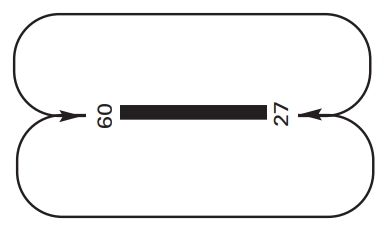
AD Traffic circuit
ATS SURVEILLANCE SYSTEMS
Within the unit´s area of responsibility, ATS surveillance systems outside the ATZ may be used to provide procedural guidance to the controller where it is necessary to maintain surveillance of air transit flow:
- Improved position information on aircraft under control;
- Supplementary information regarding other traffic; and
- Information on any significant aircraft deviations from the relevant air traffic control clearances, including cleared routes and flight levels where applicable.
The performance of the above functions is not guaranteed below 7500 ft AMSL.
Depending on the availability of ATS surveillance systems, the altitude from which the aforesaid functions can be provided may be affected or even suspended, in which case aircraft shall be informed by the available means of communicating aeronautical information.
ADDITIONAL INFORMATION
Birds Concentration and Movement Areas
Caution in landing and take-off operations to RWY 09/27 due to birds concentration in the vicinity of the aerodrome.
Flows of birds:
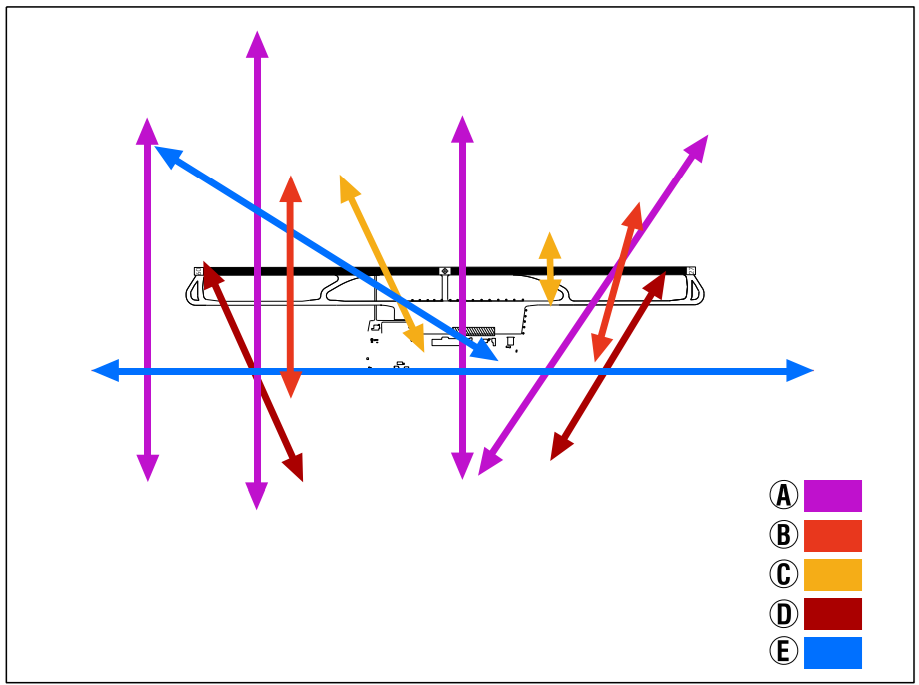
- MOVEMENT A.- Crossing of flocks of wood pigeons, specially at sunrise and sunshine. Presence all year increasing in number during winter. Passage height 20-50 m.
- MOVEMENT B.- Crossing of common buzzards. A medium-sized bird of prey present all year round, increasing in number during autumn and winter. Passage height 0-20 m (usually solitary individuals in search of prey).
- MOVEMENT C.- Crossing of murmurations of starlings. Present all year round, increasing in number during winter. Passage height 0-20 m (usually in groups on the ground).
- MOVEMENT D.- Crossing of stone-curlews during twilight and night-time, increasing in number during winter. Passage height 0-40 m (usually solitary individuals).
- MOVEMENT E.- Crossing of flocks of jackdaws. Presence all year round, increasing in number during autumn and winter. Passage height 20-50 m.
AERONAUTICAL CHARTS RELATED TO AN AERODROME
The list of charts related to the aerodrome can be found on the link below:
VISUAL SEGMENT SURFACE (VSS) PENETRATION
The instrument approach procedures affected, can be found below:
IAC 5 VOR RWY 09: direct approach.