GCRR AD 2 AERODROME DATA
AERODROME LOCATION INDICATOR AND - NAME
GCRR - LANZAROTE/César Manrique Lanzarote
AERODROME GEOGRAPHICAL AND ADMINISTRATIVE DATA
| ARP | 285644N 0133619W. See AD 2-GCRR ADC. | |
| Distance and direction from city | 5 km SW. | |
| Elevation | 14 m / 47 ft. | |
| Geoid undulation | 45.04 m ± 0.10 m (1). | |
| Reference temperature | 29°C. | |
| Low average temperature | 17°C. | |
| Magnetic variation | 4° W (2020). | |
| Annual change | 9.6'E. | |
| AD administration | CIV: Aena. MIL: Ejército del Aire y del Espacio. |
|
| Address | CIV: Oficinas Aena Aeropuertos.
MIL: Aeródromo militar de Lanzarote.
|
|
| TEL | CIV: +34-928 846 000/006 MIL: +34-928 846 800 |
|
| FAX | CIV: +34-928 846 004 MIL: +34-928 846 827 |
|
| AFTN | GCRR. | |
| Aceceops@aena.es | ||
| Approved traffic | IFR/VFR day time (2). | |
| Remarks | (1) For all AD points. (2) See item 20: Local Regulation. |
OPERATIONAL HOURS
| Airport | V: 0600-0000; I: 0700-0100. | |
| Customs and Immigration | HR AD. | |
| Health and Sanitation | See item 5. | |
| OPV | HR AD. | |
| AIS | H24. (1) | |
| ARO | H24. (2) | |
| MET briefing | HR AD PS 1 HR BFR. | |
| ATS | HR AD. | |
| Fuelling | HR AD. | |
| Handling | HR AD. | |
| Security | H24. | |
| De-icing | No. | |
| Remarks | Foreign state aircraft, see item 20: Local regulations. (1) Centralised AIO Office - International NOTAM Office
(2) Centralised ARO office geographical area 15.
|
HANDLING SERVICES AND FACILITIES
| Cargo facilities | CIV: Up to 5000 kg. MIL: Up to 6000 Kg. |
|
| Fuel types | CIV: 100LL, JET A-1. MIL: 100LL, F-34. |
|
| Oil types | No. | |
| Refuelling capacity |
|
|
| De-Icing facilities | No. | |
| Hangar space | 6 aircraft MAX wingspan 11.90 m. | |
| Repair facilities | No. | |
| Remarks | Ramp agents: AVIAPARTNER:
GROUNDFORCE ACE 2023 UTE:
|
PASSENGER FACILITIES
| Hotels | MIL: Yes. | |
| Restaurant | Yes. | |
| Transportation | CIV: Taxis, hire cars and buses. MIL: Buses and light vehicles available on request. |
|
| Medical facilities | First aid on limited schedule. | |
| Bank/Post Office | Cash dispenser. | |
| Tourist information | Yes. | |
| Remarks | None. |
RESCUE AND FIREFIGHTING SERVICES
| Fire category | CIV: 9. (1) MIL: 7. |
|
| Rescue equipment | MIL & CIV: According to the published fire category. | |
| Removal of disabled aircraft |
|
|
| Remarks | (1) The response time of the rescue and fire fighting service is less than 3 minutes, with an operational objective of less than 2 minutes.
|
RUNWAY SURFACE CONDITION ASSESSMENT AND REPORTING, AND SNOW PLAN
| Types of clearing equipment | Not applicable. | |
| Clearance priorities | Not applicable. | |
| Use of material for movement area surface treatment | Not applicable. | |
| Specially prepared winter runways | Not applicable. | |
| Remarks | Runway surface condition assessment and reporting in accordance with the Global Reporting Format (GRF) methodology described in AD 1.2.2. Aerodrome in service during all seasons of the year. |
APRONS, TAXIWAYS AND CHECK LOCATIONS/POSITIONS DATAMOVEMENT AREA DETAILS
| Apron | Surface: Concrete and asphalt.
PCN 61 F/A/W/T.
PCN 27/F/A/W/T. PCN 58/F/A/W/T. |
|
| Taxiways | Width: 23 m EXC EM 22 m. E1, E4, R2, R3, R4 & R5: PCN 85/F/C/W/T. |
|
| Holding bays | Strength: RWY 03: PCN 40/R/A/W/T. |
|
| Check locations | Altimeter: Apron: ELEV 18 m / 56 ft. |
|
| Remarks | (1) At the intersection with TWY. (2) At the intersection with RWY. (3) TWY centre line: see INSIGNIA and Data Set. |
SURFACE MOVEMENT GUIDANCE AND CONTROL SYSTEM AND MARKINGSTAXIING GUIDANCE SYSTEM AND MARKINGS
| Taxiing guidance system | Boards, NO ENTRY boards, runway-holding positions, runway guard lights in E1 and E4, anti-intrusion bars in E2, E3 and EM, intermediate holding positions LGTD, stands. | |
| RWY markings | Pre-threshold area, designators, centre line, aiming point, side stripe, threshold, displaced threshold, touchdown zone, rapid exit marking indicator on RWY 03 (E2). | |
| TWY markings | Side stripe and centre line. Reflective markers on edge. | |
| Remarks | None. |
AERODROME OBSTACLES
| Obstacles in Approach, Take-Off Climb, Conical, Inner Horizontal, Transitional, Inner Transitional and Balked Landing Surfaces established in ICAO Annex 14; and the areas 2A and 3 established in ICAO Annex 15. Those penetrating these surfaces are identified in the CSV file as "Relevante_Relevant = Si/Yes". | See item 10 and Data Set. | |
| Remarks | See AD 2-GCRR AOC. |
METEOROLOGICAL INFORMATION PROVIDEDMETEOROLOGICAL SERVICE PROVIDED
| MET office | Lanzarote EMAe. | |
| HR | HR AD PS 1 HR BFR. Outside of this schedule, a half-hourly METAR AUTO will be issued. | |
| METAR | Half-hourly. | |
| TAF | 24HR. | |
| TREND | No. | |
| Briefing | In person and by telephone. | |
| Flight documentation/Language | Charts and plain language / Spanish. | |
| Charts | Forecasted significant and wind and temperature in altitude maps. | |
| Supplementary equipment | Clouds, lightning images and radar information display. | |
| ATS unit served | TWR, APP. | |
| Additional information | Las Palmas OMAe (GCGC); H24
|
|
| Remarks | Aerodrome climatological summary available. Aerodrome warnings available. |
RUNWAY PHYSICAL CHARACTERISTICS
| RWY | Direction | DIM (m) | THR PSN | THR ELEV TDZ ELEV |
SWY (m) | CWY (m) | Strip (m) | OFZ | RESA (m) | RWY/SWY SFC PCN |
|---|---|---|---|---|---|---|---|---|---|---|
| 03 (1) (2) | 027.01° GEO 031° MAG |
2400 x 45 | 285611.5590N 0133637.4275W | THR: 5.6 m / 19 ft TDZ: 7.8 m / 26 ft |
No | 60 x 150 | 2460 x 300 (4) | No | 90 x 90 | RWY: ASPH PCN 103/F/A/W/T SWY: No |
| 21 (3) | 207.02° GEO 211° MAG |
2400 x 45 (3) | 285718.40N 0133558.67W | THR: 14 m / 47 ft TDZ: No |
No | 150 x 150 | 2430 x 300 (5) | No | 90 x 90 | RWY: ASPH PCN 103/F/A/W/T SWY: No |
| Remarks: (1) THR RWY 03 displaced 90 m. (2) Coordinates of start of RWY 03 take-off run: 285608.96N 0133638.94W. (3) The last 90 m of RWY 21 are not usable for take-off and landing. End of RWY 21 coordinates: 285611.56N 0133637.43W (4) First 882 m with right half-width of 75 m due to the proximity to the coast. (5) First 1578 m with width of 150 m on each side of the centre line. The rest with left half-width of 75 m and right half-width of 150 m. |
||||||||||
Profile
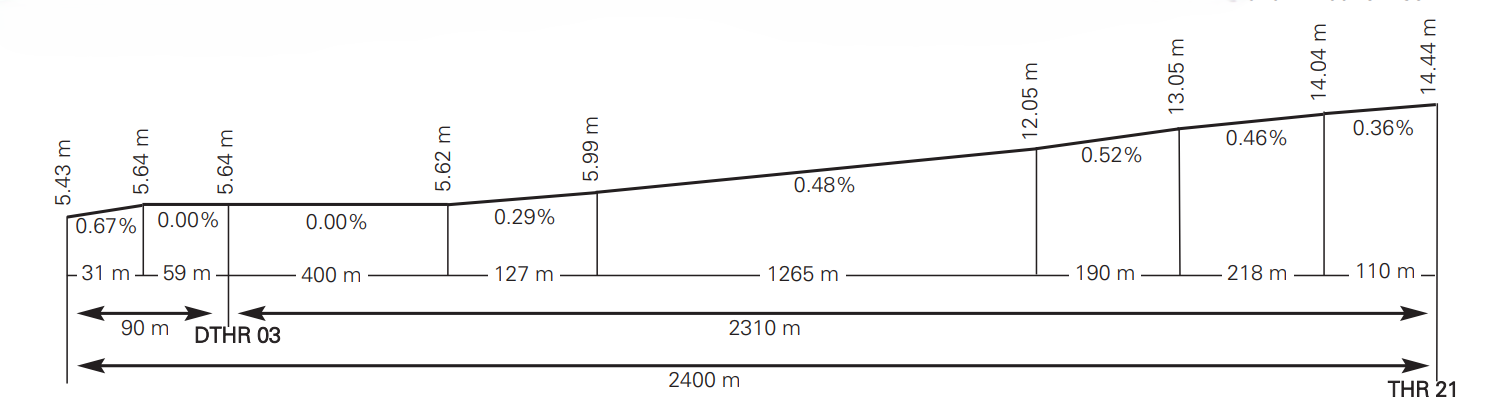
DECLARED DISTANCES
| RWY | TORA (m) | TODA (m) | ASDA (m) | LDA (m) | |||||||
|---|---|---|---|---|---|---|---|---|---|---|---|
| 03 | 2400 | 2460 | 2400 | 2310 (1) | |||||||
| 21 | 2310 (2) | 2460 (2) | 2310 (2) | 2310 (2) | |||||||
| Remarks | (1) THR RWY 03 displaced 90 m. (2) The last 90 m of RWY 21 are not usable for take-off and landing. |
||||||||||
APPROACH AND RUNWAY LIGHTING
| Runway | 03 | |
| Approach | Simple, 510 m. LIH. Threshold identification lights. (1) | |
| PAPI (MEHT) | 3° (19.26 m / 63 ft). | |
| Threshold | Green with wing bars. LIH. | |
| Touchdown zone | No. | |
| Runway centre line | 2400 m: 1500 m white + 600 m white and red + 300 m red. LIH. (2). Distance between lighting: 15 m. |
|
| Runway edge | 2400 m: 90 m red + 1710 m white + 600 m yellow. LIH. (2). Distance between lights: 50 m. |
|
| Runway end | Red. | |
| Stopway | No. | |
| Remarks | Rapid exit taxiway indicator lights (E2). (1) Crossbar to 377 m of threshold. (2) THR RWY 03 displaced 90 m. |
| Runway | 21 | |
| Approach | Simple, 420 m. LIH. Threshold identification lights. | |
| PAPI (MEHT) | 3.7° (21.41 m / 70 ft). (1) | |
| Threshold | Green with wing bars. LIH. | |
| Touchdown zone | No. | |
| Runway centre line | 2400 m: 1500 m white + 600 m white and red + 300 m red. LIH. (2). Distance between lights: 15 m. | |
| Runway edge | 2400 m: 1800 m white + 600 m yellow. LIH. (2). Distance between lights: 50 m. | |
| Runway end | Red. | |
| Stopway | No. | |
| Remarks | (1) Angular coverage restricted to 5° to the right side of RCL in direction of APCH. (2) The last 90 m of RWY 21 are not usable for take-off and landing. |
OTHER LIGHTING, SECONDARY POWER SUPPLY
| ABN/IBN | No. | |
| WDI | 1 near THR 03, 1 near THR 21, 1 near apron. LGTD. | |
| TWY lighting | Centre line. | |
| Apron lighting | Floodlighting poles. | |
| Secondary power supply | UPS equipment (uninterrupted power supply) without switch-over time for visual aids. Standby equipment for the rest of the facilities in the airport area providing a maximum switch-over time (light) of 15 seconds to the rest of the lighting systems. | |
| Remarks | None. |
HELICOPTER LANDING AREA
| Position | CIV: FATO: RWY 03/21. THR 03 and THR 21 coordinates, see item 12. Ground taxiing TLOF same as RWY 03/21. Coordinates 285644N 133619W (same as ARP). Air taxiing: TLOF same as PRKG 15, 16, 19 and 24. MIL: Airport S-W parking, military area, coordinates: 285639N 0133637W. |
|
| Elevation | CIV: FATO: RWY 03/21. Elevation THR 03 and THR 21, see item 12. Ground taxiing: TLOF same as RWY 03/21. Elevation 8.70 m (same as ARP). Air taxiing: TLOF same as PRKG 15, 16, 19 and 24. See table below. (*) MIL: 5.49 m. |
|
| Dimensions, surface, maximum weight, marking | CIV: FATO: RWY 03/21. Ground taxiing: TLOF same as RWY 03/21, see item 12. Air Taxiing: TLOF same as PRKG. PRKG 15, 16 and 24: Hydraulic concrete PCN 73/R/A/W/T. Circular strip of 50 cm width and inner diameter of 11.40 m. PRKG 19: Hydraulic concrete PCN 124/R/A/W/T. Circular strip of 50 cm width and inner diameter of 11.40 m. MIL: 25 x 25 m. |
|
| Direction | CIV: No. MIL: 029/209° |
|
| Declared distances | No. | |
| Lighting | CIV: No. MIL: Markers, centre line and apron edge. |
|
| Remarks | CIV: Helicopters maximum dimensions: see AD 2-GCRR PDC 1.3. Helicopter Operation: See AD 2-GCRR 8. Item 20. Apron lighting. |
(*)
| STAND | ELEVATION (m) |
|---|---|
| 15 | 16.09 |
| 16 | 16.59 |
| 19 | 16.70 |
| 24 | 16.07 |
AIR TRAFFIC SERVICES AIRSPACE ATS AIRSPACE
| Designation | CTR LANZAROTE. | |
| Lateral limits | 291022N 0133459W; 290543N 0132436W; 285903N 0132828W; 285646N 0132455W, arc of 10 NM radius centred on ARP clockwise to: 285124N 0134558W; 291022N 0133459W (1). | |
| Vertical limits | SFC-3500 ft AMSL. | |
| Airspace class | D. | |
Unit Language |
CANARIAS APP. ES/EN. |
|
| Transition altitude | 1850 m / 6000 ft. | |
Hours of applicability |
- |
|
| Remarks | (1) NO ADQ. |
| Designation | ATZ LANZAROTE | |
| Lateral limits | 290237N 0133929W; arc of 6.5 NM radius centred on ARP clockwise to: 285531N 0134336W; 290237N 0133929W. | |
| Vertical limits | SFC-2800 ft AMSL. | |
| Airspace class | D. | |
Unit Language |
LANZAROTE TWR. ES/EN. |
|
| Transition altitude | - | |
Hours of applicability |
- |
|
| Remarks | None. |
AIR TRAFFIC SERVICES COMMUNICATION FACILITIESATS COMMUNICATION FACILITIES
| Service | Call sign | FREQ | HR | Remarks |
|---|---|---|---|---|
| APP | Canarias APP | 129.300 MHz | HR AD | - |
| TWR | Lanzarote TWR | 120.700 MHz | HR AD | - |
| 124.000 MHz | HR AD | BACKUP | ||
| 121.500 MHz | HR AD | EMERG | ||
| 121.800 MHz | HR AD | GMC | ||
| 243.000 MHz | HR AD | EMERG | ||
| 257.800 MHz | HR AD | MIL | ||
| ATIS | Lanzarote Information | 118.625 MHz | HR AD | - |
| D-ATIS | Lanzarote Information | NIL | HR AD | Provision of ATIS information via data link. |
RADIO NAVIGATION AND LANDING AIDSRADIO NAVIGATION & LANDING FACILITIES
| Facility (VAR) | ID | FREQ | HR | Coordinates | DME ELEV | Remarks |
|---|---|---|---|---|---|---|
| DVOR (4° W) | LTE | 114.400 MHz | H24 | 285653.4N 0133604.8W | U/S at:
|
|
| DME | LTE | CH 91X | H24 | 285653.1N 0133604.4W | 0 m | U/S at:
|
| DVOR (4° W) | LZR | 115.200 MHz | H24 | 290957.6N 0133038.5W | COV 40 NM BTN:
|
|
| DME | LZR | CH 99X | H24 | 290956.4N 0133039.5W | 540 m | COV 40 NM BTN:
|
| LOC 03 (4° W) ILS CAT I |
IRR | 109.100 MHz | H24 | 285723.4N 0133555.8W | 031 MAG/175 m FM THR 21.
|
|
| GP 03 | 331.400 MHz | H24 | 285622.3N 0133634.5W | 3°; RDH 15.1 m at 330 m FM THR 03 & 80 m FM RCL To the left on APCH direction. |
||
| ILS/DME 03 | IRR | CH 28X | H24 | 285622.6N 0133634.8W | 12 m | REF DME THR 03. |
| TACAN (4° W) | TLZ | CH 94X | H24 | 285641.4N 0133625.2W | 19.95 m | NO AVBL BTN 310°-330° BLW 4500 ft. |
LOCAL AERODROME REGULATIONSLOCAL REGULATIONS
Aircraft without RNAV1 GNSS authorisation with a destination outside of the Canary Islands shall notify the TWR at the start-up time.
RNP APCH + VPT MANOEUVRE
With regard to the RNP APCH manoeuvre followed by the prescribed track section VPT, pilots are reminded that Lanzarote airport has topographical characteristics which require specific operational procedures and methods. Crew should become familiar with these before flying to GCRR. This provision is particularly important for pilots who are not familiar with this airport.
Likewise, special attention should be paid to the information published in Aeronautical Information Circulars (AIC), about the characteristics and operation of RNP APCH+VPT manoeuvres. Moreover, for this particular manoeuvre, it is recommended that the EGPWS system should be available and active.
PREFERENTIAL RUNWAYS
Crews will be provided with information on the runway conditions according to the procedures applicable.
Take-offs from runway intersections are not permitted.
The access to runway-holding position for RWY 03 is located on TWY E4 while the runway-holding position for RWY 21 is located on TWY E1.
GP signal may fluctuate while traffic aligns with RWY 03 from TWY E4.
GENERAL AVIATION FLIGHTS REGULATIONS
General Aviation IFR traffic (Except hospital, military, SAR and State flights): restricted upon slot request.
SITA: MADGSYA
General Aviation VFR traffic (Except: hospital, military, SAR and State flights): exempt from the requirement of having a slot. The Airport Operations Office must be notified 24 hours before the operation.
Operations Office:
- TEL: +34-928 846 011/006
- SITA: ACEAPYF
- E-mail: ACECEOPS@aena.es
Including the following information:
- Flight date.
- Aircraft ICAO code and wingspan.
- Aircraft registration number.
- Origin and ETA to GCRR.
- Destination and ETD from GCRR.
HANDLING SERVICES TO GENERAL AVIATION
Hiring of a handling agent (see item 4) is mandatory.
The use of chocks is mandatory.
There are anchor points at positions on the general aviation apron.
Turns of 180° shall not be performed in the stand. On the general aviation apron, the aircraft must be taken out to the taxiway with engines off or using powerback. On the commercial aviation apron, the standard published manoeuvre shall be used.
RESTRICTIONS TO STANDS
In the PRKG T1 to T7:
- Use of the 400 Hz current supply facilities is mandatory.
- The use of the air conditioning facilities is mandatory if the aircraft needs to be air-conditioned.
- The use of the aircraft APU is prohibited at these stands within the period between 2 minutes after blocks-on for arrivals and 5 minutes before off-blocks for departures.
- The aircraft APU may only be used when the 400 Hz current supply facilities or mobile units are non-operational, or when the air-conditioning service is required and the Aena air-conditioning equipment or handling agent mobile units are unavailable.
MINIMUM RUNWAY OCCUPANCY TIME
Departures:
ATC will consider that every aircraft at the holding position is able to commence line up on the runway and the take-off roll immediately after take-off clearance is issued. Pilots unable to comply with this requirement shall notify ATC before reaching the holding position.
GUIDANCE AND PARKING
Guidance and parking service assisted by a “FOLLOW ME” vehicle will be provided to all traffic during the operational hours of the airport, for access to the stands on the commercial aviation and general aviation aprons.
The allocation of stands will be made by the CEOPS unit, which will communicate this to the guidance and parking service assisted by a “FOLLOW ME” vehicle and ATC service.
The collection points by the TOAM for arriving aircraft, unless otherwise indicated by ATC, shall be:
- Intermediate holding position R4-2 for aircraft vacating runway via TWY E3, EM or E4.
- E2 holding position signal ("runway vacated") for aircraft vacating runway via this taxiway.
- Intermediate holding position on TWY R1 for aircraft vacating runway via TWY E1.
MODE S TRANSPONDER OPERATION WHEN THE AIRCRAFT IS ON GROUND
In order to cooperate Advanced Surveillance System, aircraft operators intending to use Lanzarote airport shall ensure that the Mode S transponder is able to operate when the aircraft is on the ground.
Pilots shall:
- Select AUTO mode and assigned Mode A code.
- If AUTO mode is not available, select ON (e.g. XPDR) and assigned Mode A code:
- From the request for towed push-back or taxi, whichever is earlier.
- After landing, continuously until the aircraft is fully parked in its stand.
- When the aircraft is fully parked, they shall select STBY.
Whenever the aircraft is capable of reporting Aircraft Identification (e.g. callsign used in flight), this should also be entered (by means of the FMS or the Transponder Control Panel) from the request for towed push-back or taxi, whichever is earlier.
Air crew must use the ICAO defined format to enter the Aircraft Identification (e.g. NAY123,RSC630…).
In order to ensure that the performance of systems based on SSR frequencies (including airborne TCAS units and SSR radar) is not affected, TCAS should not be selected before receiving the clearance to line-up and wait, and should be deselected after vacating the runway.
To carry out maintenance works on TCAS systems that require them to be on, they shall be conducted with prior coordination with the Airport. Aircraft taxiing without flight plan should select Mode A code 2000.
STANDARD TAXIING PROCEDURES
START-UP OF ENGINES/TURBINES
Note: This section uses abbreviations defined in ENR 1.5.
To avert the automatic cancellation of flight plans, the EOBT must be maintained up-to-date.
A. Permission to start up engines/turbines shall be requested on the frequency stated via ATIS or CLD message. When this permission is requested, the aircraft must be completely ready to start up immediately.
B. For requests by voice, pilots must indicate the full aircraft call sign to ATC, together with the stand occupied and the ATIS message received.
C. Start-up must be requested as follows:
- Aircraft without assigned CTOT: From 15 minutes before their EOBT until 15 minutes after their EOBT.
- Aircraft with assigned CTOT: From 20 minutes before their CTOT until 10 minutes before their CTOT.
- In order to better predict TTOT, ATC may instruct that start-up clearance be requested at a specific time.
- In periods of high demand, ATC may apply other values to ensure that flights comply with their Slot Tolerance Window.
D. Towed push-back manoeuvres will be accomplished according to AD 2-GCRR PDC, unless GMC advises otherwise.
E. Engine start-up at higher than idle power is prohibited at all stands in contact with the terminal until the aircraft is lined-up with the taxiway.
F. The use of reverse thrust or any manoeuvres other than towing to leave the stands that normally require the use of push-back, are prohibited without express clearance of from the ATC.
F1. PRKG 7 to 12, 13B and 13C are excluded from this rule, the use of reverse power allowed for ATR.
ATC CLEARANCE REQUEST AND START-UP VIA DATA LINK
Data Link departure procedures are applied at Lanzarote Airport in the provision of ATC clearance and start-up services. For more information on the DCL service, see AIP ENR 1.5, section 3. DEPARTING FLIGHTS, ATC clearance and start-up via data link (DCL).
In case of discrepancies, voice communications will always prevail over data link.
The pilot may request ATC clearance via DCL with a maximum advance of 30 minutes before their TOBT. Start-up approval together with ATC clearance shall be given, provided the parameters established in AD 2-GCRR, item 20, General Taxiing Procedures, 1.A and 1.C are met.
The pilot shall request ATC clearance and start-up simultaneously via RCD. The RCD message (Departure Clearance Request) shall contain the following data:
- Call sign according to the submitted flight plan (FPL).
- Departure aerodrome.
- Parking position.
- Destination aerodrome.
- Letter corresponding to the ATIS information received.
- ICAO aircraft type.
Any free text sent via the RCD by the pilot will not be considered by ATC. Special requests will always be made via voice communications.
- The pilot will receive a message of acceptance, “RCD RECEIVED”, or of rejection, “RCD REJECTED”. When an RCD message is received before the intervals established in AD 2-GCRR, item 20, General Taxiing Procedures 1.C, the RCD shall be accepted and a CLD with ATC clearance shall be sent, directing the flight crew to call when they are ready and according to their EOBT/CTOT.
When an RCD message is received within the intervals established in AD 2-GCRR, item 20, General Taxiing Procedures 1.C, the RCD shall be accepted and a CLD with ATC clearance and start-up approval shall be sent.
- If accepted, Lanzarote Autorizaciones shall transmit a CLD message with the following fields:
- Aircraft call sign.
- Destination aerodrome.
- Assigned runway for departure.
- Departure procedure (SID).
- SSR code mode A (SQUAWK).
- ADT (Approved Departure Time).
- Next frequency.
- Current ATIS information letter
- Additional information, which will include start-up clearance or instructions to request it in the case of failure to comply with the start-up approval parameters indicated in AD 2, item 20, 1.C.
Note: The initial altitude will correspond to the published SID.
Note: ADT = CTOT of the flight, if applicable.
- When an FSM message of the type “REVERT TO VOICE PROCEDURES” is received, the data link communication will be deemed to have concluded and the revert to voice procedures will be applied.
- When the CLD message is received, the pilot:
- If a CDA message is not received by the pilot within the waiting time, or a CDA that is inconsistent with the previous CLD message is received, communication via data link will be terminated and a "CDA REJECTED" message will be received in the FMS.
- When a correct CDA message is received, the ATC system will send the aircraft a "CLEARANCE CONFIRMED" message in the FMS and will terminate the communication via data link.
Push-back must be requested on the frequency stated in the appropriate CLD message, and it may only be approved via voice on that frequency.
REVERT TO VOICE PROCEDURES
Upon receiving a message of the type "REVERT TO VOICE PROCEDURES", or in the event of any inconsistency in the clearance received, the pilot will contact the controller via voice and request a new clearance
EXCHANGE OF DATA WITH NMOC-ADVANCED ATC TWR
The airport of LANZAROTE/César Manrique Lanzarote exchanges information for departure flights by applying the Advanced ATC TWR procedures.
Message exchanges from the local system to the ATM network uses the European standard for A-CDM airports, using the following message types:
- A-DPI
- C-DPI
Once start-up has been cleared, when the aircraft starts to exit the stand, the target take-off time (TTOT) is calculated and transmitted to NMOC (Network Manager Operations Center) via an ADPI message. The use of the actual off-block time (AOBT) instead of the EOBT of the flight plan, along with the variable taxiing time, increases the precision of the take-off time.
After reception of the A-DPI, DLA or CHG messages that change the flight plan data shall not be accepted. If regulated, the CTOT assigned before receiving the A-DPI shall be maintained.
If an aircraft has to abort taxiing for technical reasons, the airport shall send a C-DPI message to the NMOC (cancellation message of departure flight planning information). The result of the C-DPI is that the flight plan shall be suspended by informing the operator via an FLS message with the comment “Suspended by Departure airport”. The flight plan can be activated again by updating the EOBT with a DLA or CHG message.
TAXIING RESTRICTIONS
A. Taxiing on the apron between gates A and B, and between gates B and C, is prohibited for aircraft with a wingspan greater than 52 m. Taxiing on apron via gate B is prohibited for aircraft with a wingspan greater than 50 m.
B. Taxiing on the apron at the access to General Aviation apron is prohibited for aircraft with a wingspan greater than 15 m.
C. Use of the exit taxiway E3 must be cleared by TWR. With RWY 21 operational, only daytime use of this exit taxiway may be cleared.
D. Unless otherwise indicated by ATC, aircraft vacating the runway via rapid exit taxiway E2 and TWY E3, after landing shall taxi to TWY R without stopping at the intersection between those exit taxiways and TWY R.
E. Taxiing restriction procedure for fixed-wing aircraft:
-
1. Holding bay on RWY 21. Intermediate holding positions RA and RB:
Nosed North (under normal operation): Maximum aircraft A321-200 with sharklets or B737-800W, nosed North, in intermediate holding position RB, and simultaneously aircraft ATR72, nosed North, in intermediate holding position RA.
At RB nosed to the North: MD81, MD83 and MD87 are permitted. MAX wingspan: 36 m. Nosed South (RWY 03 operational): Maximum aircraft B757-200 with winglets, nosed south, at intermediate holding position RA. TOAM vehicle will guide the manoeuvre.
-
2. Holding bay on RWY 03. Intermediate holding positions RD and RC:
Nosed South (under normal operation): A321-200 with sharklets or B737-800W simultaneously at intermediate holding position RC and A321-200 without sharklets or B737-800W without winglets at intermediate holding position RD. Or a single B757-300 aircraft without winglets at intermediate holding position RC.
Nosed to the North (in the case of apron saturation): Simultaneously, B737-600 at RC and A321-200 with sharklets or B737-800W at RD, or else a single B757-300 aircraft without winglets at RD.
MAX wingspan: 38 m.
The runway exit TWY EM can be used without restrictions by general aviation, fighter aircraft, helicopters and models ATR-72, CN-212, C-235, C-295, EMBRAER-135, EMBRAER-145 and GULFSTREAM II, or any other with ACN lower than these and wheelbase lower than 18 m.
Aircraft with ACN higher than those cited but wheelbase lower than 18 m (B738W, A320S, A321S, for instance), must hold clearance from TWR. Aircraft with wheelbase of 18 m or higher (B737 MAX 10 or higher) cannot use the TWY EM.
EXIT MANOEUVRING FROM STANDS
- Exit from PRKG 20 and 21 must be completed nosing SW for ACFT B733, B734 and B735.
- Exit from PRKG 23 must be completed nosing NE for ACFT B752.
- No 180 turns may be carried out at the stands, pay special attention to the PRKG: 15, 16, 20 and 23.
- Autonomous exits shall be carried out using the minimum power possible during start-up and in a way that, while making the turn, minimum power idle speed will not be exceeded.
- Collision avoidance with other aircraft and obstacles is the responsibility of:
- Pilots when taxiing on apron.
- The handling companies during push-back manoeuvre or exiting the stand.
STANDARD TAXIING ROUTES
Standard taxiing routes are not established at César Manrique-Lanzarote Airport.
TAXIING PROCEDURES ACCORDING TO AIRCRAFT TYPE
TAXIING PROCEDURES FOR A320 AIRCRAFT
ARRIVALS
Oversteering manoeuvre shall be used to correct the trajectory when the aircraft enters PRKG 18 from TWY R2.
TAXIING PROCEDURES FOR B752 AIRCRAFT
ARRIVALS
Oversteering manoeuvre shall be used to correct the trajectory when the aircraft enters PRKG 15 from TWY R1 from E1.
TAXIING PROCEDURES FOR B753 AIRCRAFT
ARRIVALS
Oversteering manoeuvre shall be used to correct the trajectory when the aircraft enters PRKG 11 from inner TWY on apron from the gate A or B.
TAXIING PROCEDURES FOR B763 AIRCRAFT
ARRIVALS
B767-300 shall use oversteering manoeuvre to enter or exit by gate B, or to enter by gate C from TWY R4 or to exit by gate C when going to TWY R4, regardless of which stand it comes from.
TAXIING PROCEDURES FOR B764 AIRCRAFT
ARRIVALS
Oversteering manoeuvre shall be used when taxiing from TWY A3, in the enters manoeuvre to TWY E3 and taxiing later to TWY R3. Oversteering manoeuvre shall be used when taxiing from TWY E2 to TWY R2.DEPARTURES
Oversteering manoeuvre shall be used when taxiing from TWY R5 to TWY E4.
TAXIING PROCEDURES FOR MD11 AIRCRAFT
ARRIVALS
Oversteering manoeuvre shall be used to correct the trajectory when the aircraft enters Gate A from TWY R1 or R2, Gate B from TWY R2 or R3, or Gate C from TWY R3 or R4. Oversteering manoeuvre shall be used to correct the trajectory in the curved connection from TWY E2 to TWY R2.
DEPARTURES
Oversteering manoeuvre shall be used to correct the trajectory to exit by Gate B or C from inner TWY on apron.
HELICOPTER OPERATIONS
This section defines the operation for all helicopters operating at LANZAROTE/César Manrique Lanzarote airport. Helicopters shall be cleared by ATC for take-off and landing on flight runways. They will usually operate on RWY 03.
The helicopters stands on the civil aviation apron coincide with fixed-wing aircraft PRKG 15, 16, 19 and 24.
TAXIING ROUTES
The taxiing shall be made by taxiways intended for use by fixed-wing aircraft.
When S-61 helicopter or larger uses the EM TWY, it must taxi on the ground only.
ARRIVALS
Helicopters will normally land on RWY 03, will be cleared by ATC to vacate
the runway and taxi by the taxiway designated by ATC and to taxi by outer
taxiway R to the assigned stand.
PRKG 24: Entry to apron by gate C.
The helicopters may land on RWY 21. In this case, they will be cleared by ATC to vacate the runway by the taxiway designated by ATC and to taxi by outer taxiway R to the assigned stand.
PRKG 24: Entry to apron by gate C.
Military helicopters, unless otherwise indicated by ATC, shall land on the runway in use and vacate it via TWY EM.
Procedure whether runway 03 or 21 is in use:
- Arrivals shall minimise turns at the stand itself.
- Helicopter taxiing through inner taxiway of civil aviation apron is not allowed.
DEPARTURES
On pilot request and ATC clearance:
- RWY 03 in use: departing helicopters shall be cleared by ATC to taxi from the stand by the outer taxiway until holding position E1 in THR 21, they shall await ATC instructions to enter the runway, holding at the threshold of RWY 21 to take-off by RWY 03 or they will be cleared by ATC to taxi from the stand via the outer taxiway until access to runway by TWY E4 and take-off by RWY 03.
- RWY 21 in use: departing helicopters shall be cleared by ATC to taxi from the stand by the outer taxiway until holding position E4 in THR 03, where they shall await ATC instructions to enter the runway, holding at the threshold of RWY 03 to take-off by RWY 21 or they will be cleared by ATC to taxi from the stand via the outer taxiway until access to runway by TWY E1 and take-off by RWY21.
From PRKG 24, they will reach the outer taxiway via gate C.
From PRKG 24, they will reach the outer taxiway via gate C.
Procedure whether runway 03 or 21 is in use:
- Departures shall minimise the turns at the stand itself.
- Helicopters taxiing on the inner taxiway of the apron shall be minimised, leaving the apron by the nearest gate.
PROCEDURES FOR THE OPERATION OF AIRCRAFT EXCEEDING THE CERTIFIED DESIGN CHARACTERISTICS OF THE AERODROME
GENERAL
Operations of aircraft exceeding the certified aerodrome design characteristics up to B747-400 are allowed.
Operations of aircraft exceeding the certified aerodrome design characteristics requires prior request from the airline or handling agent and explicit authorisation from the Airport Operation Centre.
STANDS
Parking stands designated for aircraft exceeding the certified aerodrome design characteristics are T1, T7 and 14.
GROUND MOVEMENT
a) Arrival
- Landing on RWY 03, runway exit via TWY E2 or E1
- Landing on RWY 21, runway exit via TWY E4
and in both cases, taxiing via outer taxiway (R) until gate C towards PRKG T1 or T7 or until gate A towards PRKG 14.
At the apron access gate, they shall await the “FOLLOW ME” vehicle to be guided to the assigned stand.
b) Departure
Apron exit from PRKG T1 or T7 via gate C or from PRKG 14 via gate A and taxiing on outer taxiway (R) until TWY E1 or E4 (depending if take-off is from RWY 21 or 03).
RESTRICTIONS
The runway exit EM may not be used by aircraft exceeding the certified aerodrome design characteristics. In the event that an aircraft exceeding the certified aerodrome design characteristics is at the intermediate holding position of gate A and/or gate C, simultaneous taxiing is not allowed for any aircraft in the area of inner taxiway crossing gate A and/or gate C.
The holding bays may not be used by code letter E aircraft in any configuration (North or South).
Taxiing through inner TWY on apron is not allowed, entering and exiting shall be performed via the nearest to the assigned stand gate (gate C for PRKG T1 or T7 and gate A for PRKG 14).
Four-engine aircraft shall taxi at reduced speed with the minimum possible power, and twin-engine aircraft shall proceed as directed by ATC decission. In the case of four-engine aircraft and whenever possible, aircraft shall taxi with outer engines off.
OVERSTEERING MANOEUVRE TO CORRECT THE TRAJECTORY
- From TWY R1 to entry via gate A
- To exit via TWY E2 and head to TWY R2
- From TWY R3 or R4 to entry via gate C
- To access PRKG T1
OBSTACLE CLEARANCE MARGIN IN APPROACH TO RWY 03
The PAPI signal provides a Boeing 747-400 with a 5.71 m obstacle clearance margin during the approach to RWY 03.
FOREIGN STATE AIRCRAFT
Military area:
Foreign state aircraft shall request PPR at least 24 hours in advance or a minimum of two working days, when transporting hazardous freight. Requests shall be submitted to:
- AFTN: GCRRYXYX
- FAX: +34-928 846 827
- E-mail: boc_a.m.lanzarote@ea.mde.es
OPERATIONAL SAFETY REPORTS
Pilots/operator shall report to the airport as soon as possible about any accidents, incidents, occurrences or events that may have a potential operational impact and in which they have been involved or witnessed.
The aim of these reports is to compile the information in order to improve operational safety, independently of the mandatory report of the occurrence to the appropriate aeronautical authority. Data may be sent in any format, including at least the following information:
- Date and time.
- Site.
- Parties involved (data used to identify vehicles, aircraft … involved).
- Companies involved.
- Description of the facts.
- Any other data considered relevant (e.g. lighting conditions, weather, phase of the operation such as take-off/landing/stopover, pavement conditions …).
Contact e-mail address of the airport, receiving operational safety reports, is the following:
Seguridad_Operacional_ACE@aena.es
In addition to notifying the airport by means of the system indicated, it is necessary to send at least basic data of the accident, incident, occurrence or event to the air traffic control service provider (ATC).
POINT OF ENTRY FOR PASSENGERS WITH PET ANIMALS FROM THIRD COUNTRIES
To guarantee compliance with the Regulation (EU) No 576/2013 of the European Parliament and of the Council of 12 June 2013 on the noncommercial movement of pet animals and repealing Regulation (EC) No 998/2003, any Air Carrier wishing to operate at the Airport and transporting in the cabin, as a part of passenger hand baggage, the animals (pets) set out in part A of Annex I to the mentioned Regulation (dogs, cats and ferrets), must have engaged a handling agent who to be responsible for handling the same in those cases where, during the checks undertaken by the Resguardo Fiscal of the Guardia Civil or Customs Personnel of the Passenger Terminal of Cesar Manrique Lanzarote Airport, some breach of the health requirements established in the cited regulations is detected which prompts the animal's rejection at the border. The handling of an animal rejected at the border shall include, at least, its removal to the facilities of the Border Inspection Service at the cargo terminal in question, its subsistence, veterinary care and animal welfare, and even its return to the point of origin within the periods established by the health authorities.
NOISE ABATEMENT PROCEDURES
No.
FLIGHT PROCEDURES
LOW VISIBILITY PROCEDURES (LVP)
Low Visibility Procedures (LVP) are not available at LANZAROTE/César Manrique Lanzarote airport, being substituted by an operational standstill procedure in the event of low visibility.
STANDSTILL OF OPERATIONS IN THE MOVEMENT AREA PROCEDURE (PPOAM)
LANZAROTE/César Manrique Lanzarote Airport has a "Standstill of Operations in the Movement Area Procedure for visibility lower than 800 m” for maintaining safety in the movement area in low visibility conditions, consisting of the following phases:
PHASE I: WARNING
This will be initiated when:
- 900 m ≥ VIS ≥ 800 m, or when the prevailing visibility is greater than 900 m, but the visibility in the direction NNE-SSW is lower.
In this phase, all the services and users involved will be informed for the purposes of preparation.
PHASE II: STANDSTILL OF OPERATIONS
This will be initiated when:
- VIS < 800 m, or when the prevailing visibility is greater than 800 m, but the visibility in the direction NNE-SSW is lower.
While these conditions prevail, TWR will not clear operations, except for special operations envisaged in the procedure.
PHASE III: RESUMPTION OF OPERATIONS
This will be initiated when:
- VIS ≥ 900 m and there is a firm improving trend.
Pilots will be informed about the meteorological minima defined for the procedure.
| PHASES | VIS (1) |
|---|---|
| PHASE I: WARNING | 900 m ≥ VIS ≥ 800 m |
| PHASE II: STANDSTILL OF OPERATIONS | VIS < 800 m |
| PHASE III: RESUMPTION OF OPERATIONS | VIS > 900 m |
| (1) See textual description of the phases. | |
COMMUNICATIONS FAILURE
Aircraft shall continue by the designated route up to the limit of ATC clearance, where they shall hold and await the arrival of the TOAM vehicle which will guide them to the assigned stand or holding bay.
SHORT COMMUNICATION PROCEDURE
ARRIVALS
In transfers of communications from the Sector NORTH-EAST of Canarias (FREQ 129.1) to Canarias APP (FREQ 129.3), the initial call shall be limited to the flight CALL SIGN to avoid congestion on the frequency:
“Approach + Aeroflot 321”
DEPARTURES
To avoid congestion on the frequency in transfers of communications for traffic taking off from Lanzarote TWR to Canarias APP (FREQ 129.3), the initial call shall be the name of the unit being called and the call sign of the calling aircraft:
“Canarias, Aeroflot 321, from GCRR”
RADAR DISPLAY SYSTEM
Above 500 ft AMSL, ATS surveillance systems may be used in supplying the aerodrome control service to execute the following functions:
- Supervision of the flight path of aircraft on final approach, above 500 ft AMSL for RWY 03 and above 1500 ft AMSL for RWY 21.
- Supervision of the flight paths of other aircraft in the vicinity of the aerodrome, except for transits operating in the vicinity of the point N and the West of the airfield, which will be provided with the service above 1500 ft AMSL.
- Provision of navigation assistance to VFR flights, except for transits operating in the vicinity of the point N and the West of the airfield, which will be provided with the service above 1500 ft AMSL.
- Establishing radar separation between succeeding departing aircraft above 500 ft AMSL of RWY 21 and 1500 ft AMSL of RWY 03.
Depending on the availability of the radars which provide coverage to the ATZ, the areas or heights for which the indicated uses of the radar are supplied may vary.
The aerodrome air traffic controllers shall maintain all the operations taking place at the aerodrome or in the vicinity under constant visual surveillance, with access to an ATS surveillance system to support that visual observation, as stipulated in article 4.5.1.3 of the Reglamento de la Circulación Aérea. All of the foregoing shall depend on the limitations of the equipment.
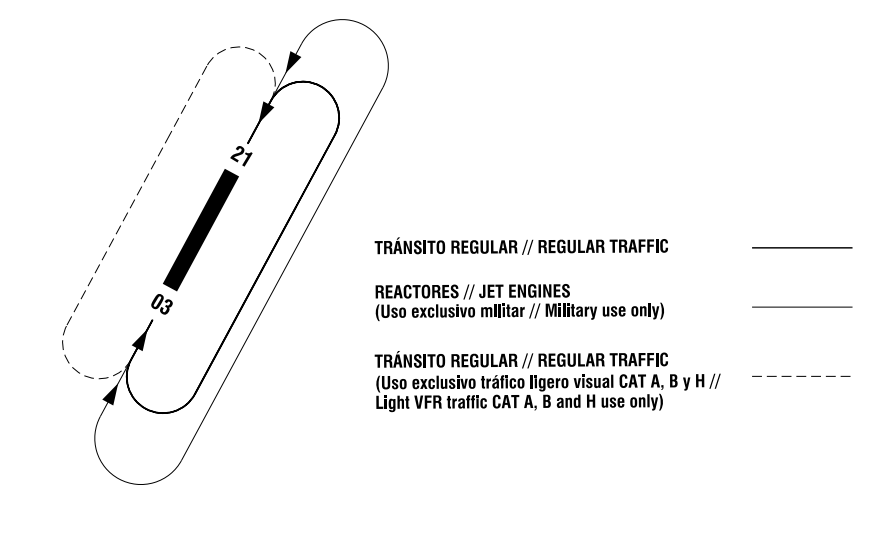
AD TRAFFIC CIRCUIT
ADDITIONAL INFORMATION
BIRD CONCENTRATION AREAS
Pigeon concentration in the vicinity of the aerodrome; pilots must proceed with caution while landing/taking-off.
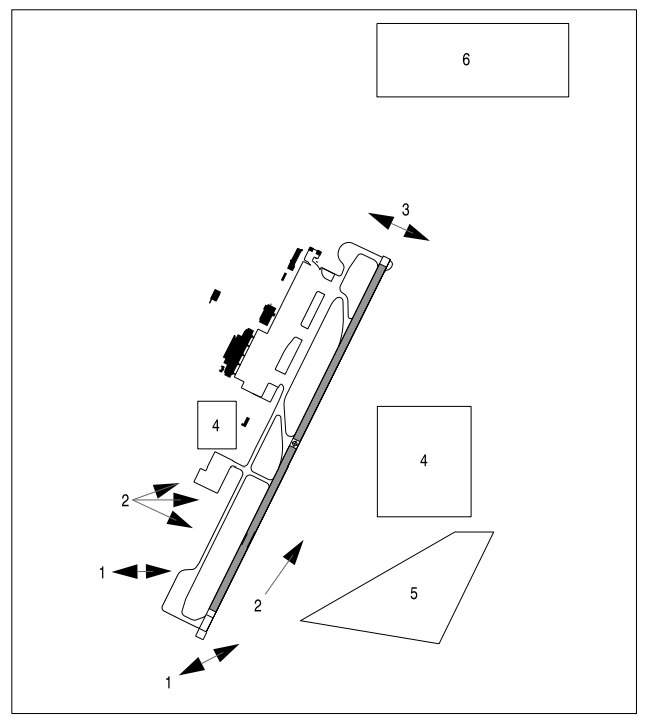
- Area 1: crossing of seagulls at sunrise and sunset. The number is greater in winter due to the migration of the lesser black-backed gull in that season.
- Area 2: crossing of homing pigeons due to pigeon breeding releases. Significant crossing months are November-December and February, March and April.
- Area 3: crossing of cattle egrets at sunrise and sunset.
- Area 4: overflying and hunting area of kestrels, woodchat shrike, cattle egrets, hoopoe and exceptionally stone curlew.
- Area 5: coastal area, crossing of egrets, seagulls, terns, grey herons and infrequently common spoonbills.
- Zone 6: Zonzamas Environmental Complex (island landfill). Major concentration of gulls, herons and small birds of prey (THR 21).
ARRESTING SYSTEMS
Nomenclature: GCRR-01-C-B.
Type: CABLE BARRIER BIDIRECTIONAL. (1)
Location on:
- RWY 03 THR + 465 m.
- RWY 21 THR + 1845 m. Readiness status: Only for military aircraft. System normally retracted.
Available for:
Scheduled flights 10-minute delay from declaring the emergency on BOC (Air Base Operations Centre) frequencies.
Non-scheduled flight:
- From 0730 LT to 1400 LT, will have the same delay from declaring emergency in BOC (Air Base Operations Center) frequencies.
- After this period, the delay is 1 hour.
Remarks: (1) Vertical markings on both sides of the RWY, at the braking system location point.
INSET LIGHTS
At a distance of 318 m from DTHR 03 there exists a section of 285 m of inset runway centre line lights (full-flush type) which may be completely or partially INVISIBLE (dark area) during approach operations or while taxiing, from distances of around 100 m or more away: take extreme care.
AERONAUTICAL CHARTS RELATED TO AN AERODROMECHARTS RELATED TO THE AERODROME
The list of charts related to the aerodrome can be found on the link below:
VISUAL SEGMENT SURFACE (VSS) PENETRATION
The instrument approach procedures affected can be found below:
- IAC 1 ILS Z RWY 03: Direct approach.
- IAC 2 RNP Z RWY 03 (LPV ONLY): LPV.
- IAC 3 RNP Y RWY 03: LNAV, LNAV/VNAV.
- IAC 4 LOC Z RWY 03: Direct approach.
- IAC 5 VOR Z RWY 03: Direct approach.
- IAC 6 VOR Y RWY 03: Direct approach.