LEMH AD 2 AERODROME DATA
AERODROME LOCATION INDICATOR AND - NAME
LEMH -MENORCA
AERODROME GEOGRAPHICAL AND ADMINISTRATIVE DATA
ARP |
395145N 0041307E. See AD 2-LEMH ADC. |
|
Distance and direction from the city |
4.5 km SW. |
|
Elevation |
92 m/303 ft. |
|
Geoid undulation |
48.19 m ± 0.05 m (1). |
|
Reference temperature |
29°C. |
|
Low average temperature |
10ºC. |
|
Magnetic variation |
2ºE (2020). |
|
Annual change |
6.9'E. |
|
AD administration |
Aena. |
|
Address |
Aeropuerto de Menorca; 07712 Mahón (Menorca). |
|
TEL |
+34-971 157 000 |
|
| FAX | +34-971 157 070 | |
AFTN |
LEMH |
|
Approved traffic |
IFR/VFR. |
|
Remarks |
(1) For all AD points. |
OPERATIONAL HOURS
Airport |
V: 0500-2230; PS 25 MIN PPR. I: 0600-2100; PS 45 MIN PPR. |
|
Customs and Immigration |
HR AD. |
|
Health and Sanitation |
No. |
|
AIS |
H24 (1) |
|
| ARO | HR AD (2) | |
MET briefing |
HR AD PS 1 HR BFR. |
|
ATS |
V: 0445-2250, I: 0545-2120. In the event of activation of PPR: V: 0445-2315, I: 0545-2205. |
|
Fuelling |
HR AD. |
|
Handling |
HR AD. |
|
Security |
HR AD. |
|
De-icing |
No. |
|
Remarks |
Airport hours of activity: V: 0445-2250, I: 0545-2120. In the event of activation of PPR: V: 0445-2315, I: 0545-2205. (1) Centralised AIO Office - International NOTAM Office.
(2) ARO service provided from the Operations Office of the airport. |
HANDLING SERVICES AND FACILITIES
Cargo facilities |
Up to 150 kg per package. Up to 250 kg PPR. |
|
Fuel types |
JET A-1, 100LL. |
|
Oil types |
Aeroshell W100, Mobil OIL, Aerored BAN. |
|
Refuelling capacity |
JET A1:
100LL: 1 tank 3000 L, 2.5 L/s. |
|
De-Icing facilities |
No. |
|
Hangar space |
Yes, ACFT MAX SPAN 20 m. |
|
Repair facilities |
No.
|
|
Remarks |
Use of a ground handling agent is mandatory for all operations, non-commercial operations included, except hospital, SAR, emergency and State flights. On arrival operations, passengers and crew must wait for their ground handling agent. Commercial Aviation handling agents:
Ramp agents may attend Commercial as well as General Aviation. General Aviation handling agents:
|
PASSENGER FACILITIES
Hotels |
No. |
|
Restaurant |
Yes. |
|
Transportation |
Taxis, buses and hire cars. |
|
Medical facilities |
First aid. (1) |
|
Bank/Post Office |
No. |
|
Tourist information |
Yes. |
|
Remarks |
(1) Limited hours. |
RESCUE AND FIREFIGHTING SERVICES
Fire category |
1 APR to 31 OCT: 8. |
|
Rescue equipment |
In accordance with the fire category published. Types and quantities of extinguishers normally available:
|
|
Removal of disabled aircraft |
All aircraft operating at the Airport shall guarantee compliance with the “Disabled Aircraft Transfer Plan Procedure” of Menorca airport. Equipment capacities available through the Airport:
External Equipment: Cranes with different maximum capacities from 35 Tm to 500 Tm, platforms, truck cranes and vehicle carriers (2). Local contact details for disabled aircraft transfer operations: Operations Centre (CEOPS):
|
|
Remarks |
(1) 8 on demand (in accordance with the procedure for requesting rescue and fire fighting protection on demand). (2) Equipment and response times subject to availability of external suppliers. |
RUNWAY SURFACE CONDITION ASSESSMENT AND REPORTING, AND SNOW PLAN
Types of clearing equipment |
Not applicable. |
|
Clearance priorities |
Not applicable. |
|
Use of material for movement area surface treatment |
Not applicable. |
|
Specially prepared winter runways |
Not applicable. |
|
Remarks |
Runway surface condition assessment and reporting in accordance with the Global Reporting Format (GRF) methodology described in AD 1.2.2. Aerodrome in service during all seasons of the year. |
APRONS, TAXIWAYS AND CHECK LOCATIONS/POSITIONS DATAMOVEMENT AREA DETAILS
Apron |
Surface: Concrete. Strength: GATE D: PCN 97/F/B/W/T.
|
|
Taxiways |
Width: 23 m, EXC: C and F: 28 m; T: 45 m. Surface: Asphalt. Strength: A1: PCN 63/F/B/W/T. A2 and F: PCN 144/F/A/W/T. C: PCN 45/F/B/W/T. D: PCN 80/F/A/W/T. E: PCN 96/F/A/W/T. J: PCN 56/F/A/W/T. NL and NR: PCN 101/F/A/W/T. T BTN J and NL: PCN 56/F/A/W/T. T BTN A1 and F: PCN 63/F/B/W/T. |
|
Check locations |
Altimeter: Apron ELEV 85 m/279 ft VOR: No. INS: See AD 2-LEMH PDC. |
|
Remarks |
None. |
SURFACE MOVEMENT GUIDANCE AND CONTROL SYSTEM AND MARKINGSTAXIING GUIDANCE SYSTEM AND MARKINGS
Taxiing guidance system |
NO-ENTRY board, mandatory instructions signs, lighted location indicator, visual docking guidance system, runway-holding position, stop bars, stands and pre-threshold area |
|
RWY markings |
Designators, threshold, displaced threshold, centre line, side stripe, aiming point and touchdown zone. |
|
TWY markings |
Centre line, side stripe and border reflective markers. |
|
Remarks |
None. |
AERODROME OBSTACLES
Obstacles in Approach, Take-Off Climb, Conical, Inner Horizontal, Transitional, Inner Transitional and Balked Landing Surfaces established in ICAO Annex 14; and the areas 2A and 3 established in ICAO Annex 15. Those penetrating these surfaces are identified in the CSV file as “Relevante_Relevant = Si/Yes”. |
See Item 10 and Data Set. |
|
Remarks |
See AD 2-LEMH AOC. |
METEOROLOGICAL INFORMATION PROVIDEDMETEOROLOGICAL SERVICE PROVIDED
MET office |
Menorca EMAe. |
|
HR |
HR AD PS 1 HR BFR. Outside this schedule, a half-hourly METAR AUTO will be issued. |
|
METAR |
Half-hourly |
|
TAF |
24 HR. |
|
TREND |
No. |
|
Briefing |
In person and by telephone. |
|
Flight documentation/Language |
Charts and plain language / Spanish. |
|
Charts |
Significant forecast and wind and temperature in altitude maps. |
|
Supplementary equipment |
Lightning and clouds image and radar information display. |
|
ATS unit served |
TWR, APP. |
|
Additional information |
Valencia OMAe (LEVA): H24
Menorca EMAe: |
|
Remarks |
Aerodrome climatological summary available. Aerodrome warnings. |
RUNWAY PHYSICAL CHARACTERISTICS
RWY |
Direction |
DIM (m) |
THR PSN |
THR ELEV TDZ ELEV |
SWY (m) |
CWY (m) |
Strip (m) |
OFZ |
RESA (m) |
RWY/SWY SFC PCN |
|---|---|---|---|---|---|---|---|---|---|---|
01 (1) |
009.00° GEO |
2550 x 45 |
395104.55N |
THR: 84.8 m / 278 ft |
No |
75 x 150 |
2510 x 300 (3) |
No |
240 x 150 |
RWY: ASPH |
19 (2) |
189.00° GEO |
2550 x 45 |
395219.81N |
THR: 91.0 m / 298 ft |
No |
75 x 150 |
2710 x 300 (3) |
No |
90 x 150 |
RWY: ASPH |
(1) The last 200 m of RWY 01 are not usable for take-off and landing. RWY 01 end coordinates: 395226.22N 0041315.57E. (2) THR RWY 19 displaced 200 m. (3) Grass soil. |
||||||||||
Profile
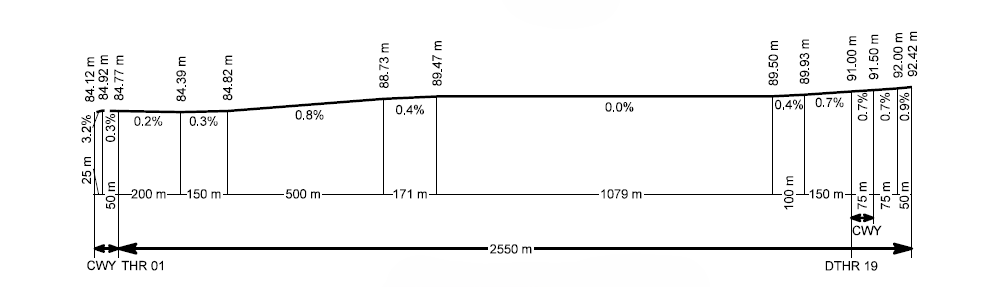
DECLARED DISTANCES
RWY |
TORA (m) |
TODA (m) |
ASDA (m) |
LDA (m) |
|---|---|---|---|---|
01 |
2350 (1) |
2425 (1) |
2350 (1) |
2350 (1) |
19 |
2550 |
2625 |
2550 |
2350 |
Remarks: (1) This is because the last 200 m are not available for take-off and landing. |
||||
APPROACH AND RUNWAY LIGHTING
Runway |
01 |
|
Approach |
Precision CAT I, 900 m. LIH (1). Threshold identification lights. |
|
PAPI (MEHT) |
3° (16.79 m/55 ft). (2) |
|
Threshold |
Green with wing bars. |
|
Touchdown zone |
No. |
|
Runway centre line |
2550 m: 1650 m white + 600 m white and red + 300 m red. LIH. (3) Distance between lights: 15 m. |
|
Runway edge |
2550 m: 1950 m white + 600 m yellow. LIH.(3) Distance between lights: 50 m. |
|
Runway end: |
Red. | |
Stopway: |
No. | |
Remarks: |
(1) LED ligthing. (2) PAPI is not suitable for use by aircraft A333, A340 and B747. (3) The last 200 m are not usable for take-off and landing. Rapid exit taxiway indicator lights. |
Runway |
19 | |
Approach |
Precision CAT I, 900 m. LIH. Threshold identification lights. | |
PAPI (MEHT) |
3° (18.59 m / 61 ft). (1) | |
Threshold |
Green with wing bars. | |
Touchdown zone |
No. | |
Runway centre line |
2550 m: 200 m without lights + 1450 m white + 600 m white and red + 300 m red. LIH. Distance between lights: 15 m. |
|
Runway edge |
2550 m: 200 m red + 1750 m white + 600 m yellow. LIH. Distance between lights: 50 m. |
|
Runway end |
Red. | |
Stopway |
No. | |
Remarks |
Rapid exit taxiway indicator lights. (1) PAPI is not suitable for use by aircraft B747. |
OTHER LIGHTING, SECONDARY POWER SUPPLY
ABN/IBN |
No. |
|
WDI |
1 near THR 01, 1 near THR 19, 1 near ARP. LGTD. |
|
TWY lighting |
Centre line, except aircraft stand taxilanes on apron. |
|
Apron lighting |
Floodlighting poles, edge (reflective markers). |
|
Secondary power supply |
Engine generators that provide a maximum switch-over (light) time of 15 seconds for all the lighting systems and uninterrupted power supply systems that provide a maximum switch-over (light) time of 1 second for all critical lighting systems. |
|
Remarks |
None. |
HELICOPTER LANDING AREA
Position |
FATO: RWY 01/19. See item 12. |
|
Elevation |
See item 12. |
|
Dimensions, surface, maximum weight, marking |
FATO: RWY 01/19: See item 12. Ground taxiing: Taxiways: See item 8. Stand: Apron: See PDC 1. Type of surface: See items 8 and 12. Strength: See items 8 and 12. Marking: See item 9. |
|
Direction |
See item 12. |
|
Declared distances |
See item 13. |
|
Lighting |
See item 14. |
|
Remarks |
None. |
AIR TRAFFIC SERVICES AIRSPACE ATS AIRSPACE
Designation |
CTR MENORCA (RMZ (1)). |
|
Lateral limits |
400211.7N 0041738.9E; 400111.6N 0041725.9E; from this point following a 10.0 NM radius arc centred on ARP LEMH up to 394627.8N 0042408.4E; 394523.9N 0042620.2E; from this point following a 12.0 NM radius arc centred on ARP LEMH up to 394151.1N 0040418.4E; 394558.5N 0040758.2E; from this point following a 7.0 NM radius arc centred on ARP LEMH up to 395821.4N 0041005.1E; 400219.6N 0040908.1E; from this point following a 11.0 NM radius arc centred on ARP LEMH up to 400211.7N 0041738.9E. |
|
Vertical limits |
SFC-6000 ft AMSL. |
|
Airspace class |
D. |
|
Unit Language |
MENORCA TWR. ES/EN. |
|
Transition altitude |
1850 m/6000 ft. |
|
Hours of applicability |
- |
|
Remarks |
(1) During periods outside the published ATS schedule, the airspace will become class G (RMZ), there will be no responsible unit and Spanish language shall be used. |
Designation |
ATZ MENORCA (RMZ (1)). |
|
Lateral limits |
Circle radius 8 km centred on ARP (2). |
|
Vertical limits Airspace class |
SFC-1000 ft AGL (3)...D. 1000 ft AGL - 3000 ft AGL (3)...A. |
|
Unit Language |
MENORCA TWR. ES/EN. |
|
Transition altitude |
- |
|
Hours of applicability |
- |
|
Remarks |
(1) During periods outside the published ATS schedule, the airspace will become class G (RMZ), there will be no responsible unit and Spanish language shall be used. (2) Or the ground visibility, whichever is lower. (3) Or up to the clouds ceiling, whichever is lower. |
AIR TRAFFIC SERVICES COMMUNICATION FACILITIESATS COMMUNICATION FACILITIES
Service |
Call sign |
FREQ |
HR |
Remarks |
|---|---|---|---|---|
APP |
Menorca APP |
119.655 C |
HR ATS |
APP/L |
TWR |
Menorca TWR |
118.205 C |
HR ATS |
BACK UP |
119.655 C |
HR ATS |
- |
||
121.500 MHz |
HR ATS |
EMERG |
||
121.755 C |
HR ATS |
GMC |
||
257.800 MHz |
HR ATS |
MIL |
||
243.000 MHz |
HR ATS |
EMERG |
||
ATIS |
Menorca Information |
129.155 C |
HR ATS |
- |
D-ATIS |
Menorca Information |
NIL |
HR ATS |
Provision of ATIS information via data link. |
Information |
Palma CONTROL |
128.350 MHz |
Out HR ATS |
Flight information on request. |
No |
No |
119.655 C |
Out HR ATS (1) |
Only air-air communications. |
| Remarks: (1) Outside ATS hours, aircrews shall operate in accordance with the provisions of ENR 1.4 RMZ, on the air-air frequency 119.655 C and in Spanish. | ||||
RADIO NAVIGATION AND LANDING AIDSRADIO NAVIGATION & LANDING FACILITIES
Facility (VAR) |
ID |
FREQ |
HR |
Coordinates |
DME ELEV |
Remarks |
|---|---|---|---|---|---|---|
DVOR (2ºE) |
MHN |
112.600 MHz |
H24 |
395149.0N 0041258.7E |
- |
- |
DME |
MHN |
CH 73X |
H24 |
395149.1N 0041258.1E |
90 m |
- |
NDB (2ºE) |
MN |
344.000 kHz |
H24 |
395011.3N 0041247.8E |
- |
COV 60 NM. |
LOC 01 (2ºE) |
IMH |
110.300 MHz |
H24 |
395240.2N 0041318.4E |
- |
007° MAG/ 638 m FM THR 19. |
GP 01 |
- |
335.000 MHz |
H24 |
395115.2N 0041255.8E |
- |
3°; RDH 15.85 m; at 314 m FM THR 01 & 120 m FM RCL to the left on APCH direction. FM 10 NM full FLY-UP indications may not be received BLW GP beyond 4º left of RCL. |
ILS/DME 01 |
IMH |
CH 40X |
H24 |
395115.2N 0041255.8E |
87 m |
REF DME THR 01. |
LOC 19 (2ºE) |
MAO |
111.500 MHz |
H24 |
395059.1N 0041257.6E |
- |
187º MAG / 171 m FM THR 01. COV 25 NM. |
GP 19 |
- |
332.900 MHz |
H24 |
395209.3N 0041307.6E |
- |
3º; RDH 15.1 m; at 343 m FM THR 19 & 106 m FM RCL to the right on APCH direction. |
ILS/DME 19 |
MAO |
CH 52X |
H24 |
395209.3N 0041307.6E |
93 m |
REF DME THR 19. |
LOCAL AERODROME REGULATIONSLOCAL REGULATIONS
The tower may clear, in accordance with the "Reglamento de Circulación Aérea" (Air Traffic Regulations), local, test or instruction flights with a VFR flight plan provided they have an appropriate authorisation from the aerodrome authority.
Tower may clear aircraft with a VFR flight plan and having two way radio, to depart or enter the TMA and CTR via the VFR corridors and sectors specially established for this purpose (see AD 2-LEMH VAC 1.1).
RWY 19 has a single runway-holding position designated as T1 and located on the TWY T.
Aircraft that carry out operations under IFR flight rules for urgent medical assistance outside the published ATS schedule have priority over the operation of any other aircraft, unless safety reasons dictate otherwise.
OPERATION OF CODE LETTER E-IV AIRCRAFT
GENERAL
The risk analyses carried out have accredited that Menorca airport can offer sufficient guarantees of the level of operational safety required for the operation of code letter E-IV aircraft. For code letter E-IV aircraft operations, the Air Carrier or Handling Agent must place the request in advance as well as obtain explicit clearance from the Airport Operations Centre.
OPERATIONAL PROCEDURES
- Arrivals: Vacate the runway via TWY F or NL (RWY 01 in use), or via TWY C or A1 (RWY 19 in use). Taxi via TWY T to access the apron by GATE D.
- Departures: After push-back nosing towards the South, the aircraft shall exit the apron by GATE D and taxi via TWY T up to the corresponding holding position, A1 (RWY 01 in use) or T1 (RWY 19 in use). Subsequently, and once cleared by ATC, it will access the runway via A1 (RWY 01 in use) or via NL (RWY 19 in use).
- Parking: This type of aircraft will use PRKG 23.
RESTRICTIONS
- These aircraft shall taxi at low speed, with engines idling, and whenever possible and in the case of four-engine aircraft, with the external engines turned off.
- On the apron, guidance will always be provided to these aircraft.
- When a code letter E-IV aircraft, of wingspan greater than 60.3 m, is using or is going to use PRKG 23, PRKG 14, 16 and 21 shall be unavailable.
- As there is less than 4.5 m between the outer main gear wheel of code letter E-IV aircraft and the edge of the taxiway, this aircraft type should oversteer as far as possible when manoeuvring in the following zones:
- Turns to exit runway:
- RWY 19 to TWY: A1, D and E.
- RWY 01 to TWY: D, E and NL.
- Turns to enter runway:
- NL to RWY 19.
- Turns on taxiway until apron GATE D:
- C to T.
- E to T.
- T to GATE D (from both directions of T).
- Turns from apron GATE D to taxiway:
- GATE D to T (to both directions of T).
- T to A1.
- T to NL.
- Turns to exit runway:
SIMULTANEOUS PRESENCE OF TWO CODE LETTER E-IV AIRCRAFT
- PRKG 14, 16 and 19 shall be out of service and the largest aircraft permitted at the PRKG 12 shall be limited to a B738.
- PRKG 21 shall be assigned to the aircraft of lower wingspan.
- The "FOLLOW ME" vehicle will provide guidance to aircraft to be parked at PRKG 23, 21 and 12.
STANDARD TAXIING PROCEDURES
TAXIING PROCEDURE ON APRON
- Pilots shall report the stand number when they request start-up.
- Collision avoidance with other aircraft or obstacles is the responsibility of:
-
pilots when taxiing on the apron;
- the ground handling companies during push-back manoeuvres.
- Unless ATC advises otherwise:
-
With RWY 01 in use, aircraft shall enter the apron by GATES E or J and vacate by GATE D.
- With RWY 19 in use, aircraft shall enter the apron by GATES D or E and vacate by GATE J.
- Aircraft must be ready for towed push-back or taxiing within the next 5 minutes from the approved start-up time; pilots shall contact ATC if otherwise.
- Unless ATC advises otherwise, push-back manoeuvres shall be carried out nosing to:
-
the North with RWY 19 in use,
-
the South with RWY 01 in use.
With the exception of PRKG 21 and 23, where nosing should always be towards the South and in PRKG 01, where nosing should always be towards the North.
- ATC clearances and instructions must be read back.
- Guidance service by means of a "FOLLOW ME" vehicle shall only be provided to the General Aviation stands and to those whose visual docking guidance system is U/S. Guidance service shall also be provided both by request of TWR and by request of the pilot, or in exceptional cases by LVP in force. TWR shall provide the stand number to the pilot of the aircraft.
- Maximum power is limited to the maximum idle speed during entry/exit manoeuvres from the stand and taxiing on the apron.
EXCHANGE OF DATA WITH NMOC – ADVANCED ATC TWR
The airport of Menorca exchanges information for departure flights by applying the Advanced ATC TWR procedures. Message exchanges from the local system to the ATM network uses the European standard for A-CDM airports, using the following message types:
- A-DPI: for all instrumental departure flights.
- C-DPI: when required.
When start-up approval has been announced and the aircraft starts to exit the stand, the target take-off time (TTOT) is calculated and transmitted to NMOC (Network Manager Operations Center) via an A-DPI message. The use of the actual off-block time (AOBT) instead of the EOBT of the flight plan, along with the variable taxiing time, increases the precision of the take-off time.
After reception of the A-DPI, DLA or CHG messages that change the flight plan data shall not be accepted. If regulated, the CTOT assigned before receiving the A-DPI shall be maintained.
If an aircraft has to abort taxiing for technical reasons, the airport shall send a C-DPI message to the NMOC (cancellation message of departure flight planning information). The result of the C-DPI is that the flight plan shall be suspended by informing the operator via an FLS message with the comment "Suspended by Departure airport". The flight plan can be activated again by updating the EOBT with a DLA or CHG message.
SIMULTANEOUS CAPACITY RESTRICTIONS IN RUNWAY-HOLDING POSITIONS A1 AND A2
| TWY | A1 | A2 |
| Wingspan | >40 m | U/S |
| <=40 m | <40 m | |
| Length | >54.5 m | U/S |
TAXIING RESTRICTIONS
Aircraft classification according to chapter 1 of annex 14 ICAO:
- Code letter F: Wingspan from 65 m up to but not including 80 m.
- Code letter E: Wingspan from 52 m up to but not including 65 m.
- Code letter D: Wingspan from 36 m up to but not including 52 m.
- Code letter C: Wingspan from 24 m up to but not including 36 m.
- Code letter B or below: Wingspan up to but not including 24 m.
| TWY | MAX ACFT |
| A1 | D-IV (1) |
| A2 | D-IV (1) |
| C | D-IV (1) |
| D | D-IV (1) |
| E | D-IV (1) |
| F | D-IV (1) |
| J | D-IV (1) |
| T | D-IV (1) |
| NR | C-IV |
| NL | D-IV (1) |
| (1) Permitted for Code letter E-IV aircraft according to the operating procedure for aircraft exceeding certified design characteristics. | |
RESTRICTIONS TO STANDS
The commercial aviation apron is limited to aircraft with a wingspan maximum 52 m, except in the following cases:
-
Code letter E-IV aircraft will enter and leave the apron through GATE D and will use PRKG 23. Also, if the wingspan is greater than 60.3 m, PRKG 14, 16 and 21 (see AD 2-LEMH PDC) may not be used.
GENERAL AND BUSINESS AVIATION
It is mandatory for all General and Business aviation operations to require the services of a ground handling agent.
OPERATION OF HELICOPTERS
GENERAL
The procedure only affects operations by all helicopters that do not have a letter of exemption in the terms set forth in SERA Article 4 and RD 552/14, Chapter VIII.
All helicopters shall conduct approaches and take-offs in the same way as fixed-wing aircraft. In these cases, helicopters approach RWY 01 or 19 (depending on weather conditions), as the FATO defined coincides with this runway.
In cases of helicopters with wheel gear, these touch down on the runway itself, because a TLOF has been declared that coincides with the FATO. Once on the ground, they taxi up to the stand in accordance with the present procedure. In cases of helicopters with skis, the aircraft approach the FATO and, once hovering, they carry out air taxiing up to the stand in accordance with the present procedure. For departure operations, they operate the same way.
At Menorca airport, air movement routes are not enabled.
DESCRIPTION OF TAXIING PROCEDURE
At Menorca airport, as no specific zone for this is defined, those helicopters whose operators do not hold a letter of exemption must be treated as fixed-wing aircraft, and will be cleared by ATC to take-off or land on the flight runway.
Taxiing shall be carried out via the taxiways which are also allocated for use by fixed-wing aircraft, and this may be air or ground taxiing, depending on the type of helicopter.
Unless ATC should indicate otherwise, helicopters will vacate RWY 01/19 via TWY D and enter the apron by GATE D. Exit, unless instructions to the contrary are received from ATC, shall be by GATE D, taxiing via TWY T up to the holding position of the runway in service.
LIMITATIONS ON TAXIING
Any helicopter may make use of any of the taxiways indicated above, irrespective of whether it taxis by air or ground, always provided that it complies with the widths of the taxiing routes defined, as well as the dimensions of the assigned stand and its safety zone.
All helicopters shall be guided by a "FOLLOW ME" vehicle from their entry to the apron up to the stand.
OPERATIONAL SAFETY REPORTS
Pilots/operator shall report to the airport as soon as possible about any accidents, incidents, occurrences or events which may have a potential operational impact and in which they have been involved or witnessed.
The aim of these reports is the compilation of the information in order to improve operational safety, independently of the compulsory report of the occurrence to the appropriate aeronautical authority. Data may be sent in any format, including at least the following information:
- Date and time.
- Site.
- Parties involved (data used to identify vehicles, aircraft… involved).
- Companies implicated.
- Description of the facts.
- Any other data considered relevant (e.g. lighting conditions, weather, phase of the operation such as takeoff/landing/stopover, pavement conditions…).
Contact e-mail address of the airport, for the reception of operational safety reports, is the following: mah.seguridadoperacional@aena.es
In addition to notifying the airport by means of the indicated system, it is necessary to send at least basic data of the accident, incident, occurrence or event to the air traffic control service provider (ATC).
On the specific instance of safety reports related with the air traffic control service provider (manoeuvring area, flight phases and ATS airspace) these may be sent to the e-mail address: lecp.safety@enaire.es
PROCEDURE FOR REQUESTING RESCUE AND FIRE FIGHTING PROTECTION ON DEMAND FROM 1 NOVEMBER TO 31 MARCH
Any operator who wishes to operate at Menorca airport with category higher than 7, from 1 November to 31 March, will have to request this from the airport at least 3 days in advance of the scheduled date of arrival, by e-mail to: mah.ejecutivos@aena.es
facilitating the following information:
- Request for operation with an aircraft of category higher than 7.
- Programmed aircraft model.
- Scheduled date and time of arrival.
- Scheduled date and time of departure.
- Handling agent engaged at the airport.
URGENT MEDICAL ASSISTANCE FLIGHTS OUTSIDE ATS HOURS
Operations under instrument flight rules (IFR) for urgent medical assistance are permitted, including the transfer of organs for transplant, when immediate and fast transport is required outside the ATS schedule published by Menorca airport and they shall be carried out as per the procedures of this section.
Companies that need to carry out this procedure should apply for the corresponding clearance from the Management of Menorca airport.
ARRIVING AIRCRAFT
The crew shall notify PALMA TACC about any variation in the ETA that is equal to or more than three minutes.
The crew shall notify PALMA TACC about the runway they want to use for landing. They shall also report the instrument approach procedure they wish to use, according to the radio aids available, which include the following:
- MENORCA VOR RWY 01 (AD 2-LEMH IAC/5);
- MENORCA VOR RWY 19 (AD 2-LEMH IAC/11) (1);
- MENORCA ILS Z or Y RWY 01 (AD 2-LEMH IAC/1 or 2);
- MENORCA ILS Z or Y RWY 19 (AD 2-LEMH IAC/7 or 8) (2).
(1) The south-east portion of the primary protection area for the missed approach section of this manoeuvre defined by timing, is not within the airspace assigned to Menorca airport outside the operational hours of LEMH TWR.
(2) The south-east portion of the primary protection area for the missed approach section of these manoeuvres, is not within the airspace assigned to Menorca airport outside the operational hours of LEMH-TWR.
PALMA TACC shall clear the urgent medical assistance flight for the STAR leading to the IAF of the selected instrument procedure. It shall also indicate the time when the aerodrome is ready to receive the operation.
After, and only after, receiving confirmation that the airport is ready and that the Control Service has terminated, the crew shall inform PALMA TACC of the time of commencement of the selected instrument approach, and at that moment they shall receive the frequency change message from PALMA TACC.
The crew shall notify Menorca airport of the termination of the flight.
In the event of a missed approach manoeuvre, the crew shall report this on the air-air frequency 119.655 C; and shall then contact PALMA TACC or Menorca airport as soon as possible to report intentions.
DEPARTING AIRCRAFT
The crew shall contact Menorca airport before starting up engines.
The crew shall inform the aerodrome about the selected runway and SID from the ones available for departures, along with the ETD.
The SID available for this procedure are:
- MENORCA RWY 01 MAMEB1C (AD 2-LEMH SID 1.1); or
- MENORCA RWY 19 MAMEB1D (AD 2-LEMH SID 2.1).
- The note in this aeronautical information publication referring to the fact that the SID via MAMEB "only available for traffic with destination Palma de Mallorca AD", is not applicable to this procedure.
Exclusively in those cases where DVOR/DME MHN is out of service, the crew may choose one of the Contingency Departures published in AD 2-LEMH SID 1.4 (RWY 01) with a minimum gradient of 9.0% until they clear 6000 ft, or AD 2-LEMH SID 2.4 (RWY 19) with a minimum gradient of 11.1% until they clear 6000 ft.
In the event they cannot comply with the gradients indicated, they shall notify Palma ACC to receive instructions; if communication is not possible, they shall circle over the AD, climbing to the altitude cleared.
LECP will provide radar assistance when the aircraft reaches 6000 ft.
The crew shall request clearance for entry into controlled airspace from PALMA TACC, which message shall state the point from which the Control Service commences, the level, pass time and SSR discrete code.
Once the take-off operation is completed, the crew shall contact PALMA TACC with sufficient notice prior to the entry into the airspace from where the Control Service shall be provided.
If the crew decides to abort the take-off operation, it shall report this on the air-air frequency 119.655 C, and shall then contact Menorca airport or PALMA TACC to communicate intentions.
If the crew decides to return to the aerodrome before entering controlled airspace, it shall report this on 119.655 C, and shall then contact PALMA TACC or the aerodrome to communicate intentions.
TAXIING PROCEDURE
- Arrivals
After completing landing, the crew shall communicate its intentions on the air-air frequency 119.655 C in Spanish until it reaches the assigned stand, and shall report this to the airport.
If it has landed on RWY 01, the aircraft shall leave the runway and taxi via TWY T to GATE D where it shall enter the apron and be directed to the general aviation apron where it shall park.
If it has landed on RWY 19, the aircraft shall leave the runway and taxi via TWY T to GATE D where it shall enter the apron and be directed to the general aviation apron where it shall park.
- Departures
The crew shall only start to taxi after receiving clearance from PALMA TACC to enter controlled airspace. This shall be carried out correctly to comply with said clearance, and if a delay of more than three minutes in compliance is forecast, a new clearance shall be requested prior to taxiing.
Before starting to taxi and during the entire movement in the manoeuvring area, the crew shall transmit their intentions on the air-air frequency 119.655 C in Spanish.
To use RWY 01, the aircraft shall leave the apron via GATE D, and taxi via TWY T to A1.
To use RWY 19, the aircraft shall leave the apron via GATE D, and taxi via TWY T to T1.
RADIO FAILURE PROCEDURE
In the event of a radio failure, the crew shall attempt to communicate by telephone: For arrivals, first with the aerodrome and alternately with PALMA TACC; for departures, first with PALMA TACC and alternately with the aerodrome. In the event that all communication is impossible, the procedures of the Reglamento de la Circulación Aérea and those published in AIP Spain shall be followed.
PROCEDURE FOR STANDSTILL OF OPERATIONS
- Arrivals
When the RVR is less than or the same as 600 m, Menorca airport shall paralyse operations. The crew may not initiate the assigned instrument approach to the aerodrome.
- Departures
When the RVR is less than or the same as 400 m, Menorca airport shall paralyse operations. The crew may not commence taxiing.
TRAINING FLIGHTS
Training flights are prohibited from 01 April to 31 October.
Outside this period, training flights will only be permitted with prior authorisation from the airport authority and will be restricted in accordance with the air traffic, and in conformance with local procedures.
NIGHT VISUAL OPERATIONS (VFR-N)
Night visual operations are authorised.
ENERGY SAVING POLICY
During operational hours and provided there are no aircraft operations planned, Menorca airport applies energy saving procedures that consist of selectively reducing floodlighting on the commercial apron in two defined sectors.
NOISE ABATEMENT PROCEDURES
GENERAL
- The following procedures have been established to avoid excessive noise in the surroundings of Menorca airport.
- These procedures may be omitted for safety reasons.
ENGINE POWER TEST
Following prior clearance, the hours for engine power tests shall be:
-
V: 0500-2100
-
I: 0600-2200
Testing engines higher than idle will take place at runway thresholds, in TWY T before taxi-holding position T1 or in T TWY at the intersection with C, always following TWR guidelines. The test shall be carried out in accordance with the local procedure IT-00045 “Autorización para prueba de motores” (Engine test authorisation).
NOISE ABATEMENT PROCEDURES TAKE-OFF
TAKE-OFF
Modifications to the nominal path of SID's shall not be cleared at least until reaching 3000 ft on the climb.
LANDING
During contact approach operations, and except for light aircraft, descents below 3000 ft shall not be cleared before the aircraft in the circuit final segment is lined up on the runway.
REVERSE POWER
Reverse power other than idle is not allowed, except for safety reasons.
FLIGHT PROCEDURES
LOW VISIBILITY PROCEDURES (LVP)
GENERAL
- The ground low visibility procedures (LVP) shall be applied when:
- The runway visual range (RVR) is below 550 m, or
- In the event of measurement equipment failure, the general visibility in the manoeuvring area is below 800 m.
- The ground low visibility procedures (LVP) shall be cancelled when the meteorological minima, as defined in the preceding point, are greater than 800 m RVR or visibility of 1000 m in the event that the measurement equipment are unavailable.
- Take-offs: RWY 01 and 19, are appropriate for low visibility take-offs under the conditions envisaged.
- Pilots shall be informed that the Low Visibility Procedures are in force by means of the ATIS.
GROUND MOVEMENTS
When the RVR is less than 1500 m, the stop bars protecting the accesses to the runway shall be activated. In addition, when the RVR is equal or less than 1000 m, the appropriate lighting shall be activated.
TWR shall not authorize access of any vehicle to the manoeuvring area, except for those essential to the operation, which are equipped with radiotelephone and are in permanent contact with TWR.
The stop bars will be used to manage the ground movements in the manoeuvring area.
Pilots shall proceed to monitor the aircraft position at all times, and ensure that taxiing takes place in conditions of complete safety.
In the event that a departing aircraft has to return to the apron, the pilot shall inform TWR and await new taxiing instructions.
- Entry to runway
- Entry to RWY 01 may only be performed by TWY A1 via GATE D and TWY T.
- Entry to RWY 19 may only be performed by TWY NL via GATE J and TWY T. Except in the case of code letter E-IV aircraft, which will exit the apron by GATE D and will be guided by a "FOLLOW ME" vehicle up to the holding position T1, the only RWY 19 holding position.
- When the Low Visibility Procedures are activated, ATC shall clear the movement of only one aircraft at a time in the movement area.
- Arrivals
- Aircraft that have landed, on vacating the runway shall report: "Runway vacated".
- On entry to the parking apron, they shall await the presence of the "FOLLOW ME" vehicle to direct them to the assigned stand, reporting to TWR: "Follow me in sight".
- Departures
- TWR shall inform pilots about the application of the Low Visibility Procedure.
- Pilots, on requesting clearance for start-up, shall notify ATC of the stand where they are.
- When the RVR is lower than 185 m, and in the event that the taxiway centre line lights are not operational, it shall be mandatory for aircraft to taxi guided by a "FOLLOW ME" vehicle up to the holding position for runway access.
For take-offs under conditions of low visibility, the following runway-holding positions must be used:
-
RWY 01 - A1 (CAT I)
-
RWY 19 - T1 (CAT I)
ANOMALOUS SITUATIONS IN THE MANOEUVRING AREA
Uncertainty about position in the manoeuvring area
- Other than as provided for in the following paragraph, if a pilot is in doubt about the position of the aircraft in relation to the manoeuvring area, they must immediately halt the aircraft and report this circumstance to ATC (including the last known position).
- In situations in which a pilot is in doubt about the position of the aircraft in relation to the manoeuvring area, but recognises that the aircraft is on a runway, the pilot shall immediately report this to ATC (including the last known position), and vacate the runway as soon as possible, if they can find an appropriate taxiway nearby, unless ATC should indicate otherwise, and then, halt the aircraft.
- In the event of disorientation of a vehicle in the manoeuvring area, this fact shall be communicated to ATC (including the last known position) and, unless other indications are received from ATC, the driver shall exit the manoeuvring area to reach a safe distance as soon as possible, and halt the vehicle.
Loss of visual contact between mobile elements
- In the event that one aircraft loses visual contact with another, or with a vehicle with which it is maintaining its own separation, ATC shall be informed immediately, and the aircraft halted. ATC shall take the measures that it shall deem fit.
Breakdown of aircraft or vehicle
- Aircraft: shall report the situation to ATC and await the arrival of assistance. Should it find itself on a runway, if possible and unless ATC should indicate otherwise, this shall be vacated.
- Vehicle: shall communicate this fact to ATC (including the last known position) and, unless other indications are received from ATC and this is possible, the driver shall exit the manoeuvring area to reach a safe distance as soon as possible, and halt the vehicle. If the vehicle cannot be moved, ATC shall be informed without delay.
Communications failure
In the event that an aircraft or vehicle operating in the manoeuvring area should experience a communications failure, it shall proceed as follows:
- Departing aircraft: the aircraft shall continue by the assigned route and halt at the limit of the ATC clearance, taking extreme care, where it shall hold the position and await the arrival of an assistance vehicle.
- Arriving aircraft: if the aircraft has just landed, it shall hold on vacating the runway and await the arrival of an assistance vehicle.
If the aircraft already has ATC taxiing clearance, it shall continue by the assigned route and halt at the limit of the ATC clearance, taking extreme care, where it shall hold and await the arrival of an assistance vehicle.
- Vehicle: the vehicle shall exit the manoeuvring area if it is inside it, and then halt, remaining in that position, and await the arrival of the assistance vehicle.
ATS SURVEILLANCE SYSTEM
It is used in the provision of the aerodrome control service to perform the following functions:
- supervision of flight path of aircraft on final approach;
- supervision of the flight path of other aircraft in the vicinity of the aerodrome;
- establishment of separation, as defined in the R.C.A., section 4.6.7.3, between successive departing aircraft; and
- provision of navigation assistance to VFR flights.
The provision of function a) within the ATZ below 800 ft AMSL or in the northern half of the ATZ below 1300 ft AMSL, is not guaranteed.
The provision of functions b) and d) within the ATZ below 1300 ft AMSL or in the northern half of the ATZ below 1600 ft AMSL, is not guaranteed.
The provision of function c) in the northern half of the ATZ below 1300 ft AMSL, is likewise not guaranteed.
Depending on the availability of the ATS surveillance systems, the altitude from which the foregoing functions (namely a), b), c) and d)) can be provided may be affected, or they may even be suspended, in which case aircraft will be notified using the means of aeronautical communication available.
In addition, in order to help monitoring air traffic progress, ATS surveillance systems may be used to provide the controller:
-
better position information of aircraft under control;
-
supplementary information about other transit;
-
information about any significant deviation of aircraft from what the corresponding air traffic control clearances may establish, including cleared routes and flight levels where necessary.
SPEED ADJUSTMENT
MAX IAS 250 kt to leave FL100, in all departures.
MAX IAS 250 kt below FL100, in all arrivals.
VISUAL DEPARTURE PROCEDURE FOR IFR FLIGHTS
Under certain circumstances which prevent the use of published SIDs and contingency departures, IFR flights may request ATC a “visual departure” under the following conditions:
-
Between the start of morning civil twilight and the end of evening civil twilight.
-
Weather in the take-off direction and subsequent initial climb permitting visual flight until the MSA, which will be provided by ATC.
-
Once aligned, the pilot shall propose to ATC a heading that ensures a safe departure.
-
The pilot shall be responsible for maintaining the minimum obstacle clearance up to the MSA provided by ATC.
The noise abatement procedures described in AIP LEMH AD-2, Item 21 "Noise Abatement Procedures" which are incompatible will not be applied in these visual departures.
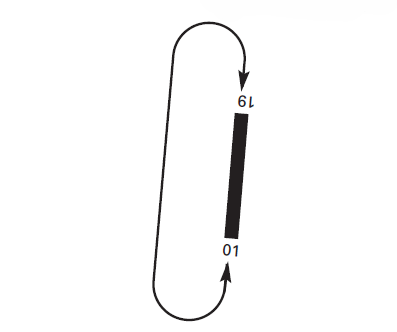
AD TRAFFIC CIRCUIT
ADDITIONAL INFORMATION
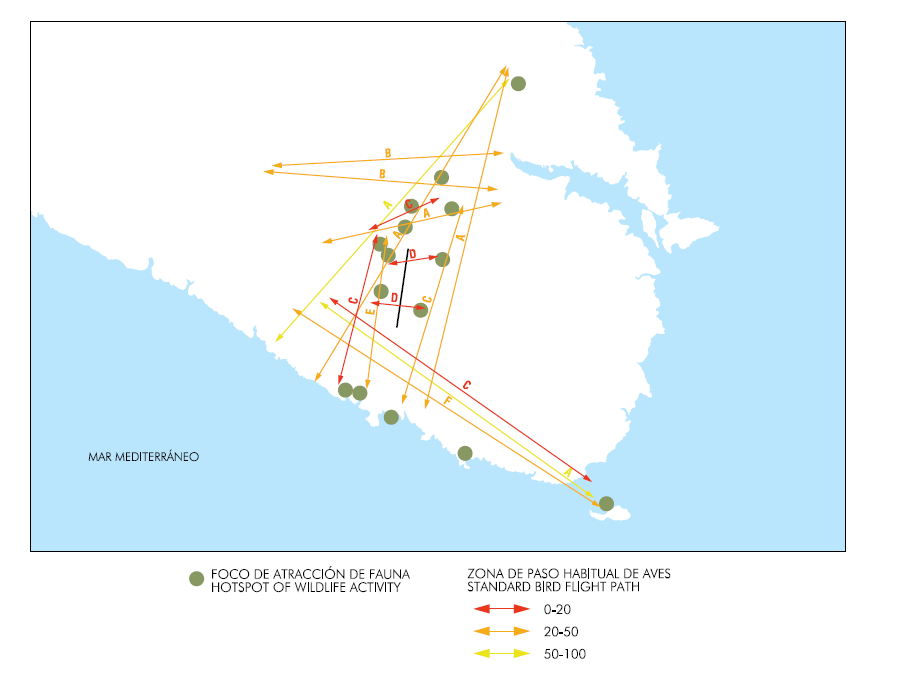
BIRD CONCENTRATION AREAS
AIRPORT SURROUNDINGS FLOWS
ZONE A: YELLOW-LEGGED GULL. Movements crossing the two runway thresholds at a height of 20 to 150 m.
ZONE B: COMMON STARLING. Perpendicular movements and crossing the two runway thresholds at a height of 20 to 50 m.
ZONE C: COMMON PIGEON. Movements at threshold 19 and crossing the runway below a height of 20 m.
ZONE D: COMMON KESTREL. Movements crossing the runway within the airport grounds below a height of 20 m.
ZONE E: WESTERN MARSH HARRIER. Movements in S-N direction parallel to the runway below a height of 20 m.
ZONE F: PEREGRINE FALCON. Movements at threshold 01 at a height of 20 to 50 m.
OTHER BIRDS
RED KITE
- Like the Booted Eagle, they tend to hunt in open spaces, which makes the airport attractive.
SWIFTS AND SWALLOWS
- They come in to feed only during the summer and on migration.
STONE CURLEW
- It does not reside at the airport, but occasionally comes at night, most frequently in spring and summer, although it may appear all year round.
LAPWINGS AND GOLDEN PLOVERS
- They may come in to feed on the strips only during the harshest times of winter.
- They tend to hunt in open spaces, which makes the airport attractive.
BOOTED EAGLE
WIND PHENOMENA
Orographical conditions of the island of Menorca and the airport situation, mean that under certain conditions, it is quite likely that wind shear and turbulence phenomena will appear.
- With winds of North and North-east component, and intensity greater than 10 kt, there is a possibility of encountering wind shear during approach and on runway thresholds.
AERONAUTICAL CHARTS RELATED TO AN AERODROME CHARTS RELATED TO THE AERODROME
The list of charts related to the aerodrome can be found at the following link:
VISUAL SEGMENT SURFACE PENETRATION (VSS)
The instrument approach procedures affected can be found below:
IAC 1 ILS Z RWY 01: Direct approach.
IAC 2 ILS Y RWY 01: Direct approach.
IAC 3 ILS X RWY 01: Direct approach.
IAC 4 LOC Z RWY 01: Direct approach.
IAC 5 LOC Y RWY 01: Direct approach.
IAC 6 VOR RWY 01: Direct approach.
IAC 7 ILS Z RWY 19: Direct approach.
IAC 8 ILS Y RWY 19: Direct approach.
IAC 9 ILS X RWY 19: Direct approach.
IAC 10 LOC Z RWY 19: Direct approach.
IAC 11 LOC Y RWY 19: Direct approach.
IAC 12 VOR RWY 19: Direct approach.