LESB AD 2 AERODROME DATA
AERODROME LOCATION INDICATOR AND - NAME
LESB - MALLORCA/Son Bonet
AERODROME GEOGRAPHICAL AND ADMINISTRATIVE DATA
ARP |
393556N 0024210E. See AD 2-LESB ADC. |
|
Distance and direction from the city |
4 km SW. |
|
Elevation |
47 m / 153 ft. |
|
Geoid undulation |
48.98 m ± 0.03 (1). |
|
Reference temperature |
31ºC. |
|
Low average temperature |
9ºC. |
|
Magnetic variation |
1° E (2020). |
|
Annual change |
7.1’E |
|
AD administration |
Aena. |
|
Address |
Aeropuerto de Son Bonet. 07141 Marratxí. Mallorca. |
|
TEL |
+34-971 449 861 |
|
| FAX | +34-971 449 862 | |
AFTN |
LESB |
|
Approved traffic |
VFR. (2) |
|
Remarks |
(1) For all AD points. (2) FPMZ aerodrome. See item 20 (Local regulations). |
OPERATIONAL HOURS
Airport |
V: 0615-1645; PS from SR or 05:00, whichever is later, until the start of the schedule, or PS from the end of the schedule until SS; PPR 96 h in advance. (2) I: 0815-1545; PS from SR until the start of the schedule, or PS from the end of the schedule until SS; PPR 96 h in advance. (2) |
|
Customs and Immigration |
No. |
|
Health and Sanitation |
No. |
|
AIS/ARO |
HR AD. (1) |
|
MET briefing |
HR AD. |
|
ATS |
No. |
|
Fuelling |
V: 0730-1200 and 1400-1630. I: 0745-1215.
|
|
Handling |
No. |
|
Security |
H24. |
|
De-icing |
No. |
|
Remarks |
(1) COM/AIS system terminal or by telephone or fax to Palma de Mallorca ARO.
(2) The airport’s operating schedule (operational hours) is the planned period in which all aircraft shall operate, and the flight arrival or departure times shall be understood as the arrival or departure times of the aircraft to or from the relevant stand. |
HANDLING SERVICES AND FACILITIES
Cargo facilities |
No. |
|
Fuel types |
100LL, JET A-1. |
|
Oil types |
No. |
|
Refuelling capacity |
100LL: 1 tank 20000 L, 3.34 L/s. JET A-1: 1 tank 20000 L, 8.34 L/s. |
|
De-Icing facilities |
No. |
|
Hangar space |
No. |
|
Repair facilities |
By the companies. |
|
Remarks |
None. |
PASSENGER FACILITIES
Hotels |
No. |
|
Restaurant |
No. |
|
Transportation |
Taxis, train and buses. |
|
Medical facilities |
No. |
|
Bank/Post Office |
No. |
|
Tourist information |
No. |
|
Remarks |
None. |
RESCUE AND FIREFIGHTING SERVICES
Fire category |
3 (1). |
|
Rescue equipment |
In accordance with the fire category published. |
|
Removal of disabled aircraft |
2 recovery apron 5 TM. |
|
Remarks |
(1) Operacional objective of response time up to the end of RWY 05/23 and PRKG 1 less than 3 MIN. |
RUNWAY SURFACE CONDITION ASSESSMENT AND REPORTING, AND SNOW PLAN
Types of clearing equipment |
Not applicable. |
|
Clearance priorities |
Not applicable. |
|
Use of material for movement area surface treatment |
Not applicable. |
|
Specially prepared winter runways |
Not applicable. |
|
Remarks |
Runway surface condition assessment and reporting in accordance with the Global Reporting Format (GRF) methodology described in AD 1.2.2. Aerodrome in service during all seasons of the year. |
APRONS, TAXIWAYS AND CHECK LOCATIONS/POSITIONS DATAMOVEMENT AREA DETAILS
Apron |
Surface: Asphalt. Strength: 4740 kg / 0.413 MPa. |
|
Taxiways |
Width: 10.5 m. Surface: Asphalt. |
|
Check locations |
Altimeter: Apron 1: 44 m/145 ft. Apron 2 (CONTINGENCY): 38 m/124 ft. VOR: No. |
|
Remarks |
For heavier aircraft, contact the Operations Office (CEOPS, see item 20 “GLOBAL REPORTING FORMAT”). |
SURFACE MOVEMENT GUIDANCE AND CONTROL SYSTEM AND MARKINGSTAXIING GUIDANCE SYSTEM AND MARKINGS
Taxiing guidance system |
Runway holding positions, NO ENTRY sign. |
|
RWY markings |
Designators, threshold, displaced threshold, centre line and side stripe. |
|
TWY markings |
Centre line and side stripe. |
|
Remarks |
None. |
AERODROME OBSTACLES
Obstacles in Approach, Take-Off Climb, Conical, Inner Horizontal, Transitional, Inner Transitional and Balked Landing Surfaces established in ICAO Annex 14; and the areas 2A and 3 established in ICAO Annex 15. Those penetrating these surfaces are identified in the CSV file as “Relevante_Relevant = Si/Yes”. |
See Item 10 and Data Set. |
|
Remarks |
See AD 2-LESB AOC. |
METEOROLOGICAL INFORMATION PROVIDEDMETEOROLOGICAL SERVICE PROVIDED
MET office |
No. |
|
HR |
No. |
|
METAR |
Automatic (on 128.275 MHz frequecy, transmitting meteorological information in English and Spanish with 5 SEC in pause). H24 halfhourly. Issued information about: wind speed and direction, visibility, current weather (precipitation, fog, mist, haze and storms), cloud amount, height of cloud base, air temperature, dew point and QNH. |
|
TAF |
No. |
|
TREND |
No. |
|
Information |
No. |
|
Flight documentation/Language |
No. |
|
Charts |
No. |
|
Supplementary equipment |
No. |
|
ATS unit served |
No. |
|
Additional information |
Valencia OMAe (LEVA): H24
|
|
Remarks |
Operations has a web terminal to display in real-time the meteorological information generated by the automatic station (wind, temperature, humidity, visibility, cloud amount, QHN and QFE, present weather), METAR AUTO, and METAR/TAF reports for alternative aerodromes. The storm information will be provided exclusively by AEMET's lightning detector network. There is a meteorological station sited within the AD area, 3936N 00242W. This station launches observation balloons daily from 1115 to 1200, and from 2315 to 0000. See ENR 5.3. Wind and precipitation aerodrome warnings available. |
RUNWAY PHYSICAL CHARACTERISTICS
RWY |
Direction |
DIM (m) |
THR PSN |
THR ELEV TDZ ELEV |
SWY (m) |
CWY (m) |
Strip (m) |
OFZ |
RESA (m) |
RWY/SWY SFC PCN |
|---|---|---|---|---|---|---|---|---|---|---|
05 (1) |
51.18º GEO |
1263 x 23 (2) |
393545.99N |
THR: 35 m / 114 ft TDZ: No |
No |
60 x 150 |
1482 x 80 |
No |
No |
RWY: ASPH PCN 14/F/A/W/T |
23 (3) |
231.18º GEO |
1299 x 23 (4) |
393606.25N |
THR: 44 m / 146 ft TDZ: No |
No |
60 x 150 |
1482 x 80 |
No |
No |
RWY: ASPH PCN 14/F/A/W/T |
Remarks: (1) THR 05 displaced 183 m. RWY 05 end coordinates: 393607.96N 0024228.57E. (2) The asphalted section of 68 m located before the take-off run starting point at RWY 05 is not runway and therefore, is not usable for take-off. (3) THR 23 displaced 183 m. RWY 23 end coordinates: 393543.55N 0024149.37E. (4) The asphalted section of 68 m located before the take-off run starting point at RWY 23 is not runway and therefore, is not usable for take-off |
||||||||||
Profile
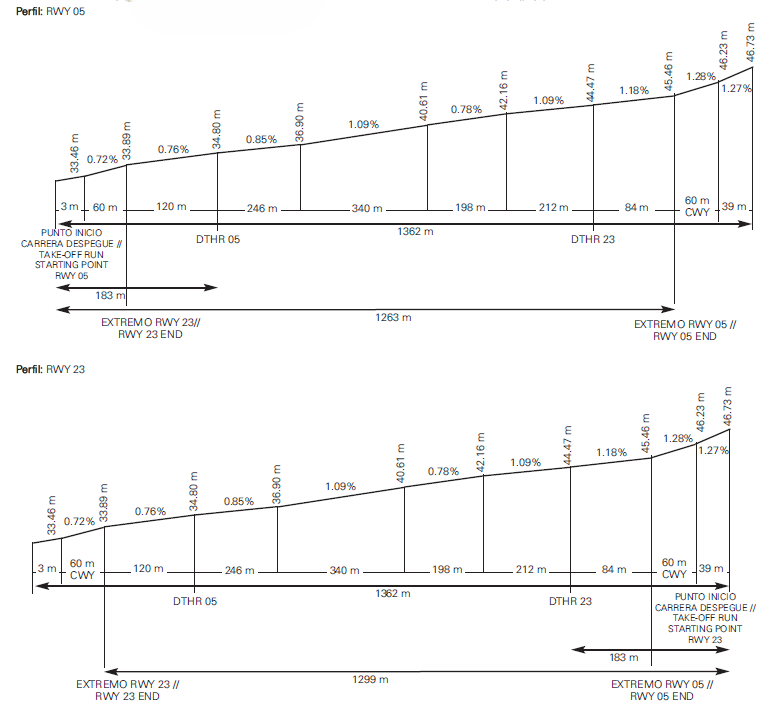
DECLARED DISTANCES
RWY |
TORA (m) |
TODA (m) |
ASDA (m) |
LDA (m) |
|---|---|---|---|---|
05 |
1263 |
1323 |
1263 |
1080 (1) |
23 |
1299 |
1359 |
1299 |
1116 (2) |
23 INT S1 |
1253 |
1313 |
1253 |
- |
Remarks: (1) THR 05 displaced 183 m. (2) THR 23 displaced 183 m. |
||||
APPROACH AND RUNWAY LIGHTING
Runway |
05 |
|
Approach |
No. |
|
| VASIS/PAPI | No. | |
Threshold |
No. |
|
Touchdown zone |
No. |
|
Runway centre line |
No. |
|
Runway edge |
No. |
|
Runway end |
No. |
|
Stopway |
No. |
|
Remarks |
None. |
Runway |
23 |
|
Approach |
No. |
|
| VASIS/PAPI | No. | |
Threshold |
No. |
|
Touchdown zone |
No. |
|
Runway centre line |
No. |
|
Runway edge |
No. |
|
Runway end |
No. |
|
Stopway |
No. |
|
Remarks |
None. |
OTHER LIGHTING, SECONDARY POWER SUPPLY
ABN/IBN |
No. |
|
WDI |
1 near THR 05, 1 near THR 23. No LGTD. |
|
TWY lighting |
No. |
|
Apron lighting |
No. |
|
Secondary power supply |
No. |
|
Remarks |
None. |
HELICOPTER LANDING AREA
Position |
|
|
Elevation |
(*) See table below |
|
Dimensions, surface, maximum weight, marking |
(**) See table below |
|
Direction |
No. |
|
Declared distances |
No. |
|
Lighthing |
No. |
|
Remarks |
Arrivals. Helicopters shall leave the RWY (FATO) by TWY S2 or TWY S3. Departures. Helicopters shall enter the RWY (FATO) by TWY S1 or TWY S3. Helicopters must be towed between the hangars and the ABL, in both directions, with the engine stopped. |
(*)
| PRKG | ELEV (m) |
|---|---|
| 1 | 46.28 |
| 4 | 45.88 |
| 5 | 46.75 |
| 6 | 45.65 |
| 7 | 45.47 |
| 8 | 45.45 |
| 9 | 45.37 |
| 10 | 45.3 |
| 27 | 43.87 |
| 28 | 43.66 |
| 51 | 43.31 |
(**)
| PRKG | PRKG WID |
|---|---|
| 1 | 17.5 |
| 4 | 18.27 |
| 5 | 14 |
| 6 | 14 |
| 7 | 12.3 |
| 8 | 12.4 |
| 9 | 18 |
| 10 | 18 |
| 27 | 32 |
| 28 | 16.12 |
| 51 | 12 |
AIR TRAFFIC SERVICES AIRSPACE ATS AIRSPACE
Designation |
No. |
|
Lateral limits |
- |
|
Vertical limits |
- |
|
Airspace class |
- |
|
Unit Language |
- |
|
Transition altitude |
- |
|
Hours of applicability |
- |
|
Remarks |
None. |
AIR TRAFFIC SERVICES COMMUNICATION FACILITIESATS COMMUNICATION FACILITIES
Service |
Call sign |
FREQ |
HR |
Remarks |
|---|---|---|---|---|
| No. | Son Bonet Radio | 122.705 C | HR AD | LESB AD. Frequency assigned for General Aviation needs. Frequency must not be used for ATS purposes. Communications at MALLORCA/Son Bonet must be made in Spanish or in English. |
RADIO NAVIGATION AND LANDING AIDSRADIO NAVIGATION & LANDING FACILITIES
Facility (VAR) |
ID |
FREQ |
HR |
Coordinates |
DME ELEV |
Remarks |
|---|---|---|---|---|---|---|
| No. | - | - | - | - | - | - |
LOCAL AERODROME REGULATIONSLOCAL REGULATIONS
Departures and arrivals from/at MALLORCA/Son Bonet AD will be reported to Palma de Mallorca AD at the telephone numbers:
- TEL: +34-971 789 275 or
- TEL: +34-971 789 286
NOTIFICATION OF TOUCH-AND-GO LANDINGS
It is compulsory to provide notification of touch-and-go landings in the flight plan, indicating the number to be performed. When the exact number is not known, an estimate shall be given. Once the operations have been concluded, the Airport Operations Office must be approached, in order to report the number of touch-and-go landings performed.
The mandatory flight plan submission is an operative condition for aircraft taking-off or landing at this aerodrome.
GLOBAL REPORTING FORMAT
The telephone numbers for receiving the runway condition report (RCR) and issuing reports (PIREPs) of the estimated braking action are those of the CEOPS:
- TEL: +34-971 449 881; TEL: +34-600 941 121
TRAFFIC WITHOUT BASE AT THE AIRPORT
Arriving traffic not based at the airport must provide a contact telephone number at the CEOPS office.
RESTRICTIONS ON STANDS
Stands are not assigned.
- Aircraft with wingspan greater than 13 m must park in the stands assigned for this purpose, PRKG 4 to 10 (provided the wingspan is less than 15 m), PRKG 25, 26 and the double stands 64-66 and 65-67.
- Fire fighting aircraft shall park in the following stands (exclusive use from 1 May to 15 October, coinciding with the season of forest fire risk):
- 1: AS50;
- 2 and 3: Airtractor;
- 4: AS50;
- 11 and 12: Partenavia.
- The aircraft of the Mallorca Fire Fighting Services, AS350, will be parked all year round at PRKG 28 (ground search and rescue, firefighting and emergency operations)
- In PRKG from 5 to 10, turning aircraft is only permitted when the stand opposite is vacant and there are no aircraft in the taxiway. Towed taxiing with the rotor turned off is permitted.
- The helicopters cleared to park on PRKG 27 must satisfy the following conditions, depending on the type of operation they are to carry out:
- Turn: D<15 m.
- Ground taxiing without turn: maximum width <21.3 m and D<18.8 m.
- Air taxiing without turn: maximum width <16 m and D<18.8 m.
- In PRKG 28, helicopters of total length less than 13 m can park. In these cases, neither turning nor operations are permitted if there are operations in any of the following PRKG: 25, 26 or 27.
- In PRKG from 25 to 30 parking is allowed for a period less than 48 hours
- In PRKG 51, turning of aircraft with total length (D) up to 10 m is permitted when all the following conditions are met: the stand adjacent is vacant, there are no aircraft in the taxiway and there are no fixed or mobile obstacles within a 10 m radius of the mid-point of the stand. Furthermore, when leaving the stand, the pilot shall report to CEOPS that they are leaving that stand.
Restrictions on use (see AD 2-LESB PDC):
- Contingency apron (PRKG from 80 to 84), only movements with the engines turned off are permitted. In the event of apron saturation, if the aircraft wingspan exceeds 10 m, then the pilot must have the means to move the aircraft with engines stopped for use. Entry into (exit from) the hangars for aircraft shall be accomplished by towing, and with engines stopped from (up to) the ABL of the apron.
- Aircraft cleaning area (in the North corner of the main apron), only movements with the engines turned off are permitted.
- It will not be permitted to taxi or remain with the engine running in stands adjacent to stands where refuelling is being carried out. In relation to this, it is understood that refuelling is taking place while the fuel bowser engine is still running.
Restrictions on taxiing
Operation on the taxiways of access to PRKG P1, P4 and P5 is restricted to code letter A aircraft.
Aircraft Taxiing Procedure
Aircraft shall approach or take-off by RWY 05 or RWY 23 as determined by the wind conditions. To reach the runway from the stand, or vice versa, they will use exit TWY S1, S2 or S3 and taxiing parallel to the runway (TWY C1 and C2), depending on which is nearest to the threshold used.
Arrivals
- Aircraft landing by RWY 05 shall vacate the runway by the nearest exit and then use the parallel TWY (C1 and C2) up to apron 1.
- Aircraft landing by RWY 23 shall vacate the runway by the nearest exit (usually S2) and then taxi via the parallel TWY (C2) up to apron 1.
Departures
- Aircraft which are going to take-off by RWY 05 shall taxi as appropriate from the stand towards the runway via the apron TWY (C1 and C2), and then via TWY S3. Once on the runway, they must use the turn pad to position themselves at the starting point for the take-off run (according to AIP) and start the take-off run.
- Aircraft which are going to take off by RWY 23 shall taxi from the stand towards the runway via the TWY S1 and then, towards the starting point for the take-off run, using the turn pad for this purpose. They may also start the take-off run from the intersection of TWY S1 itself with the runway, at the discretion and under the responsibility of the pilot.
- When operating on RWY 05, aircraft may not use the runway holding position of TWY S1.
To accomplish changes of direction on the head of runways, it is mandatory for aircraft to make use of the turn pads.
Push-back
At MALLORCA/Son Bonet airport, this kind of manoeuvre is not carried out.
Tiedown of aircraft
Aircraft should be secured to the apron tiedown rings provided at each stand for this purpose. If anchorage is not possible because the aircraft does not possess this system, it must be secured with chocks.
Operational restrictions during helicopter parking stand entry/exit manoeuvres.
The presence of passengers in the rotary-wing aircraft parking stand is not permitted when aircraft in the adjoining stand are performing entry/exit manoeuvres into or from the stand. Only trained personnel (pilots, mechanics, crew, etc.) may be present in the aircraft, as they are understood to be aware of the rotor efflux range. Even so, these personnel shall be alert to the possible presence of tools or any other item that may be ejected by the helicopter's rotor efflux and avoid, as much as possible, direct contact with the rotor’s downdraft by taking cover behind the parked aircraft itself.
The following section lists the operational restrictions defined during entry/exit manoeuvres of rotary-wing aircraft in PRKG 1, 4, 27 and 28.
- PRKG 1 (AW169, AS332, EC145 y EC135): During entry, exit and taxiing manoeuvres to/from the parking stand and TWY S1, no movement of aircraft, persons or vehicles is permitted in PRKG 2, 3 and 4 nor in the aircraft wash area. (1)
- PRKG 4 (AW169, AS332, EC145 y EC135):
- During exit from the parking stand to TWY S1: No movement of aircraft, persons or vehicles is permitted in PRKG 5 or 6. (1)
- During entry to the parking stand, from TWY S2: No movement of aircraft, persons or vehicles is permitted in Parking Stands 5, 6, 8, 10, 12, 14, 16, 18, 20, 22, 24, 26, 27, 28 or 30. (1)
- PRKG 27 (AW169, AS332, EC145 y EC135): Helicopters must ground taxi in order to park at this stand (except aircraft with a width of less than 16 m and D less than 18.8 m). In case of air taxiing:
- During exit from the parking stand to TWY S1: No movement of aircraft, persons or vehicles is permitted in Parking Stands 4, 6, 8, 10, 12, 14, 16, 18, 20, 22, 23, 24, 28, 29 or 30. (1)
- During entry to the parking stand, from TWY S2: No movement of aircraft, persons or vehicles is permitted in Parking Stands 23, 24, 28, 29 or 30. (1)
PRKG 28 (AS33, EC145 and EC135):
- During exit from the parking stand to TWY S1: No movement of aircraft, persons or vehicles is permitted in Parking Stands 4, 6, 8, 10, 12, 14, 16, 18, 20, 22, 24, 25, 26 or 27. (1)
- During entry to the parking stand, from TWY S2: No movement of aircraft, persons or vehicles is permitted in Parking Stands 25, 26 or 27. (1)
Remarks:
(1) Only qualified personnel (mechanics, pilots, etc.) may be present at these adjacent stands while the entry/exit manoeuvre is underway. In no case shall passengers be allowed.
Segregated use for fire fighting aircraft
Fire fighting aircraft, whether fixed-wing or helicopters, which operate from PRKG 1 to 4 and 12, use TWY C2, P4 and P5 to access the runway via TWY S1, or TWY C1 to access the runway via TWY S3. Moreover, those operating from PRKG 11 also use TWY P2.
Fire fighting operations, given that these are special operations (see Royal Decree 1180/2018 of 21 September, fourth additional provision) and are subject to operational charts in accordance with the Reglamento de la Circulación Aérea, have preference over other operations and are not deemed to be public use according to the Royal Decree 862/2009. Therefore, the stands and taxiways used for these operations are not subject to the technical requirements of this latter Royal Decree, provided that they are not used simultaneously and are segregated from other operations which are considered to be public use and must fulfil the technical requirements.
With regard to the stands and taxiways for aircraft used in fire fighting operations, AT8T and AS50 helicopters, the following discrepancies will be found in the case of simultaneous use with other aircraft that are engaged in public use operations:
- The safety area for turning helicopters in PRKG 1 overlaps with TWY P4 and P5 and the washing area;
- The safety area for turning helicopters in PRKG 4 overlaps with TWY P4 and PRKG 5 and 6;
- PRKG 2 and 3 are not large enough for an AT8T parked in one of them to maintain clearance from an aircraft moving in TWY P5 or parked in the other stand.
Thus, in the case that MALLORCA/Son Bonet Airport is being used by aircraft engaged in fire fighting, the operation of other traffic will be subject to the following restrictions in order to overcome the incompatibilities described:
- Fire fighting aircraft have priority access to the runway holding position in both configurations.
- All other traffic intending to operate must ensure that there is no fire fighting aircraft (either fixed-wing or helicopter) operating in PRKG 1 to 12, 27, 28 and 51, S1, S3, runway and/or surrounding taxiways, before moving towards any of these zones. Should some fire fighting aircraft be moving in any of these zones, any aircraft NOT engaged in fire fighting must wait until the former has completed its operation, whether because it has taken off or because it has reached its stand.
Aircraft pilots shall learn whether any fire fighting aircraft is taxiing by monitoring the aeronautical frequency. Pilots of fire fighting aircraft must report their taxiing intentions on the cited frequency
APRON SATURATION PROCEDURE
CEOPS will contact with the aircraft on the frequency 122.705 C to direct it to the contingency apron (apron 2), PRKG 80 to 84.
An airport vehicle will colled the aircraft´s occupants and transport them to CEOPS.
On the departure an airport vehicle will take them to the aircraft.
It is forbidden to go to the contingency apron (apron 2) on foot.
RUN-UP TEST PROCEDURE
The request for the runup test must be sent to CEOPS:
- TEL: +34-971 449 881
- FAX: +34-971 449 880
- E-mail: lesb.ops@aena.es
- Indicate: registration number/company/expected time of test.
CEOPS will authorize or refuse the request. In the case of authorization, they will indicate the selected threshold holding position to go to.
It is mandatory to inform CEOPS of the end of the test.
Any company or aircraft whose MTOW does not exceed the apron or taxiway strength published in AIP wishing to perform a pre-flight engine test can also do so in the TWY P1, PRKG 66 and 67, provided that the adjacent stands are not occupied ; and in S3 mantaining a distance of 20 meters from C1. For such tests, it is not necessary to make a request to CEOPS. In all other cases, the procedure used for full power engine testing must be followed.
PLAN FOR REMOVAL OF DISABLED AIRCRAFT
The object is to coordinate the movement of aircraft that have become disabled and cannot move by themselves.
Removal of such aircraft is the responsibility of the registered owner or the operating agency. Every movement shall be coordinated with the airport, whether this is undertaken with own means (truck or crane) or with agreed external means.
The form indicated in the procedure must be filled in at the CEOPS office.
HELICOPTER OPERATIONS
Since there is no other specific area defined for operating with helicopters at MALLORCA/Son Bonet airport, they will receive the same treatment as fixedwing aircraft and will take-off and/or land on the runway.
They shall approach and/or take-off by RWY 05 or RWY 23 depending on the wind direction.
The stands in the apron will be used as TLOF.
At MALLORCA/Son Bonet there are no air taxiing routes.
Simultaneous operations of two helicopters that involve the use of adjacent stands are not allowed.
HELICOPTER TAXIING PROCEDURE
Taxiing between the apron and runway will be performed by the exit TWY S2 or S3 and the TWY C1 and TWY C2.
Taxiing may be by air or ground.
Taxiing restrictions: Helicopter dimensions must be compatible with the TWY width as well as with the stand dimensions and its safety area.
Helicopter stands are located in the main apron, numbers: 1, 4-10, 27 and 28.In the central area, PRKG 51 can also be used by helicopters. (See restrictions to stands in Item 20).
Taxiing along the section of TWY P2 opposite hangars 1 and 2 shall be accomplished with the engine off, either under tow or carried upon a suitable vehicle.
ARRIVALS
Helicopters shall vacate the runway (FATO) via TWY S2 or S3. If they are to park inside a hangar, they will follow the TWY centre lines up to the building, stop on the pavement close to the safety line (ABL), turning off the engine, and they will be taken into the hangar by towing or on an appropriate vehicle.
DEPARTURES
Helicopters which are to take-off by RWY 05 will taxi from the stand to the runway via the apron TWY C1 and C2, and then via TWY S3. They will take-off when they are in the runway.
Helicopters which are to take-off by RWY 23 will taxi from the stand to the runway via TWY S1 and then towards THR 23; once they have passed THR 23 they shall take-off.
Helicopters taking-off from RWY 23 and located in the helicopter practice area may taxi from the helicopter practice area to the runway through the TWY C1 on apron and then onto TWY S3. Once on the runway they shall proceed to take-off.
Helicopters parked inside a hangar should be towed out with their engines turned off, up to the apron inside the ABL. Once there they shall follow the procedure described.
REMARKS
Fire fighting aircraft, in emergencies, will operate as indicated by their operational chart.
TURBOJET AIRCRAFT OPERATIONS
Turbojet aircraft are not permitted to operate at MALLORCA/Son Bonet Airport.
NOISE ABATEMENT PROCEDURES
No.
FLIGHT PROCEDURES
LOW VISIBILITY PROCEDURES (LVP)
Low Visibility Procedures (LVP) are not available at MALLORCA/Son Bonet airport.
AD TRAFFIC CIRCUIT
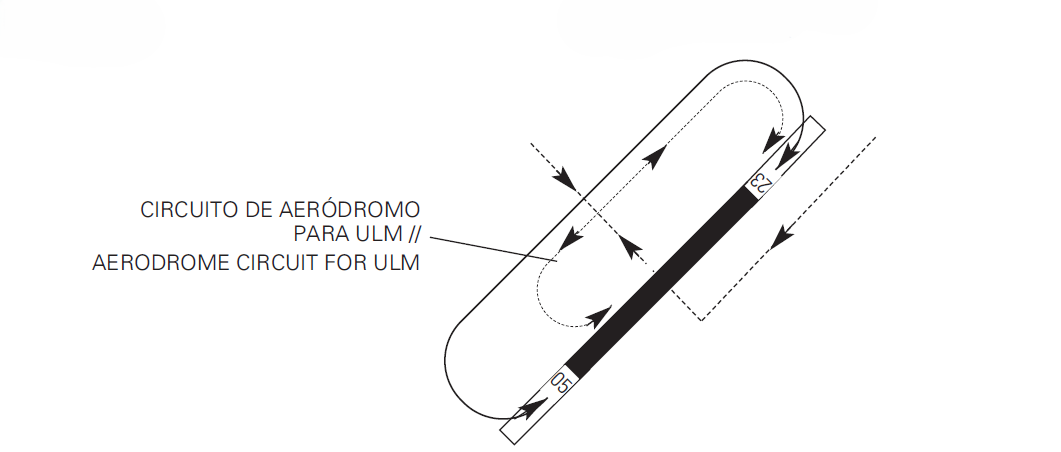
AERODROME CIRCUIT FOR MICROLIGHTS (ULM)
ENTRANCE TO CIRCUIT
- North: Maintaining 1000 ft AGL or below, ULM traffic will proceed to enter in circuit at half tail wind, always in North circuit and in a shorter circuit that the one used by the other traffic.
- South: Proceeding in parallel to the runway at 1000 ft AGL or below, within the external aerodrome perimeter and maintaining this altitude until they enter and join the circuit at half tail wind.
EXIT FROM CIRCUIT
After take-off, ULM traffic must fly to the North tail wind position before leaving the microlight circuit.
IN ANY CASE, ENTERING CTR PALMA DE MALLORCA (Controlled airspace) SHALL BE AVOIDED.
ADDITIONAL INFORMATION
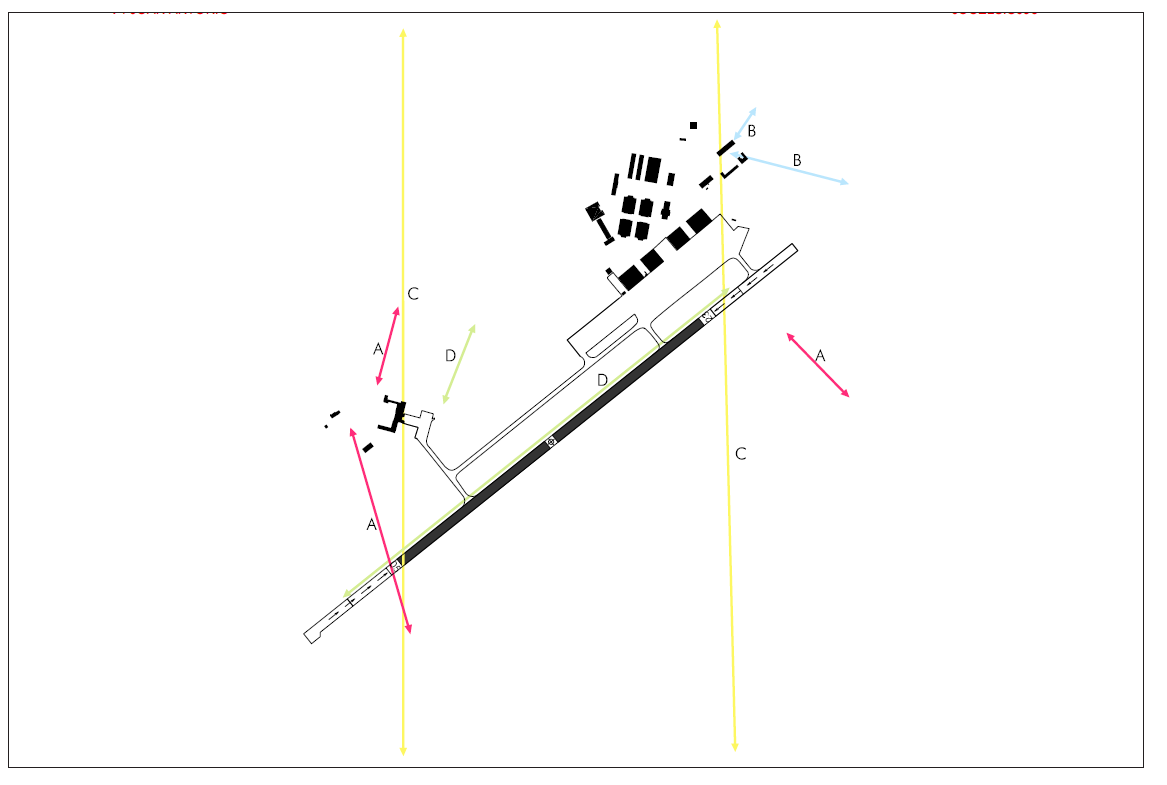
BIRDS CONCENTRATION AREAS
Movement A: wood pigeon passage.
Movement B: rock doves pigeon passage.
Movement C: large gulls passage (yellow-legged gull).
Movement D: small birds of prey passage (common kestrel).
AERONAUTICAL CHARTS RELATED TO AN AERODROMECHARTS RELATED TO THE AERODROME
The list of charts related to the aerodrome can be found on the link below:
VISUAL SEGMENT SURFACE (VSS) PENETRATION
Not applicable.