LESO AD 2 AERODROME DATA
AERODROME LOCATION INDICATORAND - NAME
LESO - SAN SEBASTIÁN
AERODROME GEOGRAPHICAL AND ADMINISTRATIVE DATA
ARP | 432123N 0014726W. See AD 2-LESO ADC. | |
Distance and direction from the city | 22 km NE. | |
Elevation | 5 m / 15 ft. | |
Geoid undulation | 48.8 m ± 0.05 m (1). | |
Reference temperature | 26°C. | |
Low average temperature | 7ºC. | |
Magnetic variation | 1ºE (2025). | |
Annual change | 9.7'E. | |
AD administration | Aena. | |
Address | Aeropuerto de San Sebastián 20280 Hondarribia (Gipuzkoa). | |
TEL |
| |
AFTN | LESO | |
Approved traffic | VFR/IFR. (2) | |
Remarks | (1) For all AD points. (2) See item 20 "Local Regulations". |
OPERATIONAL HOURS
Airport | V: 0530-1945, PS 15 MIN PPR 15 MIN BFR AD CLSD. (1). I: 0630-2045, PS 15 MIN PPR 15 MIN BFR AD CLSD. (1). | |
Customs and Immigration | HR AD. (2). | |
Health and Sanitation | See GEN 1.4. | |
AIS/ARO | H24. (3) | |
MET briefing | V: 0345-1945; I: 0445-2045; PPR: 15 MIN. | |
ATS | V: 0515-2005, I: 0615-2105. If PPR is activated: V: 0515-2020, I: 0615-2120. | |
Fuelling | HR AD. | |
| Handling | HR AD. |
| Security | HR AD. |
| De-icing | HR AD. |
Remarks | (1) PPR for commercial aviation only. (2) Authorisation must be requested 3 HR in advance for aircraft with a maximum of 10 seats, and 24 HR in advance for larger aircraft to:
(3) Centralised ARO office geographical aera 1
|
HANDLING SERVICES AND FACILITIES
Cargo facilities | No. | |
Fuel types | 100LL, JET A-1. (1) | |
Oil types | Aeroshell W100, Aeroshell 15 W.50, Mobil Aero-Red Band ESSO 100 E, ESSO 100, BP OIL 80, BP OIL 100. | |
Refuelling capacity | 100LL: 1 6000 L tanker, 2.16 L/s. JET A-1: 1 20000 L tanker, 15 L/s. 1 35000 L tanker, 15 L/s. | |
De-Icing facilities | Service provided by the handling agent on the parking apron. | |
Hangar space | No. | |
Repair facilities | No. | |
Remarks | (1) Fuel:
Agreement with handling agent (Ramp Agent) is mandatory for General and Commercial Aviation operations. Ramp agents:
|
PASSENGER FACILITIES
Hotels | No. | |
Restaurant | No. | |
Transportation | Buses and taxis. | |
Medical facilities | No. | |
Bank/Post Office | No/No. | |
Tourist information | Yes. | |
Remarks | None. |
RESCUE AND FIREFIGHTING SERVICES
Fire category | 6. (1) (2) 7. V: MON 1250-1600, THU 1850-2200, FRI 1840-2150, SUN 1305-1605 I: MON 1150-1500, THU 1750-2100, FRI 1740-2050, SUN 1205-1505 | |
Rescue equipment | In accordance with the published fire category. | |
Removal of disabled aircraft | Aerodrome coordination for the transfer of disabled aircraft in or near the manoeuvring area.
External service for removal of aircraft, following notice and charged to the owner/operator. Means available MAX: AT 76 and general aviation. Ability to tow and raise. | |
Remarks | (1) 7 on request (see item 20, “Procedure for requesting fire category on demand”). (2) Response time is less than 3 MIN, with an objetive operational less than 2 MIN. |
RUNWAY SURFACE CONDITION ASSESSMENT AND REPORTING, AND SNOW PLAN
Types of clearing equipment | Urea spreader, snowplough with capacity of 5.3 m3 for urea and 1505 L for potassium acetate. | |
Clearance priorities | Runway, taxiways and apron. | |
Use of material for movement area surface treatment | Urea (UREA), potassium acetate fluids (KAC). | |
Specially prepared winter runways | Not applicable. | |
Remarks | Period of application of snow plan: 01-DEC to 31-MAR. Runway surface condition assessment and reporting in accordance with the Global Reporting Format (GRF) methodology described in AD 1.2.2. Aerodrome in service during all seasons of the year. |
APRONS, TAXIWAYS AND CHECK LOCATIONS/POSITIONS DATAMOVEMENT AREA DETAILS
Apron | Surface: Commercial aviation: Concrete. Strength: Commercial aviation:
| |
| General Aviation area | Surface: Asphalt. Strength: PCN 35/F/B/W/U. |
Taxiways | Width: 36 m. Surface: Asphalt. Strength: PCN 67/F/B/W/T. | |
Check locations | Altimeter: Apron ELEV 4 m/13 ft. VOR: No. INS: No. | |
Remarks | None. |
SURFACE MOVEMENT GUIDANCE AND CONTROL SYSTEM AND MARKINGSTAXIING GUIDANCE SYSTEM AND MARKINGS
Taxiing guidance system | “NO ENTRY” board and stands. | |
RWY markings | Threshold, displaced threshold, designators, centre line, side stripe, touchdown zone, aiming point. | |
TWY markings | Centre line, side stripe. | |
Remarks | None. |
AERODROME OBSTACLES
Obstacles which penetrate Approach, Take-Off Climb, Conical, Inner Horizontal, Transitional, Inner Transitional and Balked Landing Surfaces established in ICAO Annex 14; and the areas 2A and 3 established in ICAO Annex 15. Those penetrating these surfaces are identified in the CSV file as “Relevante_Relevant = Si/Yes”. | See Item 10 and Data Set. | |
Remarks | See AD 2-LESO AOC. Presence of moving obstacles (boats) in the extension of THR 22 and to the left side of RWY 22 (eastern dock). |
METEOROLOGICAL INFORMATION PROVIDEDMETEOROLOGICAL SERVICE PROVIDED
MET office | San Sebastián EMAe. | |
HR | V: 0345-1945; I: 0445-2045; PPR: 15 MIN. Outside this schedule, a half-hourly METAR AUTO will be issued. | |
METAR | Half-hourly. | |
TAF | 24 HR. | |
TREND | No. | |
Briefing | In person and by telephone. | |
Flight documentation/Language | Charts and plain language / Spanish. | |
Charts | Significant forecasted and wind and temperature in altitude maps. | |
Supplementary equipment | Clouds image lightnings and radar information display | |
ATS unit served | TWR. | |
Additional information | Santander OMAe (LESD): H24
San Sebastián EMAe: HR AD
| |
Remarks | Aerodrome climatological summary available. Aerodrome warnings available. |
RUNWAY PHYSICAL CHARACTERISTICS
RWY | Direction | DIM (m) | THR PSN | THR ELEV TDZ ELEV | SWY (m) | CWY (m) | Strip (m) | OFZ | RESA (m) | RWY/SWY SFC PCN |
|---|---|---|---|---|---|---|---|---|---|---|
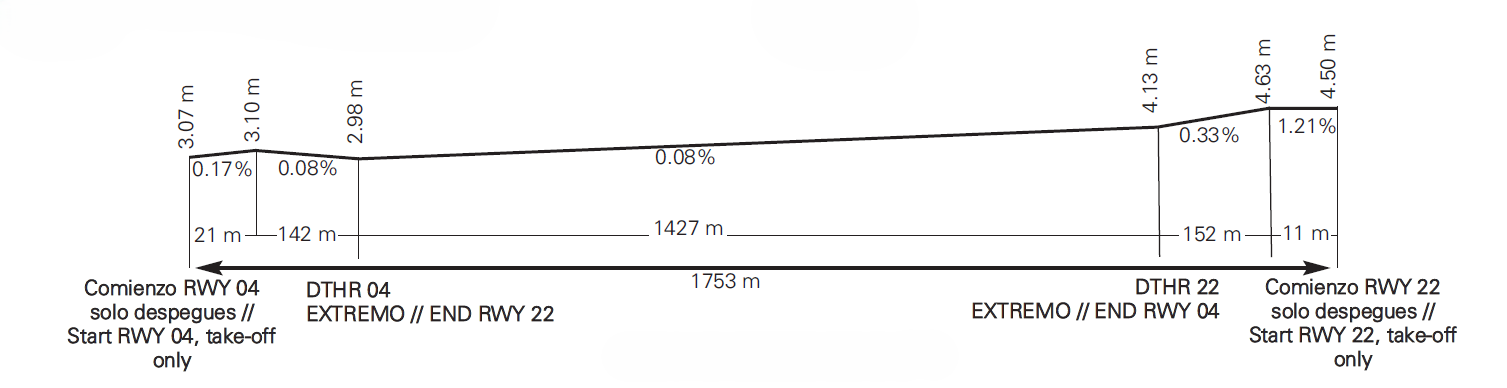
04 (1) | 038.78° GEO 038° MAG | 1590 x 45 (3) | 432105.41N 0014746.09W (4) | THR: 3 m / 10 ft TDZ: No | No | 163 x 150 | 1650 x 150 (6) | No | 90 x 90 | RWY: ASPH PCN 67/F/B/W/T SWY: No |
22 (2) | 218.79° GEO 218° MAG | 1590 x 45 (3) | 432141.47N 0014706.38W (5) | THR: 4 m / 14 ft TDZ: No | No | 163 x 150 | 1650 x 150 (6) | No | 90 x 90 | RWY: ASPH PCN 67/F/B/W/T SWY: No |
Remarks: (1) THR RWY 04 displaced 163 m. (2) THR RWY 22 displaced 163 m. (3) Central 43 m of runway grooving for 45 m. (4) Coordinates start RWY 04, take-off only: 432101.29N 0014750.63W. (5) Coordinates start RWY 22, take-off only: 432145.59N 0014701.84W. (6) Irregular strip outline at both thresholds (see AD 2-LESO ADC). | ||||||||||
PROFILE
DECLARED DISTANCES
RWY | TORA (m) | TODA (m) | ASDA (m) | LDA (m) |
|---|---|---|---|---|
RWY 04 | 1590 | 1753 | 1590 | 1427 |
RWY 22 | 1590 | 1753 | 1590 | 1427 |
22 INT A | 526 | 689 | 526 | – |
22 INT B | 672 | 835 | 672 | – |
22 INT C | 804 | 967 | 804 | – |
04 INT A | 936 | 1099 | 936 | – |
04 INT B | 791 | 954 | 791 | – |
04 INT C | 658 | 821 | 658 | – |
Remarks: None. | ||||
APPROACH AND RUNWAY LIGHTING
Runway | 04 | |
Approach | Threshold identification lights. | |
PAPI (MEHT) | 4.75º (15.66 m / 51 ft) | |
Threshold | Green with wing bars. (1) | |
Touchdown zone | No. | |
Runway centre line | 1590 m: 876 m white + 414 m white and red + 300 m red. LIH. Distance between lights: 15 m. | |
Runway edge | 1590 m: 163 m red + 827 white + 600 yellow. LIH. Distance between lights: 50 m. | |
Runway end | Red. | |
Stopway | No. | |
Remarks | Runway turn pad lights: Green. (1) With LED lighting. |
Runway | 22 | |
Approach | Threshold identification lights. | |
PAPI (MEHT) | 3º (15.57 m / 51 ft). | |
Threshold | Green with wing bars. (1) | |
Touchdown zone | No. | |
Runway centre line | 1590 m: 876 m white + 414 m white and red + 300 m red. LIH. Distance between lights: 15 m. | |
Runway edge | 1590 m: 163 m red + 827 white + 600 yellow. LIH. Distance between lights: 50 m. | |
Runway end | Red. (1) | |
Stopway | No. | |
Remarks | Runway turn pad lights: Green. (1) With LED lighting. |
OTHER LIGHTING, SECONDARY POWER SUPPLY
ABN/IBN | No. | |
WDI | 1 near THR 04, 1 near TWR, 1 near PAPI RWY 04. LGTD. | |
TWY lighting | Centre line, edge. (1) | |
Apron lighting | Edge, 6 floodlighting poles. | |
Secondary power supply | Generators providing a maximum switch-over time (light) of 15 seconds to the lighting systems. | |
Remarks | (1) With LED lighting. |
HELICOPTER LANDING AREA
Position |
| |
Elevation |
| |
Dimensions, surface, maximum weight, marking |
| |
Direction | No. | |
Declared distances | No. | |
Lighting | No. | |
Remarks |
|
AIR TRAFFIC SERVICES AIRSPACEATS AIRSPACE
Designation | CTR SAN SEBASTIÁN. | |
Lateral limits | 431333N 0015733W; 431244N 0015908W; 431304N 0020209W; 431645N 0020524W; 432216N 0020409W; Space bounded by a circular arc with a 12 NM radius centred on NDB HIG within the boundaries of the FIR MADRID up to 431333N 0015733W. | |
Vertical limits | SFC-1700 ft AGL-AMSL. | |
Airspace class | D. | |
Unit Language | SAN SEBASTIÁN TWR. ES/EN. | |
Transition altitude | 1850 m / 6000 ft. | |
| Hours of applicability | - |
Remarks | None. |
Designation | ATZ SAN SEBASTIÁN. | |
Lateral limits | Circle with a 8 km radius centred on ARP and bordered to the east by the FIR BORDEAUX. (1) | |
Vertical limits | SFC-3000 ft HGT (2). | |
Airspace class | D. | |
Unit Language | SAN SEBASTIÁN TWR. ES/EN. | |
Transition altitude | 1850 m / 6000 ft. | |
Hours of applicability | - | |
Remarks | (1) Or the ground visibility, whichever is lower. (2) Or up to the cloud ceiling, whichever is lower. |
AIR TRAFFIC SERVICES COMMUNICATION FACILITIESATS COMMUNICATION FACILITIES
Service | Call sign | FREQ | HR | Remarks |
|---|---|---|---|---|
APP/TWR | San Sebastián TWR | 119.855 C | HR ATS | Due to the characteristics of the ground, there may be loss of radio communication in the west area of the airspace below 2300 ft AGL and in the south area below 4500 ft AGL. |
243.000 MHz | HR ATS | EMERG | ||
121.500 MHz | HR ATS | EMERG | ||
121.705 C | HR ATS | GMC |
RADIO NAVIGATION AND LANDING AIDSRADIO NAVIGATION & LANDING FACILITIES
Facility (VAR) | ID | FREQ | HR | Coordinates | DME ELEV | Remarks |
|---|---|---|---|---|---|---|
NDB (1°E) | HIG | 328.000 kHz | H24 | 432310.6N 0014745.2W | - | COV 50 NM. U/S BTN 109°/139°. |
DME | HIG | 113.200 MHz/ CH 79X | H24 | 432310.6N 0014744.7W | 120 m | - |
DVOR (1°E) | SSN | 117.900 MHz | H24 | 431840.3N 0014949.4W | - | COV 10 NM U/S BTN:
COV 40 NM AVBL BTN:
|
DME | SSN | CH 126X | H24 | 431840.7N 0014949.8W | 240 m | COV 10 NM U/S BTN:
COV 40 NM AVBL BTN:
R-170 possible signal loss at FL100 or BLW FM 24 NM (overlap with PPN). |
LOCAL AERODROME REGULATIONSLOCAL REGULATIONS
For Commercial Aviation, according to GEN 1.2 “Airport slot coordination-Schedule facilitation” and due to apron capacity, clearance must be requested from:
Airport Slot Coordination Office
Postal Address: C/ Peonías, 12 - 6ª planta
28042 Madrid (ESPAÑA)
SITA: MADGSYA (slot requests)
MADCHYA (other matters)
E-mail: slot.coord@aena.es
TEL: +34-913 211 044 / 024
FAX: +34-913 211 348
Office Hours (Monday to Friday, except public holidays):
Monday-Tuesday-Wednesday-Thursday: 0800-1700 LT.
(0800-1500 LT from June to September).
Friday: 0800-1500 LT.
For Aerotaxi, Training and the rest of the General Aviation Operations, due to apron capacity, clearance must be requested from:
LESO Operations Office
TEL: +34-943 668 504 / 24
FAX: +34-943 668 514
AFTN: LESOZPZX
E-mail: OperacionesEAS@aena.es
Detailing the following information:
Name of the Operator
Origin, date, ETA and aircraft identification
Destination, date, ETD and aircraft identification
Type of aircraft
Type of flight: VFR/IFR
State, ambulance and hospital flights will be exempted from this authorisation.
IFR/VFR flights without prior clearance will be rejected.
STANDARD TAXIING PROCEDURES
Guidance service only available by request.
Avoidance of collisions with other aircraft and obstacles is the responsibility of:
Pilots when taxiing on the apron.
Pilots or ground handling companies during the stand entry and exit manoeuvres and during towing.
An aircraft shall not leave the stand without TWR clearance to occupy the runway, as the exit manoeuver will invade the runway leveled strip (75 m from runway centre line).
A general aviation aircraft must shut off engines at the indicated point before entering the General Aviation Area, and then be towed to the stand. To exit the stand, the aircraft must be towed as far as the beginning of the taxiway centreline marking, and then start up engines.
To access the engines stopped area, TWR must be notified in advance on 121.705 C from the stand itself.
Prior to the engines start-up, the handling agent or the pilot, as appropriate, shall check that there are no equipment, vehicles or people in the safety zone behind the aircraft.
Any aircraft when using the taxiway to access the General Aviation Area, located in front of the SEI, at the leveled strip, outbound and inbound, is occupying the runway.
PRKG 7: the engine stopped area must be vacated for CRJ900, A319 and A20N ACFT.
Under prior ATC clerance, are allowed the posibility of turns of 180º in runway for light aircraft of code letter L.
AIRCRAFT STAND ENTRY/EXIT PROCEDURE
Stand entry/exit manoeuvres shall be carried out at engine powers similar to idling. If increased power is required, the pilot must notify ATC so that the manoeuvre is supervised by a ground handling agent.
To prevent the effects of aircraft stopped at runway-holding positions (A, B and C) the Control tower will not usually issue any taxi clearance until it is certain that they will not have to stop at those positions, but rather they will access the active runway without stopping.
OPERATION ACFT MD83
“Oversteering” manoeuvre must be made on entry to the stand so that the aircraft can be lined-up with the paint on the stand.
On threshold turn pads, MD83 aircraft can not follow the final part of the turn painted on the runway, and the turn angle of the nose wheel must be increased from 45º (specified in the standard) to 50º.
HELICOPTER OPERATIONS
This section defines only operations for helicopter with assigned stand on civil-use ramps in San Sebastián AD and which have no letter of exemption in the terms prescribed in article 3.2.9 of the RCA. According to the above and as there is no other specific area to operate with helicopters, they will be treated the same as fixed-wing aircraft and will be authorised by ATC to take off and land on RWY 04/22.
TAXIING ROUTES
The helicopters will normally be authorised to enter or exit RWY 04/22 via TWY C.
ARRIVALS
Arriving helicopters will normally land on RWY 04/22, leaving the runway via TWY C and shall be authorised to access PRKG 3B.
DEPARTURES
Departing helicopters shall be authorised by ATC to taxi from PRKG 3B to TWY C to access RWY 04/22 and take off.
GROUND ENGINE TEST PROCEDURE
The procedure must be supervised by the pilot himself or by the appointed ground handling agent, in order ensure its safety.
Code letter A aircraft: Depending on the estimated duration of the test, in order not to affect the apron and/or runway capacity, ATC in coordination with the operations office, will assign the location with the following priority order:
The engine stopped area in the general aviation area.
TWY A, B and C.
PRKG 7B and 7C.
Code letter B and C aircraft (except A319, MD82, CR1000), idling level:
PRKG: 4, 4B, 5, 6, 6B and 7.
RWY 22, at the aiming point marking.
Code letter B and C aircraft, high power level:
RWY 22, at the aiming point marking.
LOCAL RESTRICTIONS
Overflying the French territory is forbidden between: V: 2000-0530; I: 2100-0630.
Overflying French territory below 300 m altitude should be avoided as far as possible. Aircraft having to overfly Hendaya beach when taking-off or landing shall do so as far west and as high as possible and never below 100 m altitude.
Acrobatic and publicity flights and maiden flights over the French territory are forbidden below 500 m altitude.
CATEGORY OF COMMERCIAL TRANSPORT OPERATIONS
Commercial air transport (CAT) operations at San Sebastián airport shall be considered by aircraft operators as category C (according to the classification defined in AMC1 ORO.FC.105-b-2-c).
PROCEDURE FOR THE REQUESTING OF FIRE CATEGORY ON DEMAND
San Sebastián Airport provides SEI category 6 continuously and 7 on demand. To operate under category 7 interested companies must request it via e-mail to operations EAS@aena.es
The request must be made at least 72 hours before the scheduled flight, and shall include the following data:
Flight number.
Flight class.
Aircraft type.
Scheluded date and time.
Confirmation of the required category shall be given through the same means by which it was requested.
NIGHT VISUAL OPERATIONS (VFR-N)
Night visual operations are authorized.
OPERATIONAL SAFETY REPORTS
Pilots/operator shall report to the airport as soon as possible about any accidents, incidents, occurrences or events which may have a potential operational impact and in which they have been involved or witnessed.
The aim of these reports is the compilation of the information in order to improve operational safety, independently of the compulsory report of the occurrence to the appropriate aeronautical authority. Data may be sent in any format, including at least the following information:
Date and time.
Site.
Parties involved (data used to identify vehicles, aircraft …involved).
Companies implicated.
Description of the facts.
Any other data considered relevant (e.g. lighting conditions, weather, phase of the operation such as take-off / landing / stopover, pavement conditions…).
The contact e-mail address of the airport, for the reception of operational safety reports, is the following:
Seguridad_Operacional_EAS@aena.es
In addition to notifying the airport by means of the indicated system, it is necessary to send at least basic data of the accident, incident, occurrence or event to the air traffic control service provider (ATC).
In the specific case of safety reports related to the air traffic control service provider (manoeuvring area, flight phases and ATS airspace) they may be sent to the e-mail address: lecm.safety@enaire.es
AIRPORT EMERGENCY PLAN
See AD 1.1 Emergency management.
NOISE ABATEMENT PROCEDURES
The RWY 22 PAPI angle is calculated based on environmental requirements and for local restriction due to the Spanish-French agreement of overflying the town of Hendaya (item 20).
The RWY 04 PAPI angle (see item 14) is calculated for obstacle clearance during approach.
FLIGHT PROCEDURES
LOW VISIBILITY PROCEDURES (LVP)
Low Visibility Procedures (LVP) are not available at San Sebastián airport.
OPERATIONAL STANDSTILL PROCEDURE IN THE MOVEMENT AREA (PPOAM)
Low Visibility Procedures (LVP) are not available at San Sebastián airport. The “Operational Standstill Procedure in the Movement Area when RVR is below 800 m (PPOAM 800)” is available instead to maintain safety in the movement area in low-visibility situations, which consists of the following phases:
PHASE I. Notice: 1000 m ≥ RVR ≥ 800 m
PHASE II. Operational standstill: 800 m > RVR
PHASE III. Resumption of operations: RVR ≥ 800 m
Information for pilots
Uncertainty regarding the position in the maneuvering area.
When in doubt about the position of the aircraft relative to the maneuvering area:
If it is known that the aircraft is not on runway, immediately stop the aircraft and report this event (including the last known position) to ATC.
If it is known that the aircraft is on a runway, immediately report (including the last known position) to ATC, evacuating the runway, as soon as possible if a proper nearby taxiway can be located, unless ATC indicates otherwise; and then stop the aircraft.
Aircraft failure
Report the situation to ATC and await the arrival of assistance. If on a runway, if possible and unless ATC indicates otherwise, evacuate the runway.
Loss of visual contact between traffics
If visual contact is lost with another aircraft or a vehicle with which it has his own separation, immediately inform ATC and stop the aircraft.
Communications failure
Departing aircraft: the aircraft shall continue along the assigned route and stop at the limit of ATC clearance, taking special care, holding the position and await the arrival of an assistance vehicle.
Arriving aircraft: if the aircraft has just landed, hold position after leaving the runway and await the arrival of an assistance vehicle.
If the aircraft already has ATC clearance to taxi continue along the assigned route to the limit of the clearance, taking special care, holding the position and awaiting the arrival of an assistance vehicle.
ATS SURVEILLANCE SYSTEMS
ATS surveillance systems are available for the provision of aerodrome control service and procedural approach control service.
Aircraft receiving this control service supported by ATS surveillance systems shall be identified in advance. In case of loss of identification, this fact shall be reported and the service shall be provided without support from ATS surveillance systems.
These ATS surveillance system functions will be subject to the availability of ATS surveillance sensors and aircraft equipment levels (transponder and/or ADS-B equipment).
The unavailability of these systems does not imply the declaration of an operational contingency in the unit.
USE OF ATS SURVEILLANCE SYSTEMS IN AERODROME CONTROL
When providing aerodrome control services, ATS surveillance systems may be used to perform the following functions:
Flight path monitoring of aircraft on final approach;
Fight path monitoring of other aircraft in the vicinity of the aerodrome;
Providing navigation assistance to VFR flights.
USE OF ATS SURVEILLANCE SYSTEMS IN APPROACH CONTROL
ATS surveillance systems may be used by the procedural approach controller when applicable, to maintain a watch on the progress of air traffic providing:
Improved position information regarding aircraft under control;
Supplementary information regarding other traffic; and
Information regarding any significant deviations by aircraft from the terms of their respective ATC clearances, including their cleared routes as well as levels when appropiate.
Information for pilots: This unit does not have the means to provide vectoring to aircraft.
REPORTING WIND SHEAR ON APPROACH OR TAKE-OFF
If experiencing wind shear, flights shall provide ATC with the following information as far as possible:
Flight stage at which wind shear occurred
Intensity: weak, moderate, strong, very strong, or unclassified.
Direction of the phenomenon: positive or negative.
Whether detected by the aircraft’s systems or perceived by the pilot.
Any supplementary information available.
Once notified of the wind shear, ATC shall notify the following aircraft that may be affected (including aircraft type and whether detected by the aircraft’s systems or perceived by the pilot), provided it has not already been reported by other means (e.g.: METAR/SPECI...). Likewise, ATC shall confirm with these aircraft if they have experienced wind shear or not.
In order to have the METAR updated at all times regarding the presence of wind shear, when taking off or landing with a METAR reporting wind shear, the air traffic shall always inform ATC whether they have been affected by wind shear or not.
VISUAL DEPARTURE PROCEDURES FOR IFR FLIGHTS
IFR flights may request ATC for “visual departure” on ground or in the air under the following conditions:
Between the start of morning civil twilight and the end of evening civil twilight.
Weather conditions in the take-off direction and subsequent initial climb permitting visual flight up to the Minimum Sector Altitude (MSA), which will be provided by ATC.
In the air, the pilot shall propose to ATC a heading or a direct course.
On the ground, the pilot shall propose to ATC a heading or a point, or ATC shall propose a visual departure subject to the pilot's consent and readback.
The pilot shall be responsible for maintaining the obstacle clearance distance up to the Minimum Sector Altitude.
If visual departures are applied due to the inability to use the published SID and contingency departures, the noise abatement procedures described in AIP LESO AD-2 Item 21 “Noise Abatement Procedures” shall no longer be applied.
AD TRAFFIC CIRCUIT
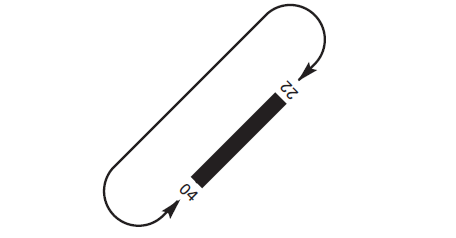
The aerodrome circuit must take place on the Spanish side. The circuit over Hendaya (France) is restricted to special situations and is only permitted at 300 m altitude or above.
ADDITIONAL INFORMATION
ANIMAL CONTROL SERVICE
Hours: Service continuously provided from sunrise to sunset.
Usual location: vehicle in the manoeuvring area.
When there is no animal control service, the following devices are available for use by airport staff:
Digital sound repeller
Laser device
Vehicle sirens
BIRD CONCENTRATION AREAS
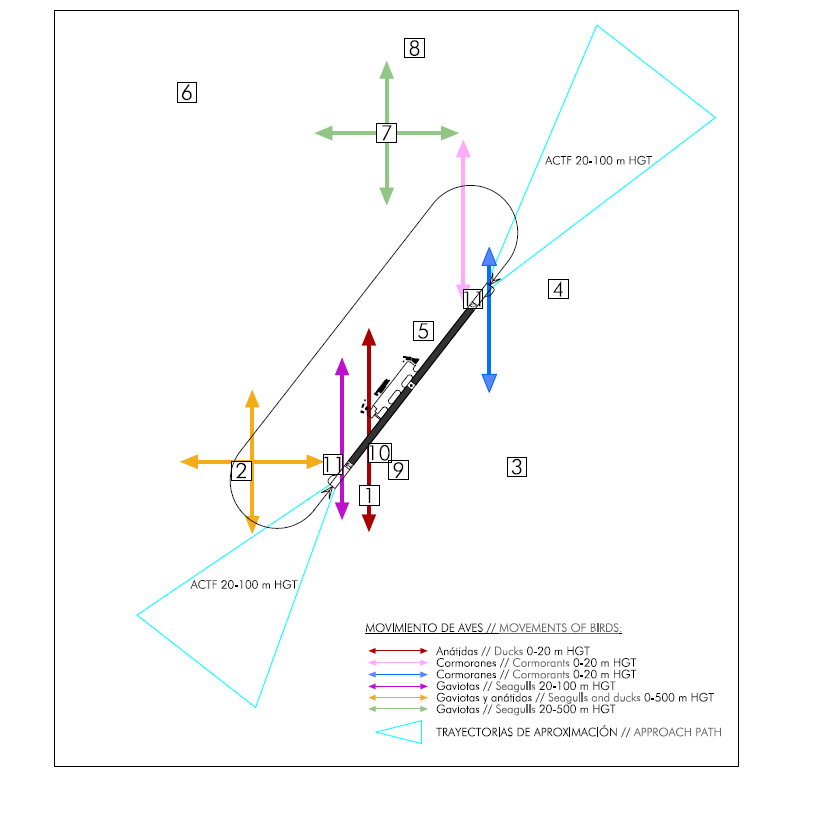
The following bird concentration and crossing areas can be identified near the airport area:
Plaiaundi eco-park.
Jaizubia marsh.
Bidasoa estuary and eastern islands.
Birds island.
El Puntal wharf.
Cape Higuer Cliffs.
Hondarribia Port.
Hondarribia Marina.
Plaiaundi marsh.
San Rafael lagoon (on the airport grounds):
THR 04 and 22.
AERONAUTICAL CHARTS RELATED TO AN AERODROMECHARTS RELATED TO THE AERODROME
The list of charts related to the aerodrome can be found on the link below:
VISUAL SEGMENT SURFACE (VSS) PENETRATION
The instrument approach procedures affected can be found below:
IAC 1 VOR RWY 22: direct approach.
IAC 3 RNP Y RWY 22: LNAV.
IAC 4 RNP X RWY 22: LNAV, LNAV/VNAV.
IAC 5 RNP A: LNAV