LEJR AD 2 AERODROME DATA
AERODROME LOCATION INDICATOR AND NAME
LEJR – JEREZ
AERODROME GEOGRAPHICAL AND ADMINISTRATIVE DATA
ARP |
364441N 0060336W. See AD 2-LEJR ADC. |
|
Distance and direction from the city |
8 km NE. |
|
Elevation |
28 m / 93 ft. |
|
Geoid undulation |
46.09 m ± 0.05 m (1). |
|
Reference temperature |
34°C. |
|
Low average temperature |
9°C. |
|
Magnetic variation |
1°W (2020). |
|
Annual change |
7.8' E. |
|
AD administration |
Aena. |
|
Address |
Aeropuerto de Jerez; Apdo. 579; 11401 Jerez de la Frontera (Cádiz). |
|
TEL |
+34-956 150 106. |
|
AFTN |
AFTN: LEJR |
|
Approved traffic |
IFR/VFR (2). |
|
Remarks |
(1) For all AD points.
In case of an authorised SLOT, this must be specified in box 18 of the flight plan, also indicating the handling agent hired to execute the operation. |
OPERATIONAL HOURS
Airport |
V: 0445–2100; I: 0545–2200; PS 1 HR PPR. |
|
Customs and Immigration |
HR AD. |
|
Health and Sanitation |
See item 5 and GEN 1.4. |
|
AIS |
H24 (1). |
|
ARO |
HR AD (2). |
|
MET briefing |
HR AD PS 1 HR 15 MIN BFR. |
|
ATS |
HR AD. |
|
Fuelling |
HR AD. |
|
Handling |
HR AD. |
|
Security |
H24. |
|
De-icing |
No. |
|
Remarks |
(2) ARO service provided from the operations office of the airport. |
HANDLING SERVICES AND FACILITIES
Cargo facilities |
No. |
|
Fuel types |
AVGAS 100LL , JET A-1. (1) . |
|
Oil types |
Not available. |
|
Refuelling capacity |
|
|
De-Icing facilities |
No. |
|
Hangar space |
No. |
|
Repair facilities |
None. |
|
Remarks |
SOUTH EUROPE GROUND SERVICES
|
PASSENGER FACILITIES
Hotels |
No. |
|
Restaurant |
Yes. |
|
Transportation |
Train (commuter / middle distance), buses, taxis and hire cars. |
|
Medical facilities |
First aid limited hours. |
|
Bank/Post Office |
Cash dispenser / Postbox. |
|
Tourist information |
No. |
|
Remarks |
None. |
RESCUE AND FIREFIGHTING SERVICES
Fire category |
7 continuously / 8 on demand (in accordance with the procedure for the request of level of protection on demand. See item 20). (1) |
|
Rescue equipment |
In accordance with the fire category published. |
|
Removal of disabled aircraft |
Jerez Airport has its own resources for the transfer of disabled aircraft of up to 10 TM. For the removal of aircraft of greater tonnage than that mentioned above, the associated nodal airport (AGP) has the capacity to make its equipment, suitable for loads greater than the above tonnage limit, available to this airport. Likewise, Jerez Airport has an updated list of external crane companies and other machinery with a load capacity of up to 700 TM. In either case, the aircraft shall be removed with the prior authorisation of the aircraft owner and under the supervision of the owner, airline, handling agent or operator designated in writing for this purpose.
|
|
|
Remarks |
(1) The response time of the rescue and fire fighting service is less than 3 minuntes, with an operational objetive of less than 2 minutes. |
RUNWAY SURFACE CONDITION ASSESSMENT AND REPORTING, AND SNOW PLAN
Types of clearing equipment |
Not applicable. |
|
Clearance priorities |
Not applicable. |
|
Use of material for movement area surface treatment |
Not applicable. |
|
Specially prepared winter runways |
Not applicable. |
|
Remarks |
Runway surface condition assessment and reporting in accordance with the Global Reporting Format (GRF) methodology described in AD 1.2.2. |
APRONS, TAXIWAYS AND CHECK LOCATIONS/POSITIONS DATA
Apron |
Surface: A1 and A2: Concrete. A3: Asphalt. |
|
Taxiways |
Width: 23 m. E-2, L-2, T-2 to T-5: PCN 136/F/A/W/T; E-3, E-5, L-3: PCN 107/F/A/W/T; E-4: PCN 40/F/D/W/T; E-6: PCN 70/F/C/W/T; L-4: PCN 32/F/A/W/T |
|
Check locations |
Altimeter: Apron ELEV 26 m / 85 ft. |
|
Remarks |
None. Remarks: TWY centre line: see INSIGNIA and Data Set. |
SURFACE MOVEMENT GUIDANCE AND CONTROL SYSTEM AND MARKINGS
Taxiing guidance system |
Lighted vertical and horizontal markings. Stop bars, runway-holding positions, intermediate holding positions, intermediate holding positions lights, no-entry bar and NO ENTRY sign in TWY E-5 and stands. |
|
RWY markings |
Threshold, designators, aiming point, touchdown zone, centre line, side stripe and marking rapid exit indicators on RWY 20 (E-5). |
|
TWY markings |
Centre line, side stripe and enhanced center line on TWY E-1, E-2, E-3, E-4 and E-6. |
|
Remarks |
None. |
AERODROME OBSTACLES
Obstacles which penetrate approach, take-off climb, conical, inner horizontal, circuit and transitional surfaces contained in Annex 14 of ICAO; areas 2 and 3 contained in Annex 15 of ICAO: |
See Item 10 and Data s Set. |
|
Remarks |
See AD 2-LEJR AOC. |
METEOROLOGICAL INFORMATION PROVIDED
MET office |
Jerez EMAe |
|
HR |
HR AD PS 1 HR 15 MIN BFR. Outside this schedule, a half-hourly METAR AUTO will be issued. |
|
METAR |
Half-hourly. |
|
TAF |
24 HR. |
|
TREND |
No. |
|
Briefing |
By telephone and fax. |
|
Flight documentation/Language |
Charts and plain language / Spanish. |
|
Charts |
Significant, and wind and temperature at altitude, forecasts. |
|
Supplementary equipment |
No. |
|
ATS unit served |
TWR, APP. |
|
Additional information |
Sevilla OMAe (LESV): H24
|
|
Remarks |
Aerodrome climatological summary available. Aerodrome warnings available. |
RUNWAY PHYSICAL CHARACTERISTICS
RWY |
Direction |
DIM (m) |
THR PSN |
THR ELEV / TDZ ELEV |
SWY (m) |
CWY (m) |
Strip (m) |
OFZ |
RESA (m) |
RWY/SWY SFC |
|---|---|---|---|---|---|---|---|---|---|---|
02 |
021.43° GEO |
2300 x 45 |
364405.91N |
THR: 21 m / 68 ft |
No |
No |
2420 x 300 |
No |
203 x 150 |
RWY: ASPH |
20 |
201.43° GEO |
2300 x 45 |
364515.37N |
THR: 28.4 m / 93 ft |
No |
No |
2420 x 300 |
No |
240 x 150 |
RWY: ASPH |
Remarks: (1) 160 m FM THR 02 PCN 129/F/A/W/T, BTN 160 & 1680 m FM THR 02 PCN 144/F/A/W/T, BTN 1680 & 1841 m FM THR 02 PCN 125/F/A/W/T, BTN 1841 & 2161 m FM THR 02 PCN 119/F/A/W/T, (2) 139 m FM THR 20 PCN 137/F/A/W/T, BTN 139 & 459 m THR 20 PCN 119/F/A/W/T, BTN 459 & 620 m FM THR 20 PCN 125/F/A/W/T, BTN 620 & 2140 m FM THR 20 PCN 144/F/A/W/T, BTN 2140 & 2300 m FM THR 20 PCN 129/F/A/W/T. |
||||||||||
Remarks: (1) 160 m FM THR 02 PCN 73/F/D/W/T, BTN 160 & 1680 m FM THR 02 PCN 110/F/A/W/T, BTN 1680 & 1840 m FM THR 02 PCN 42/F/C/W/T, BTN 1840 & 2160 m FM THR 02 PCN 65/F/B/W/T, BTN 2160 & 2300 m FM THR 02 PCN 63/F/C/W/T. (2) 140 m FM THR 20 PCN 63/F/C/W/T, BTN 140 & 460 m THR 20 PCN 65/F/B/W/T, BTN 460 & 620 m FM THR 20 PCN 42/F/C/W/T, BTN 620 & 2140 m FM THR 20 PCN 110/F/A/W/T, BTN 2140 & 2300 m FM THR 20 PCN 73/F/D/W/T. |
||||||||||
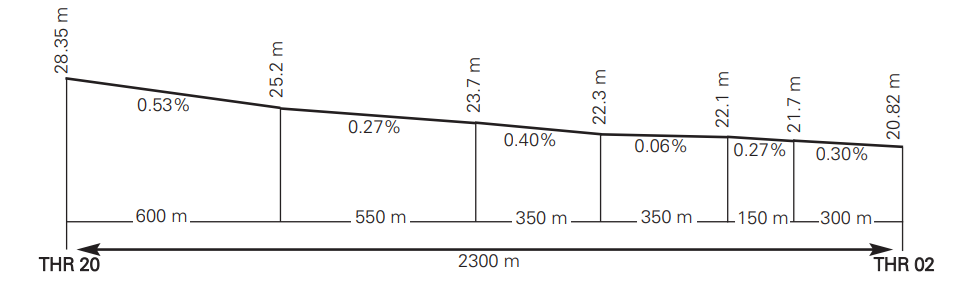
Profile:
DECLARED DISTANCES
RWY |
TORA (m) |
TODA (m) |
ASDA (m) |
LDA (m) |
|---|---|---|---|---|
02 |
2300 |
2300 |
2300 |
2300 |
20 |
2300 |
2300 |
2300 |
2300 |
02 INT E-2 |
698 |
698 |
698 |
— |
02 INT E-3 |
904 |
904 |
904 |
— |
02 INT E-4 |
1302 |
1302 |
1302 |
— |
20 INT E-2 |
1628 |
1628 |
1628 |
— |
20 INT E-3 |
1418 |
1418 |
1418 |
— |
20 INT E-4 |
1022 |
1022 |
1022 |
— |
Remarks: None. |
||||
APPROACH AND RUNWAY LIGHTING
Runway |
02 |
|
Approach |
Simple, 485 m. LIH. Threshold identification lights. |
|
PAPI (MEHT) |
3° (16.85 m/55 ft). |
|
Threshold |
Green. (1) |
|
Touchdown zone |
No. |
|
Runway centre line |
2300 m: 1400 m white + 600 m red and white + 300 m red. LIH. |
|
Runway edge |
2300 m white. LIH. |
|
Runway end |
Red. (1) |
|
Stopway |
No. |
|
Remarks |
(1) LED lighting. |
Runway |
20 |
|
Approach |
Precision CAT I, 900 m. LIH. Threshold identification lights. |
|
PAPI (MEHT) |
3° (17.00 m/56 ft). |
|
Threshold |
Green. (1) |
|
Touchdown zone |
No. |
|
Runway centre line |
2300 m: 1400 m white + 600 m red and white + 300 m red. LIH. |
|
Runway edge |
2300 m white. LIH. |
|
Runway end |
Red. (1) |
|
Stopway |
No. |
|
Remarks |
Rapid exit taxiway indicator lights (E-5). |
OTHER LIGHTING, SECONDARY POWER SUPPLY
ABN/ IBN |
No. |
|
WDI |
1 near THR 02, 1 near THR 20. LGTD. |
|
TWY lighting |
Centre line. (1) |
|
Apron lighting |
Edge. |
|
Secondary power supply |
Generators that provide a maximum (light) switching time of 1 second for visual aid systems, and a maximum (light) switching time of 15 seconds for all the lighting systems. |
|
Remarks |
(1) LED lighting. |
HELICOPTER LANDING AREA
Position |
FATO: RWY 02/20. Coordinates THR 02 and THR 20, see item 12. |
|
Elevation |
FATO: RWY 02/20. Elevation THR 02 and THR 20, see item 12. |
|
Dimensions, surface, maximum weight, markings |
FATO: RWY 02/20. |
|
Direction |
No. |
|
Declared distances |
No. |
|
Lighting |
No. |
|
Remarks |
None. |
PRKG |
ELEV (m) |
|---|---|
H1 |
25.1 |
H2 |
25.3 |
H3 |
25.5 |
H4 |
25.4 |
H5 |
25.6 |
H6A |
INFO NO AVBL |
H6D |
INFO NO AVBL |
H9 |
24.75 |
H10 |
24.75 |
AIR TRAFFIC SERVICES AIRSPACE
Designation |
CTR JEREZ. |
|
Lateral limits |
Circle radius 7 NM centred on ARP. |
|
Vertical limits |
SFC-2500 ft AMSL. |
|
Airspace class |
D. |
|
Language/Unit |
JEREZ TWR. |
|
Transition altitude |
1850 m/6000 ft. |
|
|
Hours of applicability |
- |
Remarks |
None. |
AIR TRAFFIC SERVICES COMMUNICATION FACILITIES
Service |
APP |
TWR |
VDF |
ATIS |
D-ATIS |
|
Call sign |
Sevilla APP |
Jerez TWR |
Jerez Gonio |
Jerez Information |
Jerez Information |
|
FREQ |
128.500 MHz |
118.555 C |
118.550 MHz |
125.655 C |
NIL |
|
HR |
H24 |
HR AD |
HR AD |
HR AD |
HR AD |
|
Remarks |
EMERG |
Provision of ATIS information via data link. |
RADIO NAVIGATION AND LANDING AIDS
Facility (VAR) |
ID |
FREQ |
HR |
Coordinates |
DME ELEV |
Remarks |
|---|---|---|---|---|---|---|
DVOR (1ºW) |
JRZ |
113.000 MHz |
H24 |
364854.7N 0060135.5W |
At 40 NM AVBL BTN: |
|
DME |
JRZ |
CH 77X |
H24 |
364854.9N 0060134.7W |
90 m |
At 40 NM AVBL BTN: |
NDB (1ºW) |
JER |
433.000 kHz |
H24 |
365004.1N 0060058.4W |
COV 50 NM |
|
LOC 20 ILS CAT I |
IJR |
108.900 MHz |
H24 |
364356.8N 0060357.8W |
203° MAG / 301 m FM THR 02. |
|
GP 20 |
329.300 MHz |
H24 |
364503.5N 0060319.9W |
3°; RDH 15.8 m; at 344 m FM THR 20 & 124 m FM RCL on the left in direction APCH. |
||
ILS/DME 20 (1ºW) |
IJR |
CH 26X |
H24 |
364503.7N 0060320.4W |
36 m |
REF DME THR 20. COV 17 NM AVBL BTN 35º to the right and 16º to the left of RCL at 2100 ft AMSL or ABV. |
DVOR (1ºW) |
VJF |
117.80 MHz |
H24 |
361421.6N 0055831.8W |
Oscillations BLW 4500 ft AMSL, BTN R-040/R-130. |
|
DME |
VJF |
CH 125X |
H24 |
361421.3N 0055831.2W |
210 m |
LOCAL AERODROME REGULATIONS
Banner towing flights are forbidden.
Operational use of the manoeuvring area
The operational use of the manoeuvring area at Jerez Airport, depending on the runway in use, will be as follows:
CONFIGURATION RWY 02 IN SERVICE
- Runway exits will only be cleared via TWY E1, E2, or E3.
- Take-offs from intersection, if permitted, will only be cleared with runway access via TWY E4.
CONFIGURATION RWY 20 IN SERVICE
- Runway exits will only be cleared via TWY E4, E5, or E6.
- Take-offs from intersection, if permitted, will only be cleared with runway access via TWY E2 or E3.
Use of backup frequency
Should any aircraft detect interference on TWR frequency 118.555 C that makes communication impossible, it shall switch to the backup frequency 121.155 C. Upon re-establishing communications with this aircraft, TWR will also switch all other aircraft in its area of responsibility to the backup frequency 121.155 C and will broadcast the following message on ATIS: FIRST CONTACT 121.155 C.
Aircraft towed push-back procedures
Ground movement
A. Autonomous exit from stands: 1, 2, 6A, 8A, 9, 10, 11, 11E and 12, shall be accomplished using the minimum power possible during start-up, in such a way that idling is not exceeded while turning.
B. PRKG 6A and 8A are incompatible with PRKG7, and simultaneous entry/exit to/from PRKG 6A and 8A is also incompatible.
C. Aircraft must be ready for towed push-back within the 5 minutes following the approved start-up time; otherwise pilot shall inform ATC.
D. Exit from towed push-back stands (3 to 8, except 6A and 8A) shall be accomplished leaving the apron by L-2 or L-3. To do so, TWR will inform pilots of the runway in use: - "RUNWAY IN USE 02/20", as appropriate, the pilot reporting this to the coordinator, and this latter to the towing truck driver. The push-back will be carried out orientating the aircraft towards exit L-2 with RWY 20 in use, and towards L-3 with runway 02 in use.
E. Collision avoidance with other aircraft or obstacles is the responsibility of: - Handling companies during the push-back manoeuvres. - Pilots, when taxxing in the apron.
Arriving aircraft
For entrance operations to apron, pilots will request TWR (GMC) for taxiing instructions. Aircraft will wait for the “FOLLOW ME” vehicle.
Taxiing to apron and stand shall be accomplished with the “FOLLOW ME” vehicle.
Departing aircraft
a) Pilots shall request TWR (GMC) clearance to start up and to initiate push-back manoeuvre; providing the aircraft call sign and the stand occupied. This manoeuvre shall not take more than 15 minutes from when clearance is received.
b) Clearance will be issued as soon as requested, unless delays of over 15 minutes are expected. In such cases, ATC will tell the aircraft to hold position and the time when these manoeuvres may be accomplished.
c) The time between push-back accomplishment and the start of taxiing shall be 3 minutes at the most. After this time, should some problem or breakdown make it impossible to taxi, the pilot shall report this to TWR and request the handling agent to tow the aircraft to a stand, leaving the apron taxiway free.
ATC authorization request and start-up via data link
Data link (DCL) departure procedures are applied at Jerez Airport in the provision of ATC clearance and start-up services. For more information on the DCL service, see AIP ENR 1.5, section 3. DEPARTING FLIGHTS, ATC Clearance and start-up via data link (DCL).
In case of discrepancies, voice communications will always prevail over data link.
The pilot may request the ATC clearance by DCL with a maximum of 30 minutes before the EOBT. Start-up approval together with ATC authorisation will be given, provided the parameters established in AD 2-LEJR, item 20, AIRCRAFT TOWED PUSH-BACK PROCEDURES are met.
The pilot must request ATC and start-up clearance together via RCD. The RCD message must contain the following information:
1. Aircraft callsign in accordance with the filed flight plan (FPL).
2. Aerodrome of origin.
3. Aircraft stand.
4. Destination aerodrome.
5. Letter corresponding to the ATIS information received.
6. ICAO aircraft type designator.
Any free text sent via the RCD by the pilot will not be considered by the ATC. Special requests will always be made via voice communications.
The pilot will receive a message acceptance “RCD RECEIVED” or cancellation "RCD REJECTED".
When an RCD message is received before the stablished ranges in AD 2-LEJR, item 20, AIRCRAFT TOWED PUSH-BACK PROCEDURES, the RCD will be accepted and CLD with ATC clearance will be sent, reminding the crew to call when they are ready and in accordance with their EOBT/CTOT.
When an RCD message is received within the stablished ranges in AD 2-LEJR, item 20, AIRCRAFT TOWED PUSH-BACK PROCEDURES, the RCD will be accepted and CLD with ATC clearance and start-up approval will be sent.
When communicating approval, a CLD message will be issued with the following fields:
1. Aircraft callsign.
2. Destination aerodrome.
3. Assigned runway for departure.
4. Take-off procedure (SID).
Note: The initial altitude will correspond to the published SID.
5. SSR code mode A (SQUAWK).
6. ADT (Approved Departure Time).
Note: ADT = CTOT of the flight, if applicable.
7. Next frequency.
8. Current ATIS information letter.
9. Additional information, which will include start-up clearance or instructions to request it in the event that a request is made prior to complying with the start-up approval parameters indicated in AD 2-LEJR, item 20, AIRCRAFT TOWED PUSH-BACK PROCEDURES.
When an FSM message of the type “REVERT TO VOICE PROCEDURES” is received, communication via data link will be terminated and must be reverted to voice procedures.
When a CLD message is received, the pilot:
A. If any inconsistencies in the received message are detected, the pilot must revert to voice procedures and request a new authorization.
B. If the pilot considers the authorization CLD message to be correct, he/she must respond via data link with a CDA message.
C. If not ready for start-up, the pilot must not accept the authorization and will contact via voice communications to the controller when ready.
If a CDA message is not received by the pilot within the waiting time, or a CDA that is inconsistent with the previous CLD message is received, communication via data link will be terminated and a “CDA REJECTED” message will be received in the FMS.
When the correct CDA message is received, the ATC system will send the aircraft a “CLEARANCE CONFIRMED” message in the FMS and will terminate the communication via data link.
The push-back and/or taxiing request must be made on the appropriate frequency included in the corresponding CDA message and only will be approved via voice on the given frequency.
Revert to voice procedures
Upon receiving a message of the type “REVERT TO VOICE PROCEDURES”, or in the event of any inconsistency in the authorization received, the pilot will contact via voice communications with the controller and request a new authorization
Specific actions and conditions
In order to ensure the total safety of the towed push-back manoeuvres above, it is necessary to establish the following conditions:
Only two towed push-back clearances may be issued simultaneously and a third may not be authorised until at least one of the two cleared aircraft has left the apron. These clearances are conditional upon the runway in use, defining two distinct aircraft stands groups (G1 and G2) depending on the case in question. Clearances for aircraft included in the same group or for adjacent parking stands (even if they belong to different groups) may not be issued at the same time.
On the other hand, taxiing to autonomous exit stands will be cleared depending on the runway in use and the following incompatibilities studied.
For each runway in use, the groups of parking stands for simultaneous towed push-back clearances are shown, with the autonomous exit-compatible stands indicated in parentheses.
RWY in use |
|||
|---|---|---|---|
RWY 02 |
RWY 20 |
||
Group |
G1 |
PRKG 3, 4 (PRKG 6A, 8A, 9, 10) |
PRKG 3, 4, 5, 6 (PRKG 10) |
G2 |
PRKG 5, 6, 7, 8 (PRKG 1) |
PRKG 7, 8 (PRKG 1, 2, 12) |
|
In order to ensure that ground operations are accomplished in a safe and efficient way, the Apron Safety Regulations shall be taken into account at all times.
Embarkation/disembarkation for aircraft parked at PRKG 5 must be suspended during the operation of aircraft exit from PRKG 6A.
Standard taxiing routes
There are no defined standard taxiing routes at Jerez Airport.
Procedures for code letter 4E aircraft
Code letter 4E aircraft and aircraft type 767-400 and MD11 that will follow the procedure as code letter E may only use TWY E1, E6, T-1, T-2, T-3, T-4, T-5, L-2. Only one aircraft will be authorized to taxi in the manoeuvring area at a time.
Alternate configuration procedure - Apron A1
In case Apron A2 is overfull, an alternate parking procedure for PRKG 1, 2, 9, 10, 11 and 12 applies at Jerez Airport.
While this procedure is in force:
- The SPP shall be strictly followed, regardless of markings, both when entering and exiting the apron from TWY L-2 or L-3, depending on the runway in service, to the assigned stand, and vice versa. Similarly, when an aircraft enters or exits stand in an alternate configuration, no other simultaneous movements on the apron will be permitted.
- Neither simultaneous boarding/disembarkation nor simultaneous refuelling for two aircraft on a shared stand will be permitted. Similarly, no other activities will be permitted in the stand encompassing the alternate position for the duration of the refuelling position or for the duration of entries or exits in the other part of the stand.
- When the alternate configuration positions are active, no cross-bleed starts or engine idle tests will be permitted if the aircraft is occupying a shared stand and will be carried out on the sections perpendicular to the taxiway. Likewise, engine tests shall be conducted, subject to clearance, in TWY E-6.
Operation of helicopters
At Jerez airport, as no specific zone for operations with helicopters is defined, these will be treated as fixed-wing aircraft and will be cleared by ATC to land and take-off on RWY 02/20.
Taxiing proper shall be carried out via the taxiways which are also designated for the use of fixed-wing aircraft, and this may be air or ground taxiing, depending on the type of helicopter.
Arrivals
Arriving helicopters shall approach the airport at RWY 02 / 20. They shall land and start ground taxiing or air taxiing along the runway itself as determined by the type of helicopter.
Whenever possible, they shall vacate the runway via exit TWY E-4 or E-3 and will be cleared by ATC, unless as may be otherwise determined for reasons of weather, traffic, works in the zone, etc., to taxi up to GATE L-4 or L-3 corresponding to the exit taxiway used, where they shall follow the instructions of the “FOLLOW ME” vehicle which will guide them to the stand.
Helicopters going to PRKG H1 to H5 and the SASEMAR helicopter (PRKG H6A/H6D) shall vacate the runway preferably via TWY E-4 to access the apron via GATE L-4.
Helicopters going to PRKG H9 and H10 shall vacate the runway preferably via exit TWY E-3 to access the apron via GATE L-3.
Departures
Departing helicopters will be cleared by ATC, unless as may be otherwise determined for reasons of weather, traffic, works in the zone, etc., to taxi from the stand up to GATE L-4 if they are coming from the general aviation apron (PRKG H1 to H6D and the SASEMAR helicopter -PRKG H6A/H6D-), or up to GATE L-3 if they are coming from the commercial aviation apron (PRKG H9 or H10), entering the runway designated for take-off via TWY E-4 or E-3, respectively.
Night visual operations (VFR-N)
Night VFR flights are allowed
Procedure for the request of protection level 8 on demand
Jerez Airport provides category 7 SEI continuosly and category 8 on demand.
To operate with category 8 interested companies must request this via e-mail: oficinaoperacionesxry@aena.es ; coordinadoresjerez@aena.es
The request must be made at least 15 days before the planned date.
-
It must contain the following data:
-
Flight number.
-
Flight class.
-
Aircraft type.
-
Expected date and time.
Confirmation of category 8 will be issued through the same means by which it was requested.
Operational safety reports
-
Pilots/operators shall report any accidents, incidents, occurrences or events that could have a potential impact on operational safety and which they may have been involved in or witnessed, to the airport as soon as possible. The aim of these reports is the compilation of information to improve operational safety, independently of the mandatory reporting of the occurrence to the appropriate aeronautical authority. Data may be sent in any format, including at least the following information:
-
Date and time.
-
Site.
-
Parties involved (data used to identify vehicles, aircraft … involved).
-
Companies involved.
-
Description of the facts.
Any other data considered relevant (e.g. lighting conditions, weather, phase of the operation such as take-off/landing/stopover, pavement conditions …).
The contact e-mail address of the airport, for the reception of operational safety reports, is the following:
Seguridad_ Operacional_XRY@aena.es
Airport emergency plan
See AD 1.1.
Restrictions due to jet efflux
Additionally, due to the impact of jet efflux, the following restrictions shall apply:
-
Boarding/disembarkation of aircraft parked at PRKG 5 shall be stopped during aircraft entry/exit to/from PRKG 6A.
-
Boarding/disembarkation of aircraft parked at PRKG 2 and 12 shall be stopped during aircraft entry/exit to/from PRKG 1. Likewise, the handling agent may not use the Equipment Staging Area (ESA) positioned between PKG 1 and 2, and must use the North Equipment Parking Area (EPA) or ESA between PKG 11 and 12 as the equipment holding area.
-
Boarding/disembarkation of aircraft parked at PRKG 3 shall be stopped during aircraft exit from PRKG 2.
-
Boarding/disembarkation of aircraft parked at PRKG 10 shall be stopped during aircraft exit from PRKG 9 and 11.
-
Boarding/disembarkation of aircraft parked at PRKG 1 shall be stopped during aircraft exit from PRKG 12.
Training flights
With regard to non-commercial operations categorised as training flights, priority will be given to schools based at Jerez Airport, and slots from NONJerez Airport based schools may be denied depending on whether these clearances authorisations affect the real capacity of the aerodrome.
Requests for night flights classified as training flights must be made at least seven days in advance.
General aviation FLIGHTS apron
Requests for general aviation flights in positional configuration will not be accepted more than seven calendar days in advance. Likewise, as a general rule, overnight stays of more than seven calendar days are not permitted for this type of operation
With regard to general aviation flights with passengers, requests made more than fifteen days in advance will not be accepted, with a maximum overnight stay of fifteen calendar days permitted for this type of operation.
The number of overnight stays indicated above may be extended depending on real time apron occupation, and the airport manager may refuse requests to extend the length of the stay made after the arrival/parking of the aircraft for reasons of capacity.
With regard to non-commercial operations categorised as school flights, priority will be given to schools based at Jerez Airport, and slots from NON Jerez Airport based schools may be denied depending on whether these clearances authorisations affect the real capacity of the aerodrome.
Requests for night flights classified as school flights must be made at least seven days and not more than ten days in advance. This includes slots that involve use of the airport CTR for training, whether requiring touch-and-go landings or not. Slots involving only landing and parking are excluded from the above request deadline.
NOISE ABATEMENT PROCEDURES
Engine Test
Cross bleed start and engine test higher than idling is forbidden at any stand in the apron. For cross bleed start and engine test higher than idling, the handling agent must submit the application to the Operations Centre. The authorization must be formalized in writing before the test is performed.
FLIGHT PROCEDURES
Aircraft arriving at Jerez AD under radar control shall adjust their speeds according to the following:
-
MAX IAS 250 kt at FL120 or lower.
-
IAS 210 kt at the beginning of the final turn to intercept the ILS localizer course, when the aircraft is located within 20 NM of the landing threshold.
-
IAS 180 kt once the final turn is completed and once established on the ILS localizer course, when the aircraft is located within 20 NM of the landing threshold.
-
IAS 160 kt when crossing the NDB “JER”.
-
Aircraft with cruising IAS lower than the aforementioned ones shall maintain their cruising speed up to the adjusting fix concerned.
The MAX IAS permitted for departures is 250 kt until leaving FL120.
LOW VISIBILITY PROCEDURES (LVP)
GENERAL
The low visibility procedures (LVP) shall be applied when:
-
The runway visual range (RVR) is less than 550 m, or
-
In the event of transmissometer failure, the general visibility in the manoeuvring area is less than 800 m.
The low visibility procedures (LVP) will be cancelled when:
-
The runway visual range (RVR) is greater than 1200 m, or
-
In the event of transmissometer failure, the general visibility in the manoeuvring area is greater than 1200 m, or
-
The runway visual range (RVR) is greater than 800 m for at least 15 minutes, or
-
In the event of transmissometer failure, the visibility is greater than 1000 m for at least 15 minutes.
Take-offs in conditions of low visibility: RWY 02 and 20 are authorized for LVTO (Low visibility conditions Take-offs), with the following restrictions:
-
In the case of both runways, take-offs aided by the ILS localizer signal will not be possible for lateral guidance when RVR<125m.
-
LVTO Operations are not permitted on any runways when RVR<75 m.
With RVR less than or equal to 800 m, take-offs from intersection are not permitted and the manoeuvring area is cleared.
Pilots will be informed that the low visibility procedures are in force by means of the ATIS and/or RTF .
GROUND MOVEMENTS
Only one aircraft is permitted to move in the movement area during the application of the LVP.
TWR will not clear access to the manoeuvring area for any vehicle except those indispensable to the operation which are equipped with radiotelephone and in permanent contact with TWR. When LVP are in place, only one mobile vehicle shall be cleared to move in the manoeuvring area at any given time. This means aircraft, vehicle or towed and/or vehicle-guided aircraft. However, vehicle clearance for the manoeuvring area during the LVP application phase shall be limited to those whose presence is essential for the operation and provided that they are equipped with radiotelephones and in constant contact with TWR.
The stop bars will be used to manage the surface movements in the manoeuvring area.
Entries to runway
Entry to RWY 02 may only be performed by E-6 via TWY T.
Entry to RWY 20 may only be performed by E-1 via TWY T.
Arrivals
Aircraft that have landed shall report “Runway free” when they have vacated the runway.
On entering the parking apron, they shall hold at the designated gate L-2 or L-3, and once the presence of the “FOLLOW ME” vehicle to guide them to the designated stand has been confirmed, they shall report “follow me in sight” to TWR.
If guidance for taxiing has been requested, the aircraft shall await the “FOLLOW ME” vehicle on the taxiway, ensuring that the runway is vacated, reporting the holding position and the arrival of the vehicle to TWR.
Departures
TWR will inform pilots of the application of the low visibility procedures.
With RVR less than 200 m, guidance will be given on the apron from the stand to taxiing. Once push-back has finished, or the aircraft has halted on the inner taxiway following the autonomous exit manoeuvre, the TOAM shall be awaited to guide the aircraft up to the apron gate where the taxiway centre line lights start. There it shall hold until the TOAM withdraws before continuing to taxi.
If guidance for taxiing has been requested, once push-back has finished, or the aircraft has halted on the inner taxiway following the autonomous exit manoeuvre, the TOAM shall be awaited to guide the aircraft up to the stop bar at the designated runway threshold. There it shall hold until the TOAM withdraws and await orders from TWR.
For low visibility take-offs (LVTO) the following runway holding positions should be used:
-
RWY 02 – E-6 (CAT I)
-
RWY 20 – E-1 (CAT I)
ANOMALOUS SITUATIONS IN THE MANOEUVRING AREA
Uncertainty about position in the manoeuvring area
Other than as provided for in the following paragraph, if a pilot is in doubt about the position of the aircraft in relation to the manoeuvring area, they must immediately halt the aircraft and report this circumstance to ATC (including the last known position).
In situations in which a pilot is in doubt about the position of the aircraft in relation to the manoeuvring area, but recognises that the aircraft is on a runway, the pilot shall immediately report this to ATC (including the last known position), and vacate the runway as soon as possible, if they can find an appropriate taxiway nearby, unless ATC should indicate otherwise and then halt the aircraft.
Loss of visual contact between traffic
In the event that one aircraft loses visual contact with another, or with a vehicle with which it is maintaining its own separation, ATC shall be informed immediately, and the aircraft halted. ATC will take the measures that it will deem fit.
Breakdown of aircraft
Aircraft shall report the situation to ATC and await the arrival of assistance. Should it find itself on a runway, if possible and unless ATC should indicate otherwise, this shall be vacated.
Communications failure
If an aircraft or vehicle operating in the manoeuvring area should suffer a communications failure, it shall proceed as follows:
Departing aircraft: If the aircraft already has ATC taxiing clearance, it shall continue by the designated route and halt at the limit of the ATC clearance, taking extreme care, where it shall hold and await the arrival of an assistance vehicle.
Arriving aircraft: if the aircraft has just landed, it shall hold on vacating the runway and await the arrival of an assistance vehicle. If the aircraft already has ATC taxiing clearance, it shall continue by the designated route and halt at the limit of the ATC clearance, taking extreme care, where it shall hold and await the arrival of an assistance vehicle.
RADAR DISPLAY SYSTEM
Above 1400 ft, ATS surveillance systems may be used in supplying the aerodrome control service, for the following purposes:
-
Supervision of the flight path of aircraft on final approach.
-
Supervision of the flight path of other aircraft in the vicinity of the aerodrome.
-
Provision of navigation assistance to VFR flights.
Depending on the availability of the radars which provide coverage to the CTR/ATZ, the areas or heights for which the indicated uses of the radar are supplied may vary.
The aerodrome controllers will maintain all the operations taking place at or in the vicinity of the aerodrome under constant visual surveillance, with access to an ATS surveillance system to support that visual observation, as stipulated in article 4.5.1.3 of the Reglamento de la Circulación Aérea.
All of the foregoing will depend on the limitations of the equipment.
CONTINUOUS DESCENT OPERATIONS
Depending on traffic conditions, and provided that it is not envisaged that it will be necessary to interrupt a descent, aircraft will be cleared to proceed by a standard arrival (STAR) or by means of a “direct” type clearance, to an intermediate fix of the STAR, to the IAF, to an intermediate approach fix or to the IF, at the minimum altitude of the IAF or the IF of the instrument procedure (IAC) or the minimum ATC surveillance altitude of the sectors through which the direct route passes, whichever is the higher, so that the descent operation may be accomplished continuously.
Ad traffic circuit

ADDITIONAL INFORMATION
BIRDS CONCENTRATION AREA
Caution in landing and taking-off operations by RWY 02/20 due to birds concentration in the vicinity of the aerodrome.
BIRDS MOVEMENT
-
A: Crossing of pigeons during the whole year.
-
B: Sporadic crossing of seagulls in spring and winter and storming days.
-
C: Crossing of vultures in autumn (flocks) .
-
D: Crossing of glossy Ibis in spring and summer. Crossing of storks and kites between December and March (flocks).
-
E: Crossing of egrets during the whole year.
F: Crossing of storks between December and March.
AERONAUTICAL CHARTS RELATED TO AN AERODROME
The list of charts related to the aerodrome can be found on the link below:
VISUAL SEGMENT SURFACE (VSS) PENETRATION
The instrument approach procedures affected can be found below:
IAC 1 RNP Z RWY 02 (LPV ONLY): LPV
IAC 2 RNP Y RWY 02: LNAV, LNAV/VNAV
IAC 3 VOR RWY 02: direct approach.
IAC 7 LOC Y RWY 20: direct approach.
IAC 8 VOR RWY 20: direct approach.
IAC 9 NDB RWY 20: direct approach.