LEVX AD 2 AERODROME DATA
AERODROME LOCATION INDICATOR and - NAME
LEVX - VIGO
AERODROME GEOGRAPHICAL AND ADMINISTRATIVE DATA
ARP |
421345N 0083739W. See AD 2-LEVX ADC. |
|
Distance and direction from the city |
8 km E. |
|
Elevation |
261 m / 856 ft. |
|
Geoid undulation |
55.34 m ± 0.05 m (1). |
|
Reference temperature |
25°C. |
|
Low average temperature |
8ºC. |
|
Magnetic variation |
1ºW (2025). |
|
Annual change |
10.4'E. |
|
AD administration |
Aena. |
|
Address |
Aeropuerto de Vigo, Apdo 1553, Vigo (Pontevedra). |
|
TEL |
+34-986 268 204/260 |
|
FAX |
+34-986 268 211 |
|
AFTN |
LEVX |
|
Approved traffic |
IFR/VFR. (2) (3) |
|
Remarks |
(1) For all AD points. (2) General and business aviation: see item 20. (3) VFR traffic will not be permitted in the time periods 0930-1130 and 1430-1630 (LT) from Monday to Sunday, without authorised PPR with the exception of: ambulance, emergency and State flights, fire fighting flights or flights servicing Autonomous Communities and other local Entities, provided these are public services. |
OPERATIONAL HOURS
Airport |
V: 0430-2230; I: 0530-2330; PS 2 HR 30 MIN PPR (1). |
|
Customs and Immigration |
HR AD. |
|
Health and Sanitation |
No. See GEN 1.4. |
|
AIS |
H24. (2) |
|
|
ARO |
H24. (3) |
MET briefing |
HR AD PS 1 HR BFR. |
|
ATS |
HR AD. |
|
Fuelling |
HR AD. |
|
Handling |
HR AD. |
|
Security |
HR AD. |
|
De-icing |
HR AD. |
|
Remarks |
(1) Hours extended only for commercial aviation (including cargo aircraft) expressly authorised by the Airport. (2) Centralised AIO Office - International NOTAM Office
(3) Centralised ARO office geographical area 1
|
HANDLING SERVICES AND FACILITIES
Cargo facilities |
Up to 100 TM. |
|
Fuel types |
JET A-1, AVGAS 100LL. |
|
Oil types |
None. |
|
Refuelling capacity |
JET A-1:
AVGAS 100LL:
|
|
De-Icing facilities |
No. |
|
Hangar space |
No. |
|
Repair facilities |
No. |
|
Remarks |
Ramp agents:
General Aviation agents. Only for general aviation, aerial works or non-scheduled commercial transport with aircraft whose maximum take-off weight (MTOW) is less than 10 TM or have fewer than 20 seats.
General and business aviation: see item 20. Fuelling agents:
|
PASSENGER FACILITIES
Hotels |
No. |
|
Restaurant |
Yes. |
|
Transportation |
Buses, taxis and hire cars. |
|
Medical facilities |
No. |
|
Bank/Post Office |
Cash dispensers / Postbox. |
|
Tourist information |
Yes. |
|
Remarks |
None. |
RESCUE AND FIRE FIGHTING SERVICES
Fire category |
7. (1) |
|
Rescue equipment |
In accordance with the fire category published. |
|
Removal of disabled aircraft |
Equipment for the removal of aircraft up to 30 TM. For heavier aircraft, there is an external service present at the expense of the aircraft owner/operator. (2) |
|
Remarks |
(1) 8 and 9 on demand. See item 20 "On demand fire category request procedure". (2) Responsible for coordinating the transfer operation for disabled aircraft: CECOA (Airport Operations Coordination Centre) Office. The contact details are provided in item 2. |
RUNWAY SURFACE CONDITION ASSESSMENT AND REPORTING, AND SNOW PLAN
Types of clearing equipment |
1 urea spreader. |
|
Clearance priorities |
Runway 01/19 and SEI access to runway, TWY C1/C3, parking apron. |
|
Use of material for movement area surface treatment |
UREA. |
|
Specially prepared winter runways |
Not applicable. |
|
Remarks |
Runway surface condition assessment and reporting in accordance with the Global Reporting Format (GRF) methodology described in AD 1.2.2. Aerodrome in service during all seasons of the year. |
Aprons, taxiways and check locations/positions dataMOVEMENT AREA DETAILS
Apron |
Surface: Concrete. Strength: PCN 42/R/C/W/T. |
|
Taxiways |
Width: 23 m. Surface: Asphalt. Strength: C1: PCN 64/F/C/W/T. C3: PCN 75/F/C/W/T. |
|
Check locations |
Altimeter: Apron. ELEV 254 m / 833 ft. VOR: No. INS: See AD 2-LEVX PDC. |
|
Remarks |
TWY centre line: see INSIGNIA and Data Set. |
Surface movement guidance and control system and markingsTAXIING GUIDANCE SYSTEM AND MARKINGS
Taxiing guidance system |
Information boards, runway-holding positions, stop bars and stands. |
|
RWY markings |
Designators, threshold, centre line, side stripe, touchdown zone and aiming point. |
|
TWY markings |
Centre line and side stripe. |
|
Remarks |
None. |
AERODROME OBSTACLES
Obstacles in Approach, Take-Off Climb, Conical, Inner Horizontal, Transitional, Inner Transitional and Balked Landing Surfaces established in ICAO Annex 14; and the areas 2A and 3 established in ICAO Annex 15. Those penetrating these surfaces are identified in the CSV file as "Relevante_Relevant = Si/Yes". |
See Item 10 and Data Set. |
|
Remarks |
See AD 2-LEVX AOC. |
Meteorological information providedMETEOROLOGICAL SERVICE PROVIDED
MET office |
Vigo EMAe. |
|
HR |
HR AD PS 1 HR BFR. Outside this schedule, a half-hourly METAR AUTO will be issued. |
|
METAR |
Half-hourly. |
|
TAF |
24 HR. |
|
TREND |
Yes. |
|
Briefing |
In person and by telephone. |
|
Flight documentation/Language |
Charts and plain language / Spanish. |
|
Charts |
Forecast significant and wind and temperature at altitude maps. |
|
Supplementary equipment |
Clouds, lightning and radar information image display. |
|
ATS unit served |
TWR. |
|
Additional information |
Santander OMAe (LESD): H24
Vigo EMAe: H24
|
|
Remarks |
Aerodrome climatological summary available. Aerodrome warnings available. |
RUNWAY PHYSICAL CHARACTERISTICS
RWY |
Direction |
DIM (m) |
THR PSN |
THR ELEV |
SWY (m) |
CWY (m) |
Strip (m) |
OFZ |
RESA (m) |
RWY/SWY SFC |
|---|---|---|---|---|---|---|---|---|---|---|
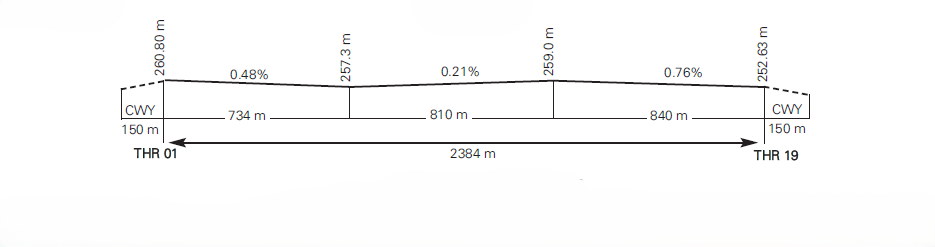
01 |
011.42° GEO |
2384 x 45 |
421317.2661N 0083746.5676W |
THR: 261 m / 856 ft TDZ: No |
No |
150 x 150 |
2504 x 180 (6) (7) |
No |
90 x 90 |
RWY: ASPH PCN 73/F/A/W/T (1) PCN 96/F/C/W/T (2) PCN 122/F/A/W/T (3) PCN 132/F/A/W/T (4) PCN 146/F/A/W/T (5) SWY: No |
19 |
191.43° GEO |
2384 x 45 |
421433.0227N 0083725.9675W |
THR: 252.6 m / 829 ft TDZ: 257.9 m / 846 ft |
No |
150 x 150 |
2504 x 180 (6) (7) |
Yes |
90 x 90 |
RWY: ASPH PCN 73/F/A/W/T (1) PCN 96/F/C/W/T (2) PCN 122/F/A/W/T (3) PCN 132/F/A/W/T (4) PCN 146/F/A/W/T (5) SWY: No |
Remarks: (1) First 150 m RWY 01 and last 150 m RWY 19. (2) 150 m - 1500 m RWY 01 and 885 m - 2235 m RWY 19. (3) 1500 m - 2000 m RWY 01 and 385 m - 885 m RWY 19. (4) 2000 m – 2200 m RWY 01 and 185 m - 385m RWY 19. (5) Last 185 m RWY 01 and first 185 m RWY 19. (6) First 360 m from THR 01, width 150 m; From 360 m to 2145 m, width 180 m; increased 30 m to the right of the strip (asymmetric strip); From 2145 m to 2505 m, width 150 m. (7) Runway strip width requirement waived, the runway strip is between 150 m and 180 m wide, less than the 280 m indicated in the regulations. |
||||||||||
Profile
DECLARED DISTANCES
RWY |
TORA (m) |
TODA (m) |
ASDA (m) |
LDA (m) |
|---|---|---|---|---|
01 |
2384 |
2534 |
2384 |
2384 |
19 |
2384 |
2534 |
2384 |
2384 |
Remarks: None. |
||||
APPROACH AND RUNWAY LIGHTING
Runway |
01 |
|
Approach |
Threshold identification lights. LIH. |
|
PAPI (MEHT) |
3° (15.55 m / 51 ft). (1) (2) |
|
Threshold |
Green with wing bars. |
|
Touchdown zone |
No. |
|
Runway centre line |
2385 m: 1485 m white + 600 m white and red + 300 m red. LIH. Distance between lights: 15 m. |
|
Runway edge |
2385 m: 1785 m white + 600 m yellow. LIH. Distance between lights: 50 m. |
|
Runway end |
Red. |
|
Stopway |
No. |
|
Remarks |
(1) PAPI not usable by code letter D or higher aircraft. See item 20. (2) Descent gradient for manoeuvre NDB Z RWY 01 (ROD 6.2%) and descent angle for manoeuvre RNP X RWY 01 (3.5º) are not coincident with the PAPI angle. |
Runway |
19 |
|
Approach |
Precision CAT II/III, 404 m. LIH. Runway lead-in lighting system. Threshold identification lights. |
|
PAPI (MEHT) |
3° (17.40 m / 57 ft). (1) (2) |
|
Threshold |
Green with wing bars. |
|
Touchdown zone |
900 m white. |
|
Runway centre line |
2385 m: 1485 m white + 600 m white and red + 300 m red. LIH. Distance between lights: 15 m. |
|
Runway edge |
2385 m: 1785 m white + 600 m yellow. LIH. Distance between lights: 50 m. |
|
Runway end |
Red. |
|
Stopway |
No. |
|
Remarks |
(1) PAPI not usable by code letter D or higher aircraft. See item 20. (2) In the angular coverage of the left bar of the PAPI, the view of one of the four units is progressively lost due to the GP tower which stands in front of it. |
OTHER LIGHTING, SECONDARY POWER SUPPLY
ABN/IBN |
No. |
|
WDI |
1 near GP, 1 near apron. LGTD. |
|
TWY lighting |
TWY C1 & C3: edge (LIH) and centre line. |
|
Apron lighting |
Edge, 7 floodlighting poles. |
|
Secondary power supply |
Static SAI that provide a switch-over time (light) for CAT II/III according to Annex 14. |
|
Remarks |
LED lighting systems in the TWY C1 and C3 centre lines, stop bars and centre and border lines of the turn pads. |
HELICOPTER LANDING AREA
Position |
FATO: RWY 01/19. See item 12. |
|
Elevation |
FATO: RWY 01/19. Elevation THR 01 and THR 19. See item 12. |
|
Dimensions, surface, maximum weight, marking |
See item 12.
Surface: See item 8 |
|
Directions |
No. |
|
Declared distances |
See item 13. |
|
Lighting |
See item 14 and 15. |
|
Remarks |
PRKG H0 can accommodate helicopters with a maximum total length of 12.20 m. PRKG H1 and H2 can accommodate helicopters with a maximum total length of 16 m. PRKG H3 and H5 can accommodate helicopters with a maximum total length of 22.80 m. PRKG H4 can accommodate helicopters with a maximum total length of 25.40 m. |
Air traffic services airspaceATS AIRSPACE
Designation |
CTR VIGO. |
|
Lateral limits |
422343N 0083202W, 421922N 0083313W, from this point following an arc of 6.5 NM radius centred on LEVX ARP up to 420718N 0083631W, 420327N 0083735W, 420416N 0084306W, 420706N 0084220W, from this point following an arc of 7.5 NM radius centred on LEVX ARP up to 422114N 0083830W, 422433N 0083736W, 422343N 0083202W. |
|
Vertical limits |
SFC - 3500 ft AMSL. |
|
Airspace class |
D. |
|
Unit |
VIGO TWR. ES/EN. |
|
Transition altitude |
1850 m / 6000 ft. |
|
Hours of applicability |
- |
|
Remarks |
Out of the hours of operation, the volume of airspace associated to CTR VIGO will be class G, with flight information service provided by SANTIAGO TACC (see SANTIAGO APP frequency in item 18). |
Air traffic services communication facilitiesATS COMMUNICATION FACILITIES
Service |
Call sign |
FREQ |
HR |
Remarks |
|---|---|---|---|---|
APP |
Santiago APP |
120.200 MHz |
HR AD |
- |
TWR |
Vigo TWR |
118.455 C |
HR AD |
- |
118.955 C |
HR AD |
BACK-UP |
||
121.500 MHz |
HR AD |
EMERG |
||
121.705 C |
HR AD |
GMC |
||
243.000 MHz |
HR AD |
EMERG |
||
ATIS |
Vigo Información |
120.830 C |
HR AD |
- |
D-ATIS |
Vigo Información |
NIL |
HR ATS |
Provision of Vigo ATIS information via data link. |
Radio navigation and landing aidsRADIO NAVIGATION & LANDING FACILITIES
Facility (VAR) |
ID |
FREQ |
HR |
Coordinates |
DME ELEV |
Remarks |
|---|---|---|---|---|---|---|
DVOR (1º W) |
VGO |
113.600 MHz |
H24 |
421916.7N 0083605.9W |
- |
COV at 40 NM BTN:
R-014 COV:
R-047 COV:
R-062 COV:
R-096 COV:
R-110 COV:
|
DME |
VGO |
CH 83X |
H24 |
421916.3N 0083605.2W |
270 m |
COV at 40 NM BTN:
R-014 COV:
R-047 COV:
R-062 COV:
R-096 COV:
R-110 COV:
|
NDB (1º W) |
VON |
433.000 kHz |
H24 |
421109.8N 0083820.4W |
- |
COV 40 NM. |
LOC 19 (1º W) ILS CAT III |
VIG |
110.900 MHz |
H24 |
421312.3N 0083747.9W |
- |
193° MAG/156 m FM THR 01. |
GP 19 |
- |
330.800 MHz |
H24 |
421423.3N 0083725.9W |
- |
3°; RDH 17 m; at 294 m THR 19 & 61 m FM RCL to the left on APCH direction. COV 10 NM at 2400 ft, full fly-up indications may not be received BLW GP. |
ILS/DME 19 |
VIG |
CH 46X |
H24 |
421423.2N 0083724.7W |
261 m |
REF DME THR 19. COV 17 NM (15.9 DME) at 4100 ft AMSL AVBL BTN -35º & +18º FM RCL. |
Local aerodrome regulationsLOCAL REGULATIONS
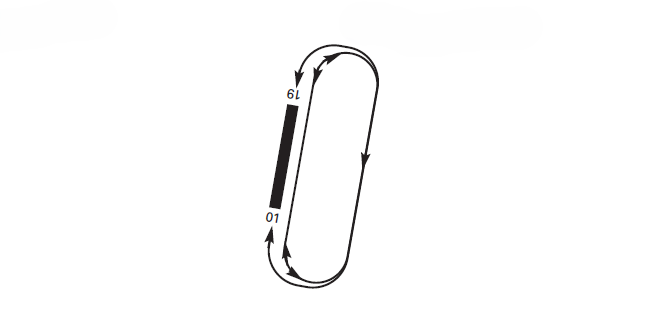
All landing aircraft overshooting the exit taxiways towards the apron, must continue taxiing to accomplish the turn at the end of the runway.
AD closed to aircraft without two-way radio communication.
GENERAL AND BUSINESS AVIATION
It is mandatory to contract a handling agent for all operations of General and Business Aviation, by virtue of what is established in item 1.3.1.6 of AD 1.1 of the AIP-España.
All General and Business operations must comply with the following procedure:
-
The aircraft operator shall request clearance from the Operations Centre (CECOA):
-
TEL: +34-986 268 204/260
-
FAX: +34-986 268 211
-
E-mail: CoordinacionVGO@aena.es
-
AFTN: LEVXYFYX
Including the following information:
-
Date of operation.
-
Aircraft type.
-
Departure aerodrome and ETA to LEVX.
-
Destination aerodrome and ETD from LEVX.
-
Regla de vuelo VFR/IRF.
-
-
Depending on the Remote Tower is active and/or the occupancy of the apron, LEVX Operation Centre (CECOA) will approve this operation or not.
-
If the flight is approved by CECOA and also has to hire a Handling Agent, crew should be aware of the Handling Agent hired at LEVX.
Hiring of handling services is compulsory for General and Business Aviation operations when the MTOW:
-
MTOW > 2 TM with passengers.
-
MTOW > 3.5 TM without passengers.
In these cases, in arrival operations, passengers and crew members shall wait for the arrival of the handling agent.
IFR and VFR flights without previous authorisation will be rejected.
ILS CATEGORY II AND III OPERATIONS
RWY 19, subject to service availability of the appropriate approach and landing aids, is suitable for carrying out CAT II and III operations by those air operators whose operational minima have been approved by the aeronautical civil authority.
STANDARD TAXIING PROCEDURES
GENERAL
-
All surface movements of aircraft, towed aircraft, personnel and vehicles on the manoeuvring area are subject to previous ATC clearance.
-
Any aircraft which on landing overshoots the exit taxiways to the apron, mandatorily shall continue taxiing to make the turn on the turning pads at the end of the runway.
-
Collision avoidance with other aircraft or obstacles is the responsibility of:
-
pilots, when taxiing and entering the stand.
-
handling companies during towed push-back manoeuvres.
-
ATC on the manoeuvring area.
-
START-UP OF ENGINES/TURBINES
Before an aircraft starts up its engines, the handling agent or air company must check that both pedestrians and vehicles comply with the distances to the engines specified in the apron safety regulations.
To avoid automatic suspension of the FPL, the EOBT must be maintained up to date.
-
Pilots shall request permission to start up the engines / turbines on the frequency corresponding to Vigo TWR. When that permission is requested, the aircraft must be completely ready for the start-up or in conditions to do so within a maximum period of 5 minutes; otherwise the pilot shall notify ATC to that effect.
-
On requesting start-up, pilots shall indicate the complete call sign of the aircraft and the stand occupied.
-
The start-up request must be made, considering that the aircraft is ready to exit its stand, with the following criteria:
-
Aircraft with assigned CTOT: 10 minutes before their CTOT, if they are parked on stands with exit by towed push-back, or 5 minutes before their CTOT for the remaining stands.
-
Aircraft without assigned CTOT: if they need towed push-back, a maximum of 5 minutes after their EOBT. In the remaining cases, a maximum of 10 minutes after the EOBT.
-
Depending on the traffic situation, any ATC clearance request made later than these times may be rejected.
ARRIVING AIRCRAFT
-
The controller will inform the aircraft of the stand allocated by the Centro de Coordinación de Operaciones (Operations Coordination Centre) (CEOPS) when approaching the stand with the docking guidance system activated. When vacating the runway and should no stand taxiing instructions be received from ATC, the aircraft shall stop at the end of the section of the taxiway before entering the apron and shall await instructions from the "FOLLOW ME" vehicle.
-
Taxiing restrictions: TWY C1 and C3 should not be used as rapid exit taxiways.
ON DEMAND FIRE CATEGORY REQUEST PROCEDURE
Vigo Airport provides category SEI 7 continuously and 8 and 9 on demand. In the case of category SEI 9, only these aircraft will operate: A124; A333; A343, A345; A359; B741, B742, B743, B744, B764, B772, B778, IL96 and MD11.
To operate with category 8 or 9, companies interested must request it by e-mail to coordinacionvgo@aena.es.
The request must be made at least 10 days prior to the expected flight date, and it must contain the following data:
-
Flight number.
-
Flight class.
-
Type of aircraft.
-
Date and time expected.
Confirmation of category 8 or 9 shall be made using the same e-mail address from which it was requested.
HELICOPTER OPERATION
This section defines the landing, take-off, taxiing and parking operations for any helicopter operating during the operational hours of the airport.
Since no other specific area has been defined for helicopter operation at Vigo airport, helicopters are treated as fixed-wing aircraft and will be cleared by ATC to take off and land on the runway.
Exceptions: see Remarks.
ARRIVALS
Helicopters will approach aligned with the runway, land via RWY 01/19 and leave the runway via TWY C1 or TWY C3 following ATC instructions, before continuing on the apron taxiway to the stand, guided at all times by the "FOLLOW ME" vehicle.
For RWY 19 approaches with LVP, the runway must be vacated via TWY C3, guided at all times by the "FOLLOW ME" vehicle.
DEPARTURES
Helicopters will take off from RWY 01/19. They will start taxiing from the stand via the apron taxiway to the TWY C1 or TWY C3 holding position, following ATC instructions.
TAXIING ROUTES
Helicopters will be cleared to enter or leave RWY 01/19 via TWY C1 and C3. They will enter the apron via these standardized taxiways and proceed to the assigned stand.
RWY 01 in use:
-
Departures: Helicopters will taxi by air or ground (as appropriate) via TWY C1 or C3, as indicated by ATC.
-
Arrivals: Helicopters will complete the final approach to the runway and vacate it via TWY C1, unless ATC should indicate otherwise. Helicopters will taxi by air or ground, as appropriate, to the assigned stand.
RWY 19 in use:
-
Departures: Helicopters will taxi by air or ground (as appropriate) via TWY C1 or C3, as indicated by ATC.
-
Arrivals: Helicopters will complete the final approach to the runway and vacate it via TWY C1 or C3, unless ATC should indicate otherwise. Helicopters will taxi by air or ground, as appropriate, to the assigned stand.
Once on the apron, the stand access taxiway will be used for both air and ground taxiing, following its centre line marking, both on arrival and departure.
REMARKS
Helicopters based at the Vigo airport holding an exemption letter under the terms laid down in SERA article 4, items 1 and 3, and RD 552/14 Chapter VIII, and in coordination with and subject to clearance by ATC, will be allowed to take off and land from FATOs C1 and C3. Otherwise, they will be treated as fixed-wing aircraft and cleared by ATC to take off and land on the runway.
Following ATC clearance, operations from these designated FATOs will only be carried out for emergency operational flights, in special circumstances such as crosswinds or tailwinds greater than 10 kts, and when reducing the taxiing distance is advisable due to weather conditions.
These helicopters shall comply with and operate in accordance with the airport manager's local procedure.
Restrictions in the use of FATOs C1 and C3:
-
ATC will establish the appropriate procedures to separate the departures and arrivals of helicopters using "FATO C3" or "FATO C1" from the aircraft using RWY 01/19. Simultaneous landing, overflying or take-off operations on the runway and FATO are not allowed, since these operations are considered dependent.
-
From "FATO C3", and for Southbound take-offs (heading 19) and Northbound landings (heading 01), helicopters will only operate in performance 1 during the hours from sunrise to sunset.
-
The following operations will not be performed from "FATO C3": heading 01 take-offs and heading 19 approaches/landings, if any of the following PRKG 6 and 7A, are occupied by an aircraft.
-
Aircraft taxiing and vehicle traffic along the taxiway on apron C1-C3 and TWY C3 are forbidden during helicopter landing/take-off operations from "FATO C3". Thus, vehicles using the taxiway on apron C1-C3 shall actively monitor the TWR frequency at all times, in order to avoid driving along that taxiway during "FATO C3" operations. Furthermore, the movement area inspection service, carried out by TOAM, continuously ensures that these helicopter operations are safely monitored from "FATO C3", verifying that there is no vehicle traffic in the taxiway on apron C1-C3 during these operations.
-
During helicopter Southbound landings (heading 19) / Northbound take-offs (heading 01) from "FATO C3", engine testing in PRKG 1, 1A, 1B, 2 and 3 is forbidden.
-
The most restrictive helicopter to operate in "FATO C3" and "FATO C1" is SIKORSKY S-76 SPIRITS76C.
OPERATIONS OF CODE LETTER D, E AND F (AN-124 Ruslan) AIRCRAFT
Neither the arrival nor stay of code letter above C aircraft will be authorised without prior authorisation from the airport. For this reason, for a code letter D, E or F (AN-124 Ruslan) aircraft to be able to operate at the airport, prior request by the air company or handling agent is mandatory, as is explicit authorisation by the airport. Either the request, by the airline or the handling agent, as well as the authorisation or not of that operation by CECOA, will be communicated via e-mail.
PROCEDURE OF OPERATION:
-
Arrivals: ATC will indicate the taxiing route depending on the configuration of the landing runway:
-
Code letter D and E aircraft: landing by RWY 01/19: taxiing via TWY C1/C3.
-
Code letter F (AN-124 Ruslan) and E aircraft with wingspan larger than that of the B777-300 (E > 60.90 m): landing by RWY 01/19: taxiing via TWY C1.
-
-
Departures:
-
Code letter D and E aircraft: take-off by RWY 01/19 and following ATC instructions, the taxiing route may also be via TWY C1/C3.
-
Code letter F (AN-124 Ruslan) and E aircraft with wingspan larger than that of the B777-300 (E > 60.90 m): take-off by RWY 01/19 and following ATC instructions; the taxiing route may only be via TWY C1.
-
-
Stand:
-
Code letter D aircraft may only park on PRKG 1A (in remote position and towed exit), PRKG 5 (in loading bridge position and towed exit) and PRKG 7A (in remote position and autonomous exit).
-
Code letter E aircraft may only park on PRKG 7A (in remote position and autonomous exit).
-
Code letter F (AN-124 Ruslan) aircraft may only park on PRKG 7A (in remote position and autonomous exit).
-
Code letter D (AN12) aircraft may park on PRKG 10A.
-
RESTRICTIONS:
-
For the code letter F aircraft AN-124 Ruslan and the code letter E aircraft with wingspan larger than the B777-300 (E > 60.90 m), the TWY C3 is restricted and shall use TWY C1.
-
By PCN, the following higher code letter aircraft cannot operate at the airport, except for emergency landings: A300-600, MD-11, B747-400 and B777-300.
-
Due to the distance of 176 m between the centre line of the TWY on apron C1-C3 and the centre line of RWY 01/19, during the taxiing of code letter E and F aircraft (AN-124 Ruslan), only one aircraft will be allowed to move in the following area of the movement area delimited by: the RWY section parallel to the TWY on apron C1-C3 and the TWY on apron C1-C3.
-
For aircraft possessing these, it is required that during taxiing on the surface, that the exterior engines 1 and 4 of the aircraft are off, preferably, or idling, to avoid the generation and ingestion of FOD (Foreign Object Deposits).
-
As there is less than 4.5 m between the exterior wheel of the main gear of the aircraft and the edge of TWY C3, code letter D and E aircraft must make oversteer manoeuvres to correct their path on the curved segments of TWY C3 towards/from THR 01. That manoeuvre will be supported by a "FOLLOW ME" vehicle.
-
As there is less than 4.5 m between the exterior wheel of the main gear of the aircraft and the edge of the apron taxiway between PRKG 10 and 8, code letter D, E and F (AN-124 Ruslan) aircraft must make oversteer manoeuvres to correct their path on this slightly curved segment of the apron taxiway towards/from TWY C1. That manoeuvre will be supported by a "FOLLOW ME" vehicle.
-
As there is less than 4.5 m between the exterior wheel of the main gear of the aircraft and the edge of the turning pad at THR 01 and 19, code letter E aircraft must take caution in the straight segment during the entry to those turning pads.
-
The wheel clearance over threshold requirements are not met, thus PAPI of RWY 01/19 is not usable by these aircraft.
-
The following higher code letter aircraft, A340-600, A350-1000, B777-300, AN124 and B763, shall carry out an oversteering manoeouvre on the turning pad of both thresholds, in order to ensure the manoeouvre safety and/or to comply with the turning path.
STAND RESTRICTIONS
PRKG 4, 5, 6 and 8 are equipped with 400 Hz current supply facilities:
-
It is mandatory to use the 400 Hz facilities.
-
The aircraft APU (Auxiliary Power Unit) may only be used when the 400 Hz facilities or mobile units are not operative, or when the air conditioning service is required and the equipment is not available.
-
The use of a harness hook is recommended for fastening of the 400 Hz system to the aircraft. Otherwise, the airport authority will not accept responsibility for any damage the aircraft could suffer.
-
The connection of the 400 Hz system will not be carried out until:
-
The aircraft engines, propellers and rotors will have been stopped, the anti-collision lights will have been switched off and the chocks will have been inserted.
-
Any deviations from the requirement for airlines and/or the specific aircraft type must be justified by the handling agent by means of a specific procedure analyzed by the airport SMS (Safety Management System) for subsequent clearance/approval by the competent authority, if appropriate.
This procedure must take into account:
-
No operation, including 400 Hz, will be carried out until the chocks are inserted.
-
The approach to the aircraft will be made avoiding the safety area in front of the engines (Art. A.2.11 and A.2.12 of Aena Apron Safety Rules). Neither boarding bridge nor any mechanism connecting with it will enter the safety area in front of the engines during the manoeuvre of connecting with the 400 Hz system.
-
In any case, the switched-on engine must be maintained at the minimum power and the cockpit crew must remain at their posts.
ENERGY SAVING POLICY, SHUTDOWN OF SURFACE AERONAUTICAL LIGHTS
Vigo Airport, within its operational hours and if there are no operations expected, applies energy saving procedures that involves the shutdown of the following Surface Aeronautical Lights (LAS): taxiway centre line and edge lights, runway centre line and edge lights and approach lights.
The stop bars on the two taxiways and the in use runway PAPI will remain lit during all operational hours.
NIGHT-TIME VISUAL OPERATIONS (VFR-N)
VFR-N flights are allowed.
OPERATIONAL SAFETY REPORTS
Pilots/operator shall report to the airport as soon as possible any accidents, incidents, occurrences or events which may have a potential operational impact and in which they have been involved or witnessed.
The aim of these reports is the compilation of the information in order to improve operational safety, independently of the mandatory reporting of the occurrence to the appropriate aeronautical authority. Data may be sent in any format, including at least the following information:
-
Date and time.
-
Site.
-
Parties involved (data used to identify vehicles, aircraft…involved).
-
Companies implicated.
-
Description of the facts.
-
Any other data considered relevant (e.g. lighting conditions, weather, phase of the operation such as take-off / landing / stopover, pavement conditions…).
Contact e-mail address of the airport, for the reception of operational safety reports, is the following: Seguridad_Operacional_VGO@aena.es
In addition to notifying the airport by means of the indicated system, it is necessary to send at least basic data of the accident, incident, occurrence or event to the air traffic control service provider (ATC).
POINT OF ENTRY FOR PASSENGERS WITH PET ANIMALS FROM THIRD COUNTRIES
To guarantee compliance with the Regulation (EU) No 576/2013 of the European Parliament and of the Council of 12 June 2013 on the non-commercial movement of pet animals and repealing Regulation (EC) No 998/2003, any Air Carrier wishing to operate at the Airport and transport in the cabin, as part of passenger hand baggage, the animals (pets) set out in Annex I to the cited Regulation, must have engaged a handling agent who is to be responsible for managing the same in those cases where, during the checks undertaken by the Resguardo Fiscal of the Guardia Civil or Customs Personnel of the Passenger Terminals of Vigo Airport, some breach of the health requirements established in the cited regulations is detected, prompting the animal's rejection at the point of entry.
The management for animals rejected at the border shall include, at least, transport to the designated facilities for its temporary stay at the airport, their subsistence, veterinary care and animal welfare, and even their return to origin within the periods stipulated by the public health authorities.
NOISE ABATEMENT PROCEDURES
No.
FLIGHT PROCEDURES
RADAR DISPLAY SYSTEM
The aerodrome air traffic controllers will maintain all the operations taking place at the aerodrome or in the vicinity under constant visual surveillance, with access to an ATS surveillance system to support that visual observation, as stipulated in article 4.5.1.3 of the Reglamento de la Circulación Aérea.
All of the foregoing will depend on the limitations of the equipment.
LOW VISIBILITY PROCEDURES (LVP)
GENERAL
RWY 19 is equipped with an ILS CAT II / III and authorised for both CAT II and CAT III approaches.
RWY 01 and 19 are authorised for take-off in low visibility conditions with RVR ≥ 75 m. Take offs with lateral guidance are not authorized.
Landing on RWY 01 is not permitted where LVP are in force.
The pilots will be informed that Low Visibility Procedures are in force through ATIS and RTF via the expression "LOW VISIBILITY PROCEDURES IN FORCE."
LVP will be applied on the ground when the meteorological minima established hereunder hold:
-
Runway Visual Range (RVR) is 1700 m or below or when the cloud ceiling is 122 m (400 ft) or below (BKN/OVC 004 or below).
LVP on the ground will be cancelled when the following meteorological minima hold:
-
Runway Visual Range (RVR) above 1900 m or when the cloud ceiling is higher than 152 m (500 ft) (BKN / OVC at or above 005), for at least 10 minutes and, following consultation with the meteorological office, an improving trend is expected.
Landing: RWY 19, provided that the required installations are in service and are appropriate for CAT II/III operations by those operators whose minima have been accepted, or who hold minima assigned by the Agencia Estatal de Seguridad Aérea or by the equivalent authority of the Operator State.
Take-offs: RWY 01 and 19 are suitable for low visibility take-offs in the predicted conditions (as long as the RVR > 75 m).
Pilots will be informed about the application of LVP by radiotelephone and ATIS. Pilots will also be informed of any notified or detected incident in relation to the visual and non-visual aids for approach, take-off and taxiing, the anti-intrusion systems in critical areas, sensitive areas and the active runway and any other available aid, which may affect the LVP and the existing meteorological conditions, besides modifications which may take place and affect the LVP.
Any notified or detected incidence that may affect the LVP will be immediately communicated to the aircraft and ATC units implicated.
Runway visual range values will be supplied directly by ATC services in accordance with the following:
-
RVR TDZ: Displayed value that corresponds to the Touchdown Zone.
-
RVR MID: Displayed value that corresponds to runway midpoint.
-
RVR END: Displayed value that corresponds to the runway end.
Landing clearance will not be supplied after the aircraft reaches the 2 NM point from the TDZ. If this is not possible, instructions for a missed approach will be issued.
When ILS approaches are taking place, landing clearance will only issued when critical and sensitive ILS areas (LCA and LSA) are vacated.
ATC will inform pilots when the LVP are to be cancelled.
CAT II/III TRAINING APPROACHES
Pilots who want to carry out training CAT II/III precision approaches will request the corresponding clearance from Vigo ATC staff.
If the critical and/or sensitive areas of the ILS are not protected, this circumstance will be notified to the pilot in command of the aircraft. Any other incident affecting the training operation will be communicated as well.
ATC staff will notify the Coordination Office (CECOA) of the call sign of a training aircraft before it begins its approach manoeuvre. The airport service coordinator, after consulting CNS/ATM technical staff and the Operational Technician in the Movement Area (TOAM), will inform ATC staff of the limitations on carrying out that manoeuvre and will proceed to place this on record.
GROUND MOVEMENT
Pilots will proceed to verify the aircraft position at each moment, especially at intersections, checking that taxiing is being executed under conditions of complete safety. In case of being disoriented or in doubt, pilots must stop the aircraft, notify ATC immediately and request the assistance of a "FOLLOW ME" vehicle.
When the value of any RVR is between 1700 m and 600 m (exclusive), there is no restriction of movement in the manoeuvering area, which will be for ATC consideration to authorise the taxing of more than an aircraft at the same time.
If the RVR is 600 m or below, or if the visibilimeters are not available, the visibility is 800 m or below, ATC will only authorise the taxiing of an aircraft within the manoeuvering area.
The apron and the taxiway on apron that runs between C1 and C3 are outside the manoeuvering area, so that taxiway is considered inside the apron. ATC will only authorise the taxing of an aircraft on apron, when RVR values are 600 m or below, or if the visibilimeters are not available, the visibility is 800 m or below.
Thus, if the RVR is 600 m or below, or if no visibilimeters are available, the visibility is 800 m or below, the maximum number of aircraft that can be moved simultaneously in the area of movement is 2.
In the case of code letter E aircraft (with wingspan > 60.90 m, higher than that of B777) and F (AN-124 Ruslan), they will have to leave runway via C1. If the RVR is 600 m or below, or if no visibilimeters are available, the visibility is 800 m or below, ATC will only authorise the taxiing of an aircraft within the manoeuvering area and apron. The maximum number of aircraft that can be moved simultaneously in the movement area is 1.
Arrivals
-
When vacating the runway, pilots will report:
-
RWY vacated.
-
Sensitive area vacated.
-
TWY used.
-
-
For code letter D, E and AN-124 Ruslan of code letter F aircraft, when leaving the runway, the pilots will notify:
-
RWY vacated.
-
TWY used.
-
TWY vacated.
-
Sensitive Area vacated.
-
-
With RVR 600 m or below, or if the visibilimeters are not available, visibility 800 m or below, and whenever the pilot requires guidance to the assigned stand, the aircraft shall await the presence of the "FOLLOW ME" vehicle at the entrance to the parking apron. Pilot will notify the stand and closure of the frequency.
In approach to RWY 19 with LVP, the runway must be vacated via TWY C3.
Exceptions: Code letter E aircraft (with wingspan > 60.90 m, higher than that of B777) and F (AN-124 Ruslan) when not being able to leave runway for TWY C3, will abandon via TWY C1.
Departures
-
Pilots will request clearance for engine start-up or taxiing, notifying the stand occupied.
-
Pilots will report the beginning of taxiing towards TWY C1 or TWY C3. In the event of RVR below 200 m, or if the visibilimeters are not available, the visibility is 800 m or below, the "FOLLOW ME" vehicle will guide the aircraft to the corresponding TWY, when the pilot or the ATC should so request.
-
Pilots will have to stop at the runway-holding position, prior to runway entry.
-
Pilots will report the entry to runway.
-
Whenever a departing aircraft needs to return to the apron, the pilot will inform TWR and wait for new taxiing instructions.
Unless ATC should instruct otherwise, push-back manoeuvres will be accomplished nosing to North direction for RWY 19 and nosing to South direction for RWY 01.
In departures with LVP the runway may be vacated either by TWY C1 or by TWY C3.
In the entry to runway via TWY C3, proceed with caution due to possible confusion of the TWY C3 centre line lights with the THR 01 lights.
COMMUNICATIONS FAILURE AND ANOMALOUS SITUATIONS IN THE MANOEUVRING AREA
Whenever an aircraft or vehicle operating in the manoeuvring area suffers a communications failure, it will follow the procedure below:
-
Departing aircraft: The aircraft will continue by the assigned route to the ATC clearance limit, taking extreme caution, where it will hold its position and will wait for the arrival of the "FOLLOW ME" vehicle that will guide it to the parking position or the designated holding bay/position.
-
Arriving aircraft: If the aircraft has just landed, it will hold its position once it has vacated the runway completely and will wait for the arrival of the "FOLLOW ME" vehicle that will guide it to the designated parking position. If the aircraft already holds ATC taxiing authorisation, it will continue by the designated route, if any, to the ATC clearance limit, taking extreme caution, where it will hold its position and will wait for the arrival of the "FOLLOW ME" vehicle in order to guide it to the parking position or the designated holding bay position.
-
Vehicle: The vehicle will hold its position and will wait for the arrival of a "FOLLOW ME" vehicle in order to guide it to the place to be determined. In case of being in runway or strip of runway, leave those areas towards safe zones, perimeter road and wait for arrival of TOAM.
CONTINUOUS DESCENT OPERATIONS
Depending on traffic situation, and if no need for interrupting the descent is foreseen, aircraft will be cleared to proceed to a standard arrival (STAR), or by means of a "direct to" clearance to an intermediate fix of the STAR, to the IAF, to an intermediate approach fix or to the IF, to the minimum altitude of the IAF or the IF of the instrument procedure (IAC) or the minimum ATC surveillance altitude of the sectors through which the direct route passes, whichever is the higher, so that the descent operation may be accomplished continuously.
ENGINE POWER TEST
Engine power test higher than idling is forbidden in any apron stand. If this test is necessary, a request must be made to CECOA (Airport Coordination Centre, TEL: +34-986 268 204; email: coordinacionvgo@aena.es) who will notify TWR, giving instructions to carry it out at a specific point, always outside the apron.
AD TRAFFIC CIRCUIT
ADDITIONAL INFORMATION
REMOTE TOWER OPERATION (RTWR)
Aerodrome air traffic service is provided from a remote tower in the time periods 0930-1130 and 1430-1630 (LT).
The signal lamp is located on top of the conventional tower, at coordinates 421333.65N 0083757.21W.
FAUNA CONTROL SERVICE
Schedule: Daily service from sunrise to sunset. Outside these hours, minimum fauna control work will be carried out by airport personnel themselves.
ZONES OF BIRD CONCENTRATION
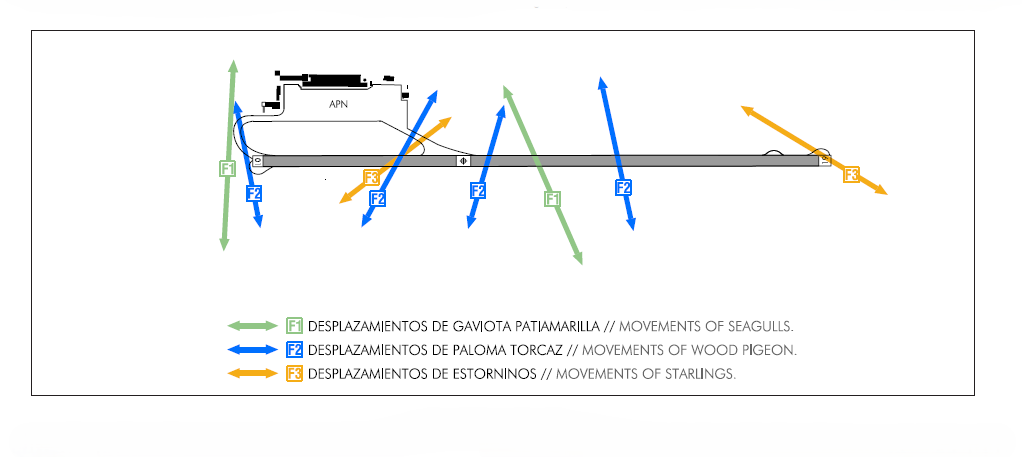
The following zones of natural bird flow areas are located near the airport:
-
F1. Non-constant movements of yellow-legged gulls throughout the year, in the area around Threshold 01 and halfway along the runway. More frequent between March and June. In the winter season, they tend to roost or roam on the runway in search of food.
-
F2. Recurrent movements of common wood pigeons between the two outer sides of the airport. They usually travel at low to medium altitude between the Mixed Forest of the Golf Course and the east section of the site. Increased presence from late summer and during autumn-winter.
-
F3. Movements of spotless starlings between the two sides of the airport, and between these areas and the interior of the site.
Regular presence of common buzzards and occasional presence of mallards.
Aeronautical charts related to an aerodromeCHARTS RELATED TO THE AERODROME
The list of charts related to the aerodrome can be found on the link below:
VISUAL SEGMENT SURFACE (VSS) PENETRATION
The instrument approach procedures affected can be found below:
IAC 3 RNP Y RWY 01: LNAV, LNAV/VNAV.
IAC 4 RNP X RWY 01: LNAV.
IAC 5 ILS Z RWY 19: Direct approach.
IAC 6 ILS Y RWY 19: Direct approach.
IAC 7 LOC Z RWY 19: Direct approach.
IAC 8 LOC Y RWY 19: Direct approach.
IAC 9 RNP Z RWY 19 (LPV ONLY): LPV.
IAC 10 RNP Y RWY 19: LNAV, LNAV/VNAV.