LEZL AD 2 AERODROME DATA
AERODROME LOCATION INDICATOR AND - NAME
LEZL - SEVILLA
AERODROME GEOGRAPHICAL AND ADMINISTRATIVE DATA
ARP |
372505N 0055356W. See AD 2-LEZL ADC. |
|
Distance and direction from the city |
10 km NE. |
|
Elevation |
34 m / 111 ft. |
|
Geoid undulation |
49.75 m ± 0.05 m (1). |
|
Reference temperature |
36°C. |
|
Low average temperature |
10C. |
|
Magnetic variation |
1°W (2020). |
|
Annual change |
7.9E. |
|
AD administration |
Aena. |
|
Address |
Aeropuerto de Sevilla, 41020 Sevilla. |
|
TEL |
+34-954 449 000 |
|
AFTN |
LEZLYFYX |
|
Approved traffic |
IFR/VFR. (2) |
|
Remarks |
Payment of charges in cash is not allowed and should preferably be http://wpastg.aena.es/csee/Satellite?Language=ES_ES&pagename=TPV_Pagos_Aeropuertos (1) For all AD points. (2) See item 20: Local Regulations. |
OPERATIONAL HOURS
Airport |
V: 0430-2300, I: 0530-0000; PS 2 HR PPR. |
|
Customs and Immigration |
HR AD. |
|
Health and Sanitation |
See GEN 1.4. |
|
AIS/ARO |
H24 (1). |
|
MET briefing |
HR AD. PS 1 HR BFR. |
|
ATS |
HR AD. |
|
Fuelling |
HR AD & O/R. |
|
Handling |
HR AD. |
|
Security |
HR AD. |
|
De-icing |
No. |
|
Remarks |
(1) Centralised ARO Office geographical area 11
Centralised AIO Office - International NOTAM Office
|
HANDLING SERVICES AND FACILITIES
Cargo facilities |
No limitations. |
|
Fuel types |
100LL, JET A-1. |
|
Oil types |
SHELL W100. |
|
Refuelling capacity |
Cia Exolum: 100LL:
JET A-1:
Cia SLCA: 100LL:
|
|
De-Icing facilities |
No. |
|
Hangar space |
No. |
|
Repair facilities |
No. |
|
Remarks |
Request of fuel supply:
Commercial aviation handling agents:
Ramp agents may attend both Commercial and General Aviation. General aviation handling agents:
Handling agents for aircraft maintenance:
|
PASSENGER FACILITIES
Hotels |
No. |
|
Restaurant |
Yes. |
|
Transportation |
Taxies, car hire and buses. |
|
Medical facilities |
First aid. (1) |
|
Bank/Post Office |
No. |
|
Tourist information |
Yes. |
|
Remarks |
(1) Operating hours 05:00 to 01:00 LT. |
RESCUE AND FIREFIGHTING SERVICES
Fire category |
7. (1) |
|
Rescue equipment |
In accordance with the fire category published. |
|
Removal of disabled aircraft |
Available upon prior signing of the declaration of aircraft operator or owner inability to remove it by its own means and exemption from liability for the airport management. The airport makes available to the ACFT owner or operator, the following specific equipment:
Aerodrome coordinator contact for removal of disabled aircraft:
|
|
Remarks |
(1) 8 and 9 occasionally (see item 20, "Procedure for the request of occasional fire category). |
RUNWAY SURFACE CONDITION ASSESSMENT AND REPORTING, AND SNOW PLAN
Type of clearing equipment |
Not applicable. |
|
Clearance priorities |
Not applicable. |
|
Use of material for movement area surface treatment |
Not applicable. |
|
Specially prepared winter runways |
Not applicable. |
|
Remarks |
Runway surface condition assessment and reporting in accordance with the Global Reporting Format (GRF) methodology described in AD 1.2.2. Aerodrome in service during all seasons of the year. |
APRONS, TAXIWAYS AND CHECK LOCATIONS/POSITIONS DATAMOVEMENT AREA DETAILS
Apron |
Surface: Concrete and asphalt. Strength: R-1: PCN 63/R/C/W/T; R-2: PCN 88/R/C/W/T; R-3: PCN 99/R/C/W/T; R-4: PCN 82/R/C/W/T; R-5: PCN 104/R/C/W/T. |
|
Taxiways |
Width: 23 m. Surface: Asphalt. Strength: A3, A4, A5, HP2, HP3, HP4: PCN 119/F/A/W/T; HP1: PCN 76/F/C/W/T; A1, A2, E1, E2, E3, E5, G6, G8: PCN 80/F/D/W/T; S2: PCN 45/F/C/W/T; HP5: PCN 58/F/A/W/T; G7: PCN 133/F/B/W/T; N2: PCN 49/F/B/W/T. |
|
Check locations |
Altimeter: Apron: 26 m / 85 ft. VOR: No. INS: See AD 2-LEZL PDC. |
|
Remarks |
None. |
SURFACE MOVEMENT GUIDANCE AND CONTROL SYSTEM AND MARKINGSTAXIING GUIDANCE SYSTEM AND MARKINGS
Taxiing guidance system |
NO ENTRY signs, mandatory instructions and information boards LGTD, runway-holding positions, stop bars, runway guard lights, stands and visual docking guidance system. (1). |
|
RWY markings |
Designators, centre line, side stripe, threshold, aiming point and touchdown zone. |
|
TWY markings |
Centre line, edge and enhanced centre line in TWY E5, HP1, HP2, HP3, HP4 and S2. |
|
Remarks |
(1) See AD 2-LEZL PDC. |
AERODROME OBSTACLES
Obstacles in Approach, Take-Off Climb, Conical, Inner Horizontal, Transitional, Inner Transitional and Balked Landing Surfaces established in ICAO Annex 14; and the areas 2A and 3 established in ICAO Annex 15. Those penetrating these surfaces are identified in the CSV file as "Relevante_Relevant = Si/Yes". |
See Item 10 and Data Set. |
|
Remarks |
See AD 2-LEZL AOC. |
METEOROLOGICAL INFORMATION PROVIDEDMETEOROLOGICAL SERVICE PROVIDED
MET office |
Sevilla EMAe. |
|
HR |
HR AD. PS 1 HR BFR. Outside this schedule, a half-hourly METAR AUTO will be issued. |
|
METAR |
Half-hourly. |
|
TAF |
24 HR. |
|
TREND |
Yes. |
|
Briefing |
In person and by telephone. |
|
Flight documentation/Language |
Charts and plain language / Spanish. |
|
Charts |
Forecasted significant and wind and temperature in altitude maps. |
|
Supplementary equipment |
Aeronautical meteorological self-service. Cloud, lightning image and radar information display. |
|
ATS unit served |
TWR, APP. |
|
Additional information |
Sevilla OMAe (LESV): H24
Sevilla EMAe: HR AD
|
|
Remarks |
Aerodrome climatological summary available. Aerodrome warnings available. |
RUNWAY PHYSICAL CHARACTERISTICS
RWY |
Direction |
DIM (m) |
THR PSN |
THR ELEV |
SWY (m) |
CWY (m) |
Strip (m) |
OFZ |
RESA (m) |
RWY/SWY SFC |
|---|---|---|---|---|---|---|---|---|---|---|
09 (1) |
089.74° GEO |
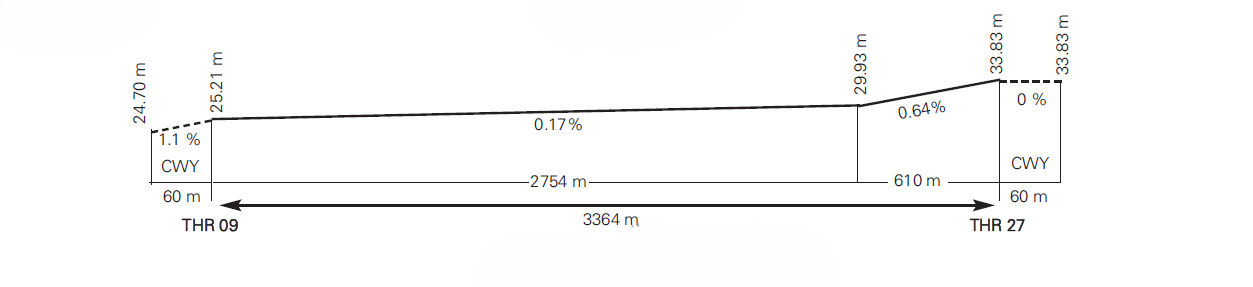
3364 x 45 |
372504.37N 0055443.47W |
THR: 25.2 m / 83 ft |
No |
60 x 150 |
3484 x 280 (2) |
No |
90 x 150 |
RWY: ASPH |
27 (3) |
269.77° GEO |
3364 x 45 |
372504.83N 0055226.75W |
THR: 33.8 m / 111 ft |
No |
60 x 150 (4) |
3484 x 280 (2) |
No |
240 x 150 |
RWY: ASPH |
Remarks: (1) End RWY 09 coordinates: 372504.83N 0055226.75W. (2) Unpaved. (3) End RWY 27 coordinates: 372504.37N 0055443.47W. (4) 50 m blast resistant area. |
||||||||||
Profile
DECLARED DISTANCES
RWY |
TORA (m) |
TODA (m) |
ASDA (m) |
LDA (m) |
|---|---|---|---|---|
09 |
3364 |
3424 |
3364 |
3364 |
27 |
3364 |
3424 |
3364 |
3364 |
Remarks: None. |
||||
APPROACH AND RUNWAY LIGHTING
Runway |
09 |
|
Approach |
Precision CAT I, 900 m LIH. (2) |
|
PAPI (MEHT) |
3° (16.14 m/53 ft). (1) |
|
Threshold |
Green with wing bars. LIH. |
|
Touchdown zone |
No. |
|
Runway centre line |
3364 m: 2464 m white + 600 m red/white + 300 m red. LIH. (2). Distance between lights: 15 m. |
|
Runway edge |
3364 m: 2764 m white + 600 m yellow. LIH. Distance between lights: 45 m. |
|
Runway end |
Red. LIH. |
|
Stopway |
No. |
|
Remarks |
(1) Not suitable for use by code letter F aircraft: AN124, A380-800 and B747-8. (2) LED lighting. |
Runway |
27 |
|
Approach |
Precision CAT I, 900 m LIH. (2) |
|
PAPI (MEHT) |
3° (15.53 m/51 ft). (1) |
|
Threshold |
Green with wing bars. LIH. |
|
Touchdown zone |
No. |
|
Runway centre line |
3364 m: 2464 m white + 600 m red/white + 300 m red. LIH. (2). Distance between lights: 15 m. |
|
Runway edge |
3364 m: 2764 m white + 600 m yellow. LIH. Distance between lights: 45 m. |
|
Runway end |
Red. LIH. |
|
Stopway |
No. |
|
Remarks |
(1) Not suitable for use by code letter F aircraft: AN124, A380-800 and B747-8. (2) LED lighting. |
OTHER LIGHTING, SECONDARY POWER SUPPLY
ABN/IBN |
No. |
|
WDI |
1 near THR 09, 1 near THR 27, 1 near TWY A4. LGTD. |
|
TWY lighting |
Centre line (1), EXC S2 and HP5. Edge: S2 and HP5. LIH. |
|
Apron lighting |
Floodlighting poles. |
|
Secondary power supply |
Engine generators that provide a maximum switch-over time of 1 second for the visual aid systems and a maximum of 15 seconds for the terminal buildings and apron lighting. |
|
Remarks |
(1) LED lighting. |
HELICOPTER LANDING AREA
Position |
FATO: RWY 09/27. THR 09 and THR 27 coordinates, see item 12. Ground taxiing: TLOF same as RWY 09/27. THR 09 and THR 27 coordinates, see item 12. Air taxiing: TLOF same as PRKG 06, 12 and 40 in General Aviation apron and PRKG 37 and 39 on the Commercial Aviation apron. |
|
Elevation |
FATO: RWY 09/27. THR 09 and THR 27 elevation, see item 12. Ground taxiing: TLOF same as RWY 09/27. THR 09 and THR 27 elevation, see item 12. Air taxiing: TLOF same as PRKG 06, 12 and 40 in General Aviation apron and PRKG 37 and 39 on the Commercial Aviation apron. |
|
Dimensions, surface, maximum weight, marking |
FATO: RWY 09/27. Ground taxiing: TLOF same as RWY 09/27, see item 12. Air taxiing: TLOF same as PRKG 06, 12 and 40 in General Aviation apron and PRKG 37 and 39 on the Commercial Aviation apron. PRKG 40: concrete PCN 63/R/C/W/T. Circular strip of 50 cm width and inner diameter of 8.75 m. PRKG 06 and 12: concrete PCN 63/R/C/W/T. Circular strip of 50 cm width and inner diameter of 4.50 m. PRKG 37 and 39: concrete PCN 88/R/C/W/T. Circular strip 50 cm width and inner diameter of 9.85 m. |
|
Direction |
See item 12. |
|
Declared distances |
See item 13. |
|
Lighthing |
See item 14. |
|
Remarks |
Apron lighting. |
PRKG |
ELEV (m) |
TAXIING TYPE |
MAX HELICOPTER |
|---|---|---|---|
06 |
24.98 |
Ground and air taxiing |
H269 |
12 |
24.86 |
Ground and air taxiing |
H269 |
37 |
25.20 |
Air taxiing |
AS32 |
39 |
25.38 |
Air taxiing |
AS32 |
40 |
25.11 |
Air and ground taxiing |
AS 365 |
AIR TRAFFIC SERVICES AIRSPACE ATS AIRSPACE
Designation |
CTR SEVILLA. |
|
Lateral limits |
373002N 0060441W; 373007N 0054413W; 372236N 0054411W; 372236N 0054624W; Circle radius 6.5 NM centred on ARP (372505N 0055356W); clockwise to 372233N 0060127W; 372232N 0060437W; 373002N 0060441W. |
|
Vertical limits |
SFC - 1900 ft AMSL. |
|
Airspace class |
D. |
|
Unit |
SEVILLA TWR. |
|
Transition altitude |
1850 m/6000 ft. |
|
Hours of applicability |
- |
|
Remarks |
None. |
AIR TRAFFIC SERVICES COMMUNICATION FACILITIESATS COMMUNICATION FACILITIES
Service |
Call sign |
FREQ |
HR |
Remarks |
|---|---|---|---|---|
APP |
Sevilla APP |
120.800 MHz |
H24 |
APP/L Sector APP/N |
124.730 C |
H24 |
APP/H Sector APP/N BACK-UP |
||
128.500 MHz |
H24 |
APP/H Sector APP/S |
||
264.700 MHz |
H24 |
MIL |
||
278.400 MHz |
H24 |
APP/MIL Sector APN/N |
||
TWR |
Sevilla TWR |
118.105 C |
HR ATS |
- |
121.500 MHz |
HR ATS |
EMERG |
||
121.705 C |
HR ATS |
GMC |
||
243.000 MHz |
HR ATS |
EMERG |
||
278.075 MHz |
HR ATS |
MIL |
||
VDF |
Sevilla gonio |
118.105 C |
HR ATS |
- |
121.500 MHz |
HR ATS |
- |
||
ATIS |
Sevilla Information |
118.180 C |
HR ATS |
- |
D-ATIS |
Sevilla Information |
NIL |
HR ATS |
Provision of ATIS information via data link. |
RADIO NAVIGATION AND LANDING AIDSRADIO NAVIGATION & LANDING FACILITIES
Facility (VAR) |
ID |
FREQ |
HR |
Coordinates |
DME ELEV |
Remarks |
|---|---|---|---|---|---|---|
DVOR (1 W) |
SVL |
113.700 MHz |
H24 |
372539.4N 0054544.0W |
- |
COV 40 NM U/S BTN:
R-189 COV 75 NM at 3000 ft AMSL. R-221 U/S:
|
DME |
SVL |
CH 84X |
H24 |
372539.4N 0054544.6W |
120 m |
COV 40 NM U/S BTN:
|
NDB (1 W) |
SPP |
420 kHz |
H24 |
372505.0N 0054743.8W |
- |
COV 40 NM. |
LOC 09 (1 W) |
ISE |
111.100 MHz |
H24 |
372504.9N 0055220.8W |
- |
091° MAG / 145 m FM THR 27, COV 25 NM +/- 10 DEG FM RCL AVBL at 2500 ft AMSL or ABV. |
GP 09 |
- |
331.700 MHz |
H24 |
372500.4N 0055431.4W |
- |
3°; RDH 16.32 m; at 297 m FM THR 09 & 125 m FM RCL to the right on APCH direction. |
ILS/DME 09 |
ISE |
CH 48X |
H24 |
372500.4N 0055431.4W |
30 m |
REF DME THR 09. |
LOC 27 (1 W) |
ISV |
110.100 MHz |
H24 |
372504.3N 0055456.3W |
- |
271° MAG / 314 m FM THR 09, COV 25 NM +/- 10 DEG FM RCL AVBL at 2500 ft AMSL or ABV. |
GP 27 |
- |
334.400 MHz |
H24 |
372500.7N 0055242.5W |
- |
3°; RDH 15.9 m; at 388 m FM THR 27 & 125 m FM RCL to the left in the direction of APCH. |
ILS/DME 27 |
ISV |
CH 38X |
H24 |
372500.7N 0055242.5W |
36 m |
REF DME THR 27. |
LOCAL AERODROME REGULATIONSLOCAL REGULATIONS
REGULATIONS FOR GENERAL AVIATION FLIGHTS
PPR Slot must be requested by general aviation flights with origin/destination outside Spanish territory, in addition to those aircraft with a wingspan of over 13 metres regardless of their origin, except for: hospital, SAR, emergency and State flights.
Flights without authorised PPR shall not be permitted.
Request Slot PPR to Sevilla Operations Centre (CEOPS LEZL):
-
TEL: +34-954 449 202
-
AFTN: LEZLYFYX
-
SITA: SVQOOYA
-
E-mail: svq.ceopstr@aena.es
PPR must include: AD of origin and destination, date/time of ETA and ETD, aircraft type, operator, registration and handling agent. They shall comply with the requirements laid down in Regulation (UE) 2016/399, for this type of flights.
CEOPS LEZL will assign Airport Slot code to the cleared aircraft operations. The flight plan shall include: authorised PPR (item 18), aircraft type (code ICAO), registration, operator, handling agent, departure AD, ETA date/time, destination AD and EOBT date/time.
GENERAL AVIATION HANDLING
Pursuant to the provisions of Section AD 1.3.1.6 of the AIP, all General Aviation and Air Taxi aircraft, except aircraft based at the airport and those whose crews hold a General Aviation pilot identification card, must hire ground handling services to transfer flight crews and passengers.
During arrival operations, passengers and flight crews shall wait on board the aircraft for their handling agent to arrive.
The ground handling company hired must be mentioned in Field 18 of the Flight Plan.
STANDARD TAXIING PROCEDURES
START-UP OF ENGINES/TURBINES
Note: In this section, abbreviations defined in ENR 1.5 are used.
To avert the automatic suspension of flight plans, the EOBT should be maintained up to date.
- Clearance to start-up engines/turbines shall be requested on the GMC frequency or, in the case that this is not attended, on the frequency notified via ATIS or CLD message. When this clearance is requested, the aircraft must be completely ready to start-up immediately.
- For voice requests, pilots shall notify ATC of the full call sign of the aircraft, the stand occupied and the ATIS message received.
- Start-up clearance must be requested as follows:
-
Aircraft without assigned CTOT: From 15 minutes before their EOBT until 5 minutes after their EOBT.
-
Aircraft with assigned CTOT: From 20 minutes before their CTOT until 10 minutes before their CTOT.
-
To improve the predictability of the TTOT, ATC may issue instructions for start-up clearance to be requested at a specific time.
-
In periods of high demand, ATC may apply other values to ensure compliance with the tolerance window of the flight.
REQUEST FOR ATC AND START-UP CLEARANCE VIA DATA LINK
At Sevilla Airport, DCL departure procedures are applied for the ATC clearance and start-up services. For more information about the DCL service, see AIP ENR 1.5, section 3. OUTBOUND FLIGHTS: ATC and start-up clearance via data link.
In cases of discrepancy, voice shall always prevail over data link.
The pilot may request ATC clearance via DCL no earlier than 30 minutes before the EOBT. Approval for start-up and ATC clearance shall be facilitated together, provided that the parameters in AD 2-LEZL, item 20, Standard taxiing procedures, 1.C, are satisfied.
- The pilot shall request ATC and start-up clearance together via RCD. The RCD message should contain the following data:
- Aircraft call sign according to the filled flight plan (FPL).
- Departure aerodrome.
- Parking position.
- Destination aerodrome.
- Letter of the ATIS information received.
- ICAO aircraft type designator.
-
The pilot will receive a message of acceptance, "RCD RECEIVED, or rejection, "RCD REJECTED. When an RCD message is received earlier than the ranges established in AD 2-LEZL, item 20, Standard taxiing procedures, 1.C, the RCD will be accepted and a CLD will be sent with ATC clearance, instructing the crew to call when they are ready and in accordance with their EOBT/CTOT.
-
In the case of acceptance Sevilla Clearances will issue a CLD message with the following fields:
- Aircraft call sign.
- Destination aerodrome.
- Runway assigned for departure.
- Departure procedure (SID). Note: The initial altitude will be that of the published SID.
- SSR code mode A (SQUAWK).
- ADT (Approved Departure Time). Note: ADT = CTOT of the flight, if there is one.
- Next frequency.
- Letter of the current ATIS information.
- Additional information, which shall include the start-up clearance or instructions to request this in the event it is requested before the start-up approval parameters set out in AD 2-LEZL, item 20, 1.C, are satisfied.
- When an FSM message of the type "REVERT TO VOICE PROCEDURES is received, data link communication shall be terminated and the revert to voice procedure will apply.
-
When the CLD message is received, the pilot shall:
-
Revert to voice to request a new clearance if some inconsistency is detected in the message received.
-
Respond via data link with a CDA message if the clearance of the CLD message is considered correct.
-
If not ready to start-up, the pilot shall not accept the clearance and will contact the controller via voice when ready.
-
-
When no CDA message is received from the pilot within the time-out parameter, or a CDA inconsistent with the earlier CLD message is received, the data link communication shall be terminated and a "CDA REJECTED message will be received in the FMS.
-
When a correct CDA message is received, the ATC system will send the aircraft a "CLEARANCE CONFIRMED message in the FMS and the data link communication shall be terminated.
Free text sent in the RCD by the pilot shall not be considered by ATC. Any specific request shall be transmitted by voice.
When an RCD message is received within the ranges established in AD 2-LEZL, item 20, Standard taxiing procedures, 1.C, the RCD will be accepted and a CLD will be sent with ATC and start-up clearance.
Push-back clearance should be requested on the frequency given in the appropriate CLD message, and it may only be approved on that frequency by voice.
REVERT TO VOICE PROCEDURE
When a message of the type "REVERT TO VOICE PROCEDURES is received, or there is some inconsistency in the clearance received, the pilot shall make voice contact with the controller and request a new clearance.
GROUND MOVEMENT
ATC clearances and instructions must be read back.
Due to TWR location, aerodrome control service will not be provided on the apron.
Collision avoidance with other aircraft or obstacles is the responsibility of:
- Pilots when taxiing on the apron.
- Handling companies during towing of aircraft.
Guidance and Parking
TWR will give the stand number to the pilot of the aircraft.
Guidance and parking service by "FOLLOW ME vehicle will not be available for accessing any stand. This service will only be provided to the General Aviation stands for aircraft not based at the airport and at positions where the visual docking guidance system is out of service.
Guidance service by "FOLLOW ME vehicle will also be provided in exceptional cases by request of TWR or the pilot and when the LVP is activated or in adverse meteorological conditions.
Push-back manoeuvres
Autonomous exit is permitted from PRKG 09, under the responsibility of the aircraft commander.
For safety reasons, simultaneous push-backs from adjoining stands will not be cleared.
For all stands, the autonomous exit manoeuvre must be accomplished at minimum power.
Taxiing Routes
Taxiing routes will be assigned as indicated below, unless ATC should issue instructions to the contrary.
- RWY 09 in use
PRKG |
ENTRY BY |
EXIT BY |
|---|---|---|
01, 02 |
GATE G5 |
GATE G4 |
03 to 07 |
GATE G5 or GATE G8 |
GATE G4 |
08, 09 |
GATE G5 or GATE G8 |
GATE G7 |
10 to 19 |
GATE G8 |
GATE G7 |
15A, 16A |
GATE G6 or GATE G8 |
GATE G7 |
15B |
GATE G8 |
GATE G7 |
20 to 24 |
GATE G8 |
GATE G4 |
25 |
GATE G5 |
GATE G4 |
30 |
GATE G4 or GATE G5 |
GATE G4 |
31 |
GATE G3 |
GATE G4 |
32 |
GATE G3 |
GATE G3 or GATE G4 |
33 |
GATE G3 |
GATE G3 |
34, 36, 38 |
GATE G2 |
GATE G3 |
35, 37, 39 |
GATE G2 |
GATE G1 |
40 to 44 and AG |
GATE G1 |
GATE G1 |
- RWY 27 in use
PRKG |
ENTRY BY |
EXIT BY |
|---|---|---|
01 |
GATE G4 or GATE G5 |
GATE G4 |
02 |
GATE G5 |
GATE G8 |
03 to 09 |
GATE G5 or GATE G8 |
GATE G8 |
10 to 19 |
GATE G5, GATE G6 or GATE G8 |
GATE G8 |
15A, 16A |
GATE G6 or GATE G8 |
GATE G8 |
15B |
GATE G6, GATE G7 or GATE G8 |
GATE G8 |
20 to 23 |
GATE G6 or GATE G8 |
GATE G8 |
24 |
GATE G7 |
GATE G8 |
25 |
GATE G5 |
GATE G8 |
33 |
GATE G3 |
GATE G3 |
32 |
GATE G3 |
GATE G3 or GATE G4 |
31 |
GATE G3 |
GATE G4 |
30 |
G4 or G5 |
GATE G4 |
34, 36, 38 |
GATE G2 |
GATE G3 |
35, 37, 39 |
GATE G2 |
GATE G1 |
40 to 44 and AG |
GATE G1 |
GATE G1 |
Power limitations to enter the stand.
Entry into PRKG 34, 35, 36, 37, 38 and 39 shall be accomplished at minimum power.
Carrying out cross-bleed start.
-
Carrying out cross-bleed is only allowed for aircraft with inoperative APU.
-
It is necessary to inform the Airport Operations Center of the need to perform this manoeuvre.
-
Aircraft parked on a remote stand may carry out the manoeuvre in the same stand with the exception of PRKG 10 and 11.
-
Aircraft parked on a contact stand shall carry out the manoeuvre at the pushback point when the push-back has been completed.
TAXIING RESTRICTIONS
- GENERAL
Aircraft classification according to Annex 14, chapter 1 of ICAO:
-
Code letter B or below: Wingspan up to but not including 24 m.
-
Code letter C: Wingspan 24 m up to but not including 36 m.
-
Code letter D: Wingspan 36 m up to but not including 52 m.
-
Code letter E: Wingspan 52 m up to but not including 65 m.
-
Code letter F: Wingspan 65 m up to but not including 80 m.
- GROUND MOVEMENT
Restrictions to taxiways and apron entry gates according to the maximum wingspan:
-
Restricted use by code letter C aircraft: TWY: G1, G2, G3, G9 and G4 (between GATE G3 and GATE G4).
-
Restricted use by code letter D aircraft: TWY: G6 and HP4.
-
Restricted use by code letter E aircraft: TWY: G5, G4 (between GATE G4 and GATE G5), G7 and G8.
-
The use of TWY: N2, S2 and HP5 is only permitted for aircraft bound for the Airbus Defence & Space facilities or the Maestranza military apron, or those holding clearance from the airport.
-
OVERSTEERING AND RESTRICTIONS
-
A340-600: Oversteering on the runway exit taxiways HP1, HP2 and HP3 on the runway entry taxiways HP2 and HP3; when entering and exiting the apron via GATE G4; when entering the apron via GATE G5 from TWY A3; when exiting and entering the apron via GATE G8 from/to TWY A4; and when turning between TWY G7 and G8.
-
A350-1000: Oversteering on the runway exit taxiway HP2; when exiting the apron via GATE G4; when exiting and entering the apron via GATE G8 from/to TWY A4; and when turning between TWY G7 and G8.
-
B777-300: Oversteering on the runway exit taxiways HP1, HP2; when exiting and entering the apron via GATE G4; when exiting and entering the apron via GATE G8 from/to TWY A4; and when turning between TWY G7 and G8.
-
A321, B737MAX10, B757-200 and B757-300: oversteering the turn between TWY G8 and G6.
-
B767-300ER, B767-400ER, DC-10: The use of TWY HP4 is restricted.
PERSONNEL MOVEMENT ON THE APRON
Any movement on foot through the apron shall be carried out through the indicated pedestrian tracks in the service roads or through the existing pavements.
CODE LETTER F AIRCRAFT OPERATION
Operations of code letter F aircraft are not permitted at the Sevilla Airport without prior permission from airport authorities. Therefore, for a code letter F aircraft to operate it is mandatory for the Airline or Handling Agent to request explicit clearance from the Airport Operations Centre.
Stands suitable for use by code letter F aircraft:
-
PRKG 24 (Incompatible 20, 21).
- TAXIING ROUTES
Due to these aircraft characteristics, both on departure and on arrival, code letter F aircraft must be taxiing at reduced speed, with idle engine regime and, whenever possible, with outboard motors off.
- ARRIVALS
This type of aircraft will be carried out by the "FOLLOW ME" vehicle.
The Handling Agent will check before the arrival of the aircraft that there is no equipment or people who may be affected by the parking manoeuvre in the assigned area.
Depending on the runway, the taxiing route will be:
- Landing RWY 09: EXIT VIA E5 OR HP3, CONTINUE TAXIING VIA TWY A ENTERING APRON VIA GATE G8.
- Landing RWY 27: EXIT VIA E1 OR HP1, CONTINUE TAXIING VIA TWY A ENTERING APRON VIA GATE G7.
- DEPARTURES
The Handling Agent will check, before engine ignition, that there is no equipment or people in the safety zone behind the aircraft, including the service road and equipment restriction area in adjacent positions.
Depending on the runway, the taxiing route will be:
- Take-off from RWY 09: EXIT VIA GATE G7 TO CONTINUE TAXIING VIA TWY A TO HP1.
- Take-off from RWY 27: EXIT VIA GATE G8 TO CONTINUE TAXIING VIA TWY A TO HP3.
HELICOPTER OPERATION
Since there is no other specific area to operate with helicopters, these will have the same treatment as fixed-wing aircraft and will be authorised by ATC to take off and land on the runway.
- ARRIVALS
Helicopters will land on RWY 09/27, they will usually exit the runway by TWY E1 and will be cleared by ATC to taxi via TWY A1 in the direction of gate G1 or G2 where they will follow the "FOLLOW ME vehicle indications which will guide them to the assigned stand.
- DEPARTURES
Helicopters will be cleared by ATC to taxi from the stand by gate G1 and TWY A1 to the holding position in E1, where they will wait for ATC instructions.
This procedure does not apply when LVP procedures are active, in such case helicopters shall proceed according to what has been published. (See Item 22).
EXCHANGE OF DATA WITH NMOC-ADVANCED ATC TWR
Seville Airport exchanges information for departing flights by applying the Advanced ATC TWR procedures.
Message exchanges between the local system and the ATM network observe the European standard for A-CDM airports, using the following message types:
-
A-DPI: for all instrumental departure flights.
-
C-DPI: when required.
When start-up approval has been announced and the aircraft starts to exit the stand, the target take-off time (TTOT) is calculated and transmitted to the NMOC (Network Manager Operations Center) via an A-DPI message. Use of the actual off-block time (AOBT) instead of the EOBT of the flight plan, along with the variable taxiing time, increases the precision of the take-off time.
After reception of the A-DPI, DLA or CHG messages that change the flight plan data shall not be accepted. If so regulated, the CTOT assigned before receiving the A-DPI shall be maintained.
If an aircraft has to abort taxiing for technical reasons, the airport shall send a C-DPI message to the NMOC. The result of the C-DPI is that the flight plan will be suspended and the operator will be informed via a FLS message with the comment "Suspended by Departure airport. The flight plan can be activated again by updating the EOBT with a DLA or CHG message.
REGULATIONS FOR FLIGHT TRAINING AND FLIGHT SCHOOLS
All training and schools flights are subject to ATS capacity.
Night VFR:
Due to the capacity of the general aviation apron and for the purpose of noise abatement, schools and flying clubs should request PPR Slot for VFR flights at night to svq.ceopstr@aena.es
The PPR should include the following data:
-
Date and SIBT of arrival.
-
Date and SOBT of departure.
-
Flight number.
-
Aircraft type.
-
Registration.
Local flights at LEZL
-
Local navigation flight SOBT-EIBT. Flight number.
-
Local flight with touch-and-go landing: SOBT-EIBT. Flight number.
Night VFR without PPR clearance shall not be permitted.
Only one night VFR flight with a touch-and-go landing shall be permitted. Night VFR flights with a touch-and-go landing shall stop at 00:00 local time.
SIBT: Scheduled In Block Time. SOBT: Scheduled Off-Block Time. EIBT: Estimated In Block Time.
PROCEDURE FOR THE REQUEST OF OCCASIONAL FIRE CATEGORY
Sevilla Airport provides SEI category 7 continuously and 8 or 9 occasionally. To operate with category 8 or 9 interested companies must request so via:
-
SITA: SVQOOYA
-
E-mail: SVQ_CPOS@aena.es
Requests must be made at least 15 days before the scheduled flight, and must contain the following data:
-
Required ICAO-SEI Category.
-
Aircraft type and model.
-
Flight class.
-
Expected date and time of operation.
Confirmation of Category 8 or 9 will be notified by the same means used when requested.
LIGHTING ENERGY-SAVING PROCEDURE
From sunset to sunrise hours, and in absence of scheduled operations, Sevilla Airport will apply energy-saving procedures consisting of switching off the runway and taxiway aeronautical surface lights.
OPERATIONAL SAFETY REPORTS
Pilots/operator shall report to the airport any accidents, incidents, occurrences or events which may have a potential operational impact and in which they have been involved or witnessed as soon as possible.
These reports are aimed at compiling information to improve operational safety, regardless of the compulsory report of the occurrence to the appropriate aeronautical authority. Data may be sent in any format, including at least the following information:
-
Date and time.
-
Site.
-
Parties involved (data used to identify vehicles, aircraft…involved).
-
Companies involved.
-
Description of the facts.
-
Any other data considered relevant (e.g. lighting conditions, weather, phase of the operation such as take-off / landing / stopover, pavement conditions…).
The contact e-mail address of the airport for the reception of operational safety reports is the following:
SeguridadOperacionalSVQ@aena.es
In addition to notifying the airport through the indicated system, at least basic data of the accident, incident, occurrence or event shall be sent to the air traffic control service provider (ATC).
NOISE ABATEMENT PROCEDURES
ENGINE TEST
Engine tests higher than idle power are not allowed in any stand of the apron. Engine test clearance higher than idle regime must be requested from the Centro de Operaciones (TEL: +34-954 449 112), which will refuse or approve and shall indicate the procedure to be followed.
FLIGHT PROCEDURES
SPEED LIMITS
Within Sevilla TMA, arrival flights to Sevilla AD under radar control shall adjust their speeds according to the following:
-
Maximum IAS 250 kt at FL120 or lower.
-
IAS 210 kt at the beginning of the final turn to intercept the ILS localizer course when the aircraft is located within 20 NM of the landing threshold.
-
IAS 180 kt once the final turn is completed and established on the ILS localizer when the aircraft is located within 20 NM of the landing threshold.
-
MAX IAS 160 kt when crossing the NDB SPP.
-
Aircraft with cruising IAS lower than the aforementioned shall maintain cruising speed up to the adjusting point concerned.
The MAX IAS permitted for departures is 250 kt until leaving FL120.
RADAR DISPLAY SYSTEM
Above 600 ft, ATS surveillance systems may be used in supplying the aerodrome control service to execute the following functions:
-
Supervision of the flight path of aircraft on final approach;
-
Supervision of the flight paths of other aircraft in the vicinity of the aerodrome;
-
Provision of navigation assistance to VFR flights.
Depending on the availability of the radars which provide coverage to the CTR, the areas or heights for which the indicated uses of the radar are supplied may vary.
The aerodrome air traffic controllers shall maintain all the operations taking place at the aerodrome or in the vicinity under constant visual surveillance, with access to an ATS surveillance system to support that visual observation, as stipulated in article 4.5.1.3 of the Reglamento de la Circulación Aérea.
All of the foregoing shall depend on the limitations of the equipment.
LOW VISIBILITY PROCEDURES (LVP)
GENERAL
Departures in low visibility conditions will be cleared at RWY 09/27 with RVR > 125 m.
Low Visibility Procedures (LVP) will be applied subject to the following conditions:
- When the meteorological minimum values established below, defined in terms of:
- Runway visual range (RVR) for RWY 27, or
- Runway visual range (RVR) for RWY 09, or
- In case of all RVR equipments failure. Horizontal visibility in manoeuvre area are below 550 m, either of them.
Pilots will be informed of the application of Low Visibility Procedures by the appropriate ATC unit on the ATIS system with the following text "LOW VISIBILITY PROCEDURE IN OPERATION".
Pilots will be informed by ATC when the application of the procedures are cancelled, which will take place when meteorological conditions allow a RVR in all visibility meters or if the horizontal visibility is above 800 m during 10 minutes at least and an improvement tendency is expected.
GROUND MOVEMENT
Pilots will proceed to verify at every moment the aircraft position checking that taxiing is being executed under total safety conditions. In the event of being disoriented or in case of doubt, pilots will stop the aircraft and will immediately notify ATC.
Under low visibility conditions (RVR / visibility < 550 m), the following measures will be taken on the apron:
-
The entry to and the exit from the General Aviation stands are not allowed.
-
Exit from PRKG 40 to 44 will be carried out with "FOLLOW ME" vehicle in sight.
Arrivals:
- Aircraft that have already landed will notify on exiting the runway:
- "Runway vacated, in sight of the yellow/green centre line lights and/or runway vacated boards".
- At the entry of the apron, they must wait for the arrival of a "FOLLOW ME" vehicle in order to be guided to the assigned stand, notifying TWR:
- "Follow me is in sight."
Departures:
- Pilots will request clearance for starting-up or taxiing, notifying the stand where they are. In order to establish an improvement on the transit sequence, pilots will avoid requesting clearance for starting-up, pushing-back or taxiing, when RVR values or the meteorological visibility are below their operational minimum.
- When RVR/visibility is below 550 m, the taxiing of only one aircraft at the same time in the movement area will be authorised.
- If a departing aircraft must return to the apron, the pilot will inform TWR and wait for new instructions for taxiing.
- LVC taxiing routes: Exit through the gates for each stand as established in general taxiing procedures and TWY A to HP1 or HP2 for RWY 09 in use and HP3 and HP4 for RWY 27 in use.
- Code letter F aircraft and code letter E model A340-600 aircraft: Take-off operation is not permitted for code letter F or model A340-600 aircraft when this procedure is activated.
- The use of the following roads for vehicles will not be authorised during the application of LVP: perimeter road and access road to runway from SEI. There is no vehicle service road closed within the apron.
- Aircraft taxiing via HP5 or S2:
- Pilots of aircraft leaving via HP5 or S2 who notice a lack of visibility will stop the aircraft, inform TWR and wait for the arrival of a "FOLLOW ME vehicle in order to be guided to the assigned runway threshold to take-off, and will report to TWR: "Follow me in sight".
- When RVR is less than 185 m, guidance of the "FOLLOW ME vehicle will be required for use in TWY HP5 and S2, so in these conditions the aircraft will confirm the presence of a "FOLLOW ME vehicle before entering such taxiways, and will report to TWR: "Follow me in sight".
COMMUNICATIONS FAILURE
Whenever an aircraft or vehicle operating in the manoeuvring area experiences a communication failure, it will comply as follows:
-
Departing aircraft: It will continue through the assigned route to its clearance limit, taking extreme precaution to avoid detours. Once that point has been reached, it must maintain the position and wait for the arrival of a "FOLLOW ME" vehicle in order to be guided to the stand assigned.
-
Arriving aircraft: It will hold the position in the first section of the taxiway in which the sensitive area of the ILS remains free and will wait for the arrival of a "FOLLOW ME" vehicle that will lead it to the assigned stand.
-
Vehicle: It will proceed to leave the "no permanence" area through the point that is closer to its position, and it will then hold its position and wait for the arrival of a "FOLLOW ME" vehicle which will guide it to the assigned place.
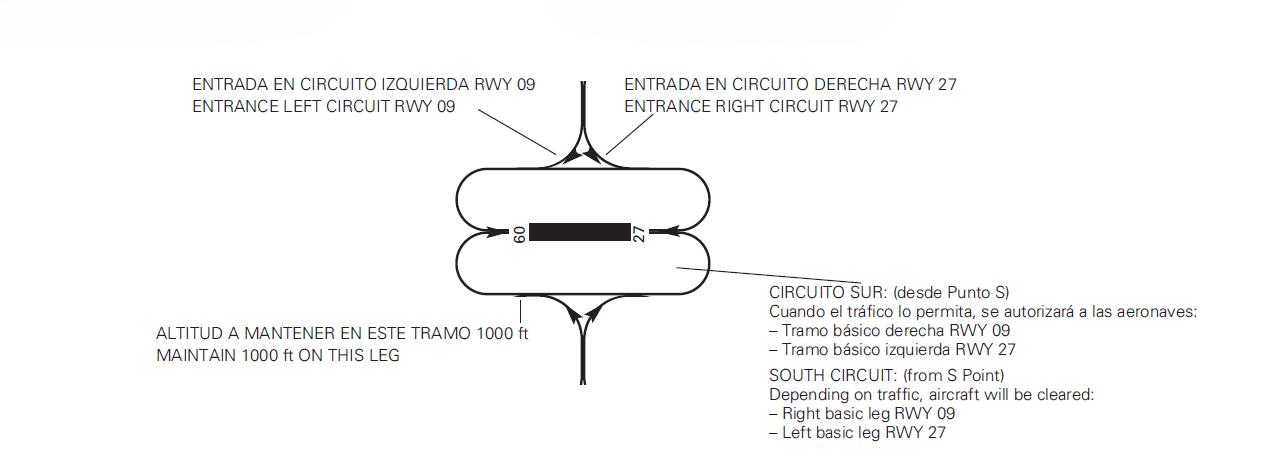
AD TRAFFIC CIRCUIT
ADDITIONAL INFORMATION
MODEL FLYING FIELD
"R.C. Saeta" model flying field located at coordinates 372534N, 0060013W.
Activities shall be performed visually, under VMC and in coordination with LEZL TWR.
Vertical and lateral limits: see ENR 5.5.
Hours of activity: see ENR 5.5.
TETHERED BALLOON ACTIVITY
Tethered balloon activity ascending/descending at the Parque Temático Isla Mágica (Sevilla):
- Coordinates: 372422N 0060001W.
- Schedule: 11:00-23:00 (LT).
- Balloon characteristics:
- Capacity: up to 30 passengers + pilot.
- Diameter: 22.8 m.
- Rate of ascent: 0.8 m/s.
- Rate of descent: 0.65 m/s.
- Maximum height: 150 m.
BIRD CONCENTRATION AREAS
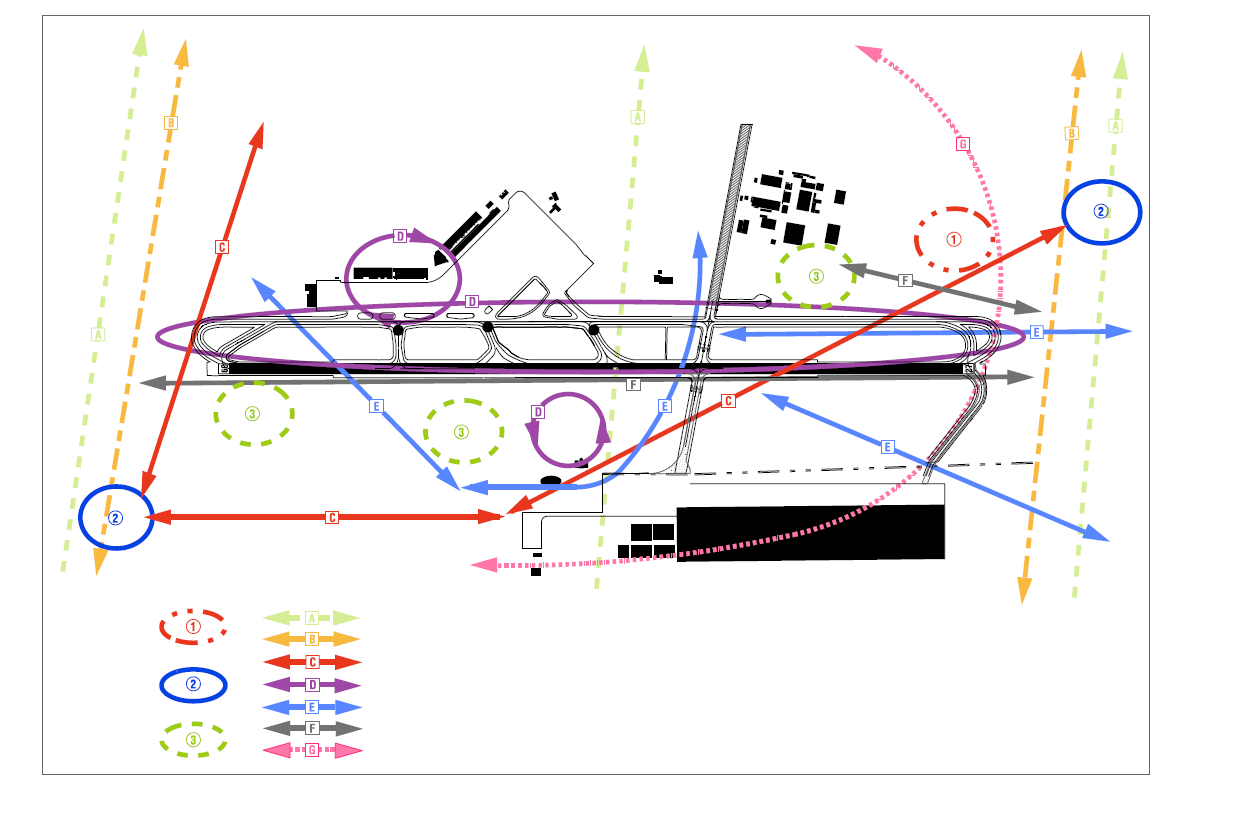
Zone 1: concentration of lapwings and glossy ibises.
Zone 2: concentration of mallards, western cattle egrets and in winter, great cormorants.
Zone 3: concentration of spotless starlings, common sparrows, common linnets, red-legged partridges and stone-curlews.
Beyond the airport surroundings lies the Espacio Natural Doñana, a zone of concentration of aquatic species, birds of prey and storks, about 30 NM to the South-West and with an area of over 100000 ha, and the Espacio Natural Brazo del Este, a zone of concentration of aquatic species and storks, situated 20 NM to the South-West.
BIRD MOVEMENTS
Movement A: Passage in migration from South to North and winter movements of white storks, most abundant from December to March and from September to November. The movements may take place up to about 15 NM to the West and 5 NM to the East of the complex. The most frequent time of passage is from 11:00 to 16:00 local time.
Movement B: Passage in migration of black kites and griffon vultures, from February to April and from August to November. The movements may take place up to about 12 NM to the East of the complex.
Movement C: Passage of mallards all year and, from October to February, of great cormorants.
Movement D: Concentration of swallows and common swifts from March to September.
Movement E: Passage of common buzzards, black kites, booted eagles and common kestrels.
Movement F: Passage of common sparrows, Eurasian skylarks and common linnets.
Movement G: Passage of rock doves, most frequent from August to October.
AERONAUTICAL CHARTS RELATED TO AN AERODROMECHARTS RELATED TO THE AERODROME
The list of charts related to the aerodrome can be found on the link below:
VISUAL SEGMENT SURFACE (VSS) PENETRATION
The instrument approach procedures affected can be found below:
IAC 1 ILS Z RWY 09: Direct approach.
IAC 2 ILS Y RWY 09: Direct approach.
IAC 3 LOC Z RWY 09: Direct approach.
IAC 4 LOC Y RWY 09: Direct approach.
IAC 5 VOR RWY 09: Direct approach.
IAC 6 ILS Z RWY 27: Direct approach.
IAC 7 ILS Y RWY 27: Direct approach.
IAC 8 ILS X RWY 27: Direct approach.
IAC 9 ILS W RWY 27: Direct approach.
IAC 10 LOC Z RWY 27: Direct approach.
IAC 11 LOC Y RWY 27: Direct approach.
IAC 12 LOC X RWY 27: Direct approach.
IAC 13 LOC W RWY 27: Direct approach.
IAC 14 VOR RWY 27: Direct approach.
IAC 15 NDB RWY 27: Direct approach.