LELL AD 2 AERODROME DATA
AERODROME LOCATION INDICATORAND NAME
LELL - SABADELL
AERODROME GEOGRAPHICAL AND ADMINISTRATIVE DATA
ARP |
413115N 0020618E. See AD 2-LELL ADC. |
|
Distance and direction from the city |
2 km S. |
|
Elevation |
148 m / 485 ft. |
|
Geoid undulation |
49.40 m ± 0.05 m (1). |
|
Reference temperature |
30°C. |
|
Low average temperature |
9ºC. |
|
Magnetic variation |
2ºE (2025). |
|
Annual change |
8.9'E. |
|
AD administration |
Aena. |
|
Address |
Aeropuerto de Sabadell - Sabadell (Barcelona). |
|
TEL |
+34-937 282 100 |
|
FAX |
+34-937 282 105 |
|
AFTN |
LELL |
|
Approved traffic |
VFR/VFR especial. (2) |
|
Remarks |
(1) For all AD points. (2) See item 20: Local Regulation. |
OPERATIONAL HOURS
Airport |
V: 0700-SS; I: 0800-SS (1) (Opening will be SR when later than opening hour). Except State and special operations flights according to the RCA. |
|
Customs and Immigration |
HR AD. (2) |
|
Health and Sanitation |
No. |
|
AIS/ARO |
H24 (3). |
|
ARO |
HR AD (4). |
|
MET briefing |
V:0600-SS; I:0700-SS. |
|
ATS |
HR AD. (2) |
|
Fuelling |
HR AD. |
|
Handling |
HR AD. |
|
Security |
H24. |
|
De-icing |
No. |
|
Remarks |
(1) For other operational hours, prior request, consult NOTAM in force. (2) Air traffic with those signatory Countries of the Schengen Agreement that require customs service shall requesting it 24 HR in advance. Air traffic with Countries non-signatory Countries of the Agreement is not allowed. (3) Centralised AIO Office - International NOTAM Office
(4) ARO service provided from the operations office of the airport. Centralised ARO Office geographical area 5
|
HANDLING SERVICES AND FACILITIES
Cargo facilities |
No. |
|
Fuel types |
100LL, JET A-1. (1). |
|
Oil types |
On request. AEROSHELL W100. |
|
Refuelling |
100LL:
JET A-1:
|
|
De-Icing facilities |
No. |
|
Hangar space |
Consult with management. |
|
Repair facilities |
No. |
|
Remarks |
(1) Fuel handling agent: EXOLUM
|
PASSENGER FACILITIES
Hotels |
No. |
|
Restaurant |
Yes. |
|
Transportation |
Bus. |
|
Medical facilities |
No. |
|
Bank/Post Office |
No. |
|
Tourist information |
No. |
|
Remarks |
None. |
RESCUE AND FIREFIGHTING SERVICES
Fire category |
3. |
|
Rescue equipment |
In accordance with the fire category published. |
|
Removal of disabled aircraft |
Slings, belts and straps. Cut release tools. Load-pulling platform. Maximum aircraft type CONSOLIDATED PBY-5. |
|
Remarks |
None. |
RUNWAY SURFACE CONDITION ASSESSMENT AND REPORTING, AND SNOW PLAN
Types of clearing equipment |
Not applicable. |
|
Clearance priorities |
Not applicable. |
|
Use of material for movement area surface treatment |
Not applicable. |
|
Specially prepared winter runways |
Not applicable. |
|
Remarks |
Runway surface condition assessment and reporting in accordance with the Global Reporting Format (GRF) methodology described in AD 1.2.2. Aerodrome in service during all seasons of the year. |
APRONS, TAXIWAYS AND CHECK LOCATIONS/POSITIONS DATA
Apron |
Surface: R-1: Concrete. R-2, R-3 and R-4: Asphalt. Strength: 1222 Kg / 0.19 MPa. |
|
Taxiways |
Width: 11 m, EXC E5: 30. Surface: Asphalt. Strength: 1222 Kg / 0.19 MPa. |
|
Check locations |
Altimeter: Apron R-1 and R-3: ELEV 146 m/479 ft. Apron R-2: ELEV 143 m/468 ft EXC PRKG 210 to 212: ELEV 139 m/456 ft. Apron R-4: ELEV 136 m/446 ft. VOR: No. INS: See AD 2-LELL PDC. |
|
Remarks |
Parking slopes of apron R-1 above 2.0%. TWY W2 clearance distance between outer main wheel and taxiway edge below 2.25 m. |
SURFACE MOVEMENT GUIDANCE AND CONTROL SYSTEM AND MARKINGS
Taxiing guidance system |
Boards, runway-holding positions and parking positions, intermediate holding positions. |
|
RWY markings |
Threshold, designators, centre line, side stripe and touchdown zone. |
|
TWY markings |
Centre line. |
|
Remarks |
None. |
AERODROME OBSTACLES
Obstacles in Approach, Take-Off Climb, Conical, Inner Horizontal, Transitional, Inner Transitional and Balked Landing Surfaces established in ICAO Annex 14; and the areas 2A and 3 established in ICAO Annex 15. Those penetrating these surfaces are identified in the CSV file as "Relevante_Relevant = Si/Yes". |
See Item 10 and Data Sets. |
|
Remarks |
See AD 2-LELL AOC. |
METEOROLOGICAL INFORMATION PROVIDED
MET office |
Sabadell EMAe. |
|
HR |
V: 0600-SS; I: 0700-SS. Outside this schedule, a half-hourly METAR AUTO will be issued. |
|
METAR |
Half-hourly. |
|
TAF |
24 HR. |
|
TREND |
No. |
|
Briefing |
In person and by telephone. |
|
Flight documentation/Language |
Charts and plain language / Spanish. |
|
Charts |
Significant, forecasted in altitude (wind and temperature) maps. |
|
Supplementary equipment |
Clouds and lightning image and radar information display. |
|
ATS unit served |
TWR, APP. |
|
Additional information |
Valencia OMAe (LEVA): H24
Sabadell EMAe: HR AD
|
|
Remarks |
Aerodrome warning available. |
RUNWAY PHYSICAL CHARACTERISTICS
RWY |
Direction |
DIM (m) |
THR PSN |
THR ELEV TDZ ELEV |
SWY (m) |
CWY (m) |
Strip (m) |
OFZ |
RESA (m) |
RWY/SWY SFC PCN |
|---|---|---|---|---|---|---|---|---|---|---|
13 (1) |
127.09° GEO 125° MAG |
1049 x 30 |
413124.04N 0020602.63E |
THR: 148 m / 485 ft TDZ: No |
No |
No |
1110 x 60 |
No |
No |
RWY: ASPH 1222 Kg / 0.19 MPa SWY: No |
31 (2) (3) |
307.09° GEO 305° MAG |
1049 x 30 |
413106.45N 0020633.58E |
THR: 136 m / 445 ft TDZ: No |
No |
No |
1110 x 60 |
No |
No |
RWY: ASPH 1222 Kg / 0.19 MPa SWY: No |
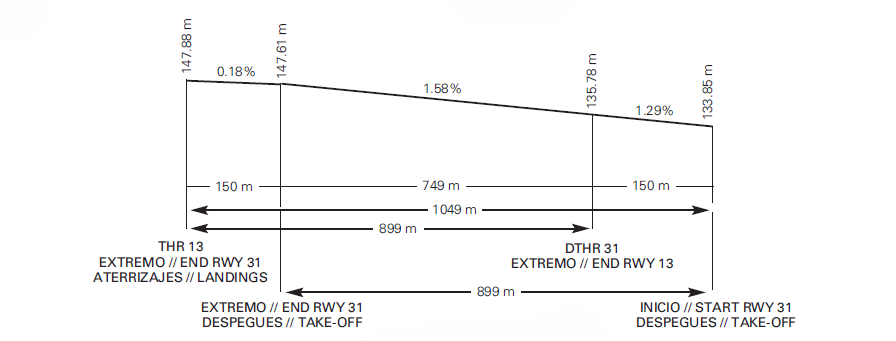
Remarks: (1) The last 150 m are not usable for take-off and landing. End of RWY 13 coordinates: 413106.45N 0020633.58E. (2) THR 31 displaced 150 m. End of RWY 31 coordinates: 413124.04N 0020602.63E. (3) In take-off RWY 31 Coordinates of the beginning of the take-off run RWY 31: 413103.52N 0020638.74E. The last 150 m are not usable. End of RWY 31 DER coordinates: 413121.11N 0020607.79E. |
||||||||||
profile
DECLARED DISTANCES
RWY |
TORA (m) |
TODA (m) |
ASDA (m) |
LDA (m) |
|---|---|---|---|---|
13 |
899 (1) |
899 (1) |
899 (1) |
899 (1) |
31 |
899 (2) |
899 (2) |
899 (2) |
899 (3) |
13 INT C |
646 |
646 |
646 |
– |
13 INT B |
672 |
672 |
672 |
– |
31 INT A |
471 |
471 |
471 |
– |
31 INT D |
497 |
497 |
497 |
– |
31 INT E5 |
759 |
759 |
759 |
– |
31 INT T5 |
771 |
771 |
771 |
– |
Remarks: (1) Due to the fact that the last 150 m are not usable for take-off and landing. (2) Due to the fact that the last 150 m are not usable for take-off. (3) THR 31 displaced 150 m. |
||||
APPROACH AND RUNWAY LIGHTING
Runway |
13 |
|
Approach |
Threshold identification lights. |
|
PAPI (MEHT) |
4.01° (8.18 m / 27 ft). |
|
Threshold |
Green. |
|
Touchdown zone |
White, simple. |
|
Runway centre line |
No. |
|
Runway edge |
599 m white and 300 m yellow. Distance between lights: 61.75 m. |
|
Runway end |
Red. |
|
Stopway |
No. |
|
Remarks |
Runway lighting usually off except PAPI. Switch on shall be on demand of the pilot. |
Runway |
31 |
|
Approach |
Threshold identification lights. |
|
PAPI (MEHT) |
4.05° (7.39 m / 24 ft). |
|
Threshold |
Green. |
|
Touchdown zone |
White, simple. |
|
Runway centre line |
No. |
|
Runway edge |
150 m red, 599 m white and 300 m yellow. Distance between lights: 61.75 m. |
|
Runway end |
Red. |
|
Stopway |
No. |
|
Remarks |
Runway lighting usually off except PAPI. Switch on shall be on demand of the pilot. |
OTHER LIGHTING, SECONDARY POWER SUPPLY
ABN/IBN |
No. |
|
WDI |
1 near THR 13 LGTD, 1 near THR 31 no LGTD. |
|
TWY lighting |
Edge (reflective markers). |
|
Apron lighting |
Floodlighting poles in apron R-3, edge in all apron. |
|
Secondary power supply |
Engine generators that provide a maximum switch-over time (light) of 15 seconds for the following lighting systems: Approach, PAPI, runway edge, threshold and runway end. |
|
Remarks |
None. |
HELICOPTER LANDING AREA
Position |
Geoid undulation: See item 2. FATO: RWY 13/31. Coordinates THR 13 and THR 31, see item 12. Ground taxiing: TLOF same as RWY 13/31. Coordinates THR 13 and THR 31, see item 12. Air taxiing: TLOF same as PRKG 101 to 108, 120 to 122, 302 to 305, hangar entry position adjoining PRKG 302, between PRKG 308 and PRKG 309 and between PRKG 311 and PRKG 312. |
|
Elevation |
FATO: RWY 13/31. Elevation THR 13 and THR 31, see item 12. Ground taxiing: TLOF same as RWY 13/31. ELEV THR 13 and THR 31, see item 12. Air taxiing: TLOF same as PRKG 101 to 108, 120 to 122, 302 to 305, hangar entry position adjoining PRKG 302, between PRKG 308 and PRKG 309 and between PRKG 311 and PRKG 312. |
|
Dimensions, surface, maximum weight, marking |
FATO: RWY 13/31. Ground taxiing: TLOF same as RWY 13/31. See item 12. Air taxiing: TLOF same as PRKG 101 to 108, 120 to 122, 302 to 305, hangar entry position adjoining PRKG 302, between PRKG 308 and PRKG 309 and between PRKG 311 and PRKG 312. PRKG 101 to 108, 120 to 122: Concrete 1222 Kg/0.19 MPa. PRKG 302 to 305 and hangar entry position adjoining PRKG 302: Asphalt. 1222 Kg/0.19 MPa. |
|
Direction |
See item 12. |
|
Declared distances |
See item 13. |
|
Lighting |
See item 15 (1). |
|
Remarks |
(1) Apron lighting. |
AIR TRAFFIC SERVICES AIRSPACE
Designation |
ATZ SABADELL. |
|
Lateral limits |
Circle with an 8 km radius centred on ARP. |
|
Vertical limits |
SFC-3500 ft AMSL. |
|
Airspace class |
D. |
|
Unit Language |
SABADELL TWR (1). ES/EN. |
|
Transition altitude |
1850 m / 6000 ft. |
|
Hours of applicability |
-H24 (2). |
|
Remarks |
(1) Call sign: Sabadell TWR. HR ATS: see item 3. (2) Outside the airport’s operational hours (HR AD), ATZ SABADELL changes from Class D to Class G. Aircraft flying within ATZ SABADELL Class G shall report their intentions on frequency 120.805, for the knowledge of other users of the ATZ. |
AIR TRAFFIC SERVICES COMMUNICATION FACILITIES
Service |
Call sign |
FREQ |
HR |
Remarks |
|---|---|---|---|---|
TWR |
Sabadell TWR |
120.805 C |
HR AD |
- |
121.605 C |
HR AD |
GMC |
||
121.500 MHz |
HR AD |
EMERG |
||
VDF |
Sabadell gonio |
120.800 MHz |
HR AD |
- |
121.500 MHz |
HR AD |
- |
||
121.600 MHz |
HR AD |
- |
||
A/G |
|
123.500 MHz |
HR AD |
Flying club |
RADIO NAVIGATION AND LANDING AIDS
Facility (VAR) |
ID |
FREQ |
HR |
Coordinates |
DME ELEV |
Remarks |
|---|---|---|---|---|---|---|
DVOR (2ºE) |
SLL |
112.000 MHz |
H24 |
413111.5N 0020635.1E |
- |
R-353 low signal intensity FM 48 NM. |
DME |
SLL |
CH 57X |
H24 |
413112.0N 0020635.1E |
150 m / 492 ft |
R-353 low signal intensity FM 50 NM. |
LOCAL AERODROME REGULATIONS
Compass testing zone for helicopters on PRKG 103 and 104.
Compass testing zone for fixed-wing aircraft on apron W3.
UTILISATIONS OF HANGARS
Aircraft using the hangars will contact the Operations office by telephone on +34-937 282 110, prior to exit or after entering into the hangar.
OPERATIONS OF AIRCRAFT WITH WINGSPAN GREATER THAN 17 M
Aircraft with a wingspan greater than 17 m which are going to operate in AD, in departure or arrivals, will communicate their wingspan during their first communication with the ATC aerodrome service.
STATE AIRCRAFT OPERATIONS AND AIRCRAFT IN SPECIAL MISSION OPERATIONS OUT OF OPERATION HOURS
DEPARTURES
-
Advise Airport Security of the departure with as much advance notice as possible, and always prior to start-up (+34-937 282 100). In the course of this telephone call, Airport Security will report whether there are personnel working in the movement area.
-
Mandatory communication on frequency 120.805 C of start-up before take-off.
-
Keep watch on the aforementioned frequency for possible responses from other traffic both in the movement area of the airport and in the ATZ. In addition, Security will announce by the same means when the movement area is free of personnel and machinery.
ARRIVALS
-
Advise Airport Security of the arrival (+34-937 282 100), always provided that this does not impair the safety of the operation of the aircraft, and always with as much advance notice as possible. In the course of this telephone call, Airport Security will report whether there are personnel working in the movement area.
If the operator has a coordination centre, it is recommended that the notice be made by the centre.
-
It is mandatory to report the arrival on frequency 120.805 C as much in advance as possible.
-
Keep watch on the aforementioned frequency until the aircraft is completely parked, for possible responses from other traffic both in the movement area of the airport and in the ATZ. In addition, Security will announce by the same means when the movement area is free of personnel and machinery.
OPERATIONS OF HELICOPTERS FOR MEDICAL TRANSFER
Those helicopters requiring the assistance of a ground ambulance should park preferably at PRKG 107 to facilitate access.
STANDARD TAXIING PROCEDURES
START-UP OF ENGINES/TURBINES
It is forbidden to start-up engines outside hours of operation without confirmation from the ATC aerodrome service.
During the hours of operation, fixed-wing aircraft with flight plan with flight rules Z and all helicopters, will request start-up from the ATC aerodrome service.
There are engine stopping and starting zones on R-1 (1 zone for fixed-wing aircraft), R-2 (2 zones for fixed-wing aircraft and 1 zone for fixed-wing aircraft and helicopters) and R-3 (3 zones for fixed-wing aircraft and helicopters). Parking in these zones is not permitted.
GROUND MOVEMENT
All surface movements of any type of aircraft, towed aircraft, personnel and vehicles in the manoeuvring area are subject to previous aerodrome ATC clearance.
Avoiding collisions with other aircraft and obstacles is the responsibility of:
-
Pilots, when taxiing and parking on the apron.
-
Ground handling operators during stand entry and exit manoeuvres, or during towing.
Helicopters should move in the movement area by taxiways, following the taxiing guidance centre line markings those taxiways.
It is prohibited to cross taxiways leading to apron stands on foot except at authorised points by means of pedestrian walkways.
All aircraft seeking to taxi on internal taxiways R1, R2 and R3 of the apron shall first inform TWR.
TAXIING RESTRICTIONS
Segments TA, TB, T1, T2 and T3 of TWY T as well as TWY B, S1, S2, F9, K1, K2 and K4 are limited to the use of aircraft with a maximum wingspan of 12 m.
TWY Y1 and Z2 are limited to the use of aircraft with a maximum wingspan of 17 m.
TWY Y2 and the fuel station loop are limited to the use of aircraft with maximum wingspan of 20 m.
Refuelling for aircraft with wingspan greater than 20 m shall be accomplished by bowser.
STANDARD TAXIING ROUTES FOR FIXED-WING AIRCRAFT
DEPARTURES BY RWY 13 FROM APRON R-1
If holding positions TA or TB are vacated, aircraft shall incorporate into TWY F9 and taxi to the holding position vacated.
If both are vacated, it will taxi to TB.
DEPARTURES BY RWY 13 FROM APRON R-2
-
If holding positions TA or TB are vacated, aircraft shall incorporate to TWY T and shall taxi to the holding positions vacated. If both are vacant, it will taxi to TA.
-
If both holding positions are taken, it will taxi to intermediate holding position T2.
DEPARTURES BY RWY 13 FROM APRON R-3
Aircraft shall incorporate into TWY N and will taxi by TWY N or E to holding vacated. If both are vacated, it will taxi to M1.
DEPARTURES BY RWY 13 FROM APRON R-4
Aircraft shall incorporate into TWY T4, taxi on rapid exit taxiway A, taxi on runway, taxi on rapid exit taxiway C, taxi on TWY E to holding position vacated. If both are vacated, it will taxi to M1.
DEPARTURES BY RWY 31 FROM APRONS R-1 OR R-2
Aircraft shall incorporate into TWY T and will taxi to holding position T6.
DEPARTURES BY RWY 31 FROM APRON R-3
Aircraft shall incorporate into TWY N and will taxi by TWY E to holding position E6.
DEPARTURES BY RWY 31 FROM APRON R-4
Aircraft shall incorporate into TWY T6, to T6 holding position.
STANDARD TAXIING ROUTES FOR HELICOPTERS
-
DEPARTURES BY RWY 13 FROM APRON R-1
-
If TWY T1, TA and TB are vacated, aircraft shall incorporate to TWY T1, TB or F9 according to its stand and taxi to the holding position TB.
-
If TWY T1, TA or TB are occupied:
-
For positions where taxiways between its stand and the TWY B are vacated, aircraft shall incorporate into TWY T1, TB or F9 according to its stand and taxi to the holding position of TWY B to accomplish the take-off from that intersection.
-
For the rest of positions await instructions from ATC aerodrome service will be expected.
-
-
-
DEPARTURES BY RWY 31 FROM APRON R-1
Aircraft shall incorporate into TWY T1, TB or F9 according to its stand and taxi to holding position of TWY B to take-off from that intersection.
-
DEPARTURE FROM APRON R-2
Aircraft shall taxi to the holding position in TWY A following route TWY K3 and K2.
-
DEPARTURE FROM APRON R-3
Aircraft shall taxi to the holding position in TWY C following route TWY Y1, TWY W1, TWY C.
-
ARRIVALS TO APRON R-1
Aircraft shall leave the runway via TWY B and incorporate to TWY F9 and then to TWY T1, and TB in its case, as far as the stand.
-
ARRIVALS TO APRON R-2
Aircraft shall leave the runway via TWY A and taxi to the apron following route TWY K3 and K2.
-
ARRIVALS TO APRON R-3
Aircraft shall leave the runway via TWY C, and taxi to the apron following route TWY C, TWY W1, TWY Y1.
PARKING OF HELICOPTERS
In apron R-1, helicopters shall park according to the alignment bar indication at PRKG 101 to 108 and towards TWY F9 at the PRKG 120 to 122, except for helicopters whose tail, as judged by the pilot, could remain very close to the apron surface. These will be able to be positioned contrary to the above.
When departure is accomplished from PRKG 101 to 108, it is mandatory to do a 180° aerial turning in stationary flights, when the helicopter is parked positioned oriented according to the alignment bar indication, to leave the stand by its access taxiway.
In apron R-3 helicopters shall access the stand through the access, it is mandatory to do a 180º aerial turning in stationary flights, and park nosed to TWY Z2.
Helicopter hovering area, apron W3.
RESTRICTIONS TO STANDS
PRKG 109 and 110, TWY F7 and F8 in apron R-1 are closed, on the third Sunday of each month, from 0730 to 1300 UTC except for aircraft participating in the event.
Parking on apron R-4 is forbidden except for aircraft authorised by the airport.
PRKG 107 is reserved for flights of helicopters for medical transfer.
In PRKG 320, 321, 322, 323, 324, 325 and 326 it is forbidden to park aircraft with wingspan less than 15 m, except if express clearance has been provided by the airport through the aerodrome ATC Service.
In PRKG 320A, 322A and 324A it is forbidden to park aircraft with wingspan less than 18 m, except if express clearance has been provided by the airport through the aerodrome ATC Service.
In PRKG 307A, 309, 310, 311 and 312 it is forbidden to park aircraft with wingspan less than 12 m, except if express clearance has been provided by the airport through the aerodrome ATC Service.
PRKG 303 should not be used unless there is no other stand available in apron R-3, compatible with the aircraft to be parked.
Parking of aircraft with jet engines is forbidden in PRKG 307A and 308.
In the PRKG 309-312, 320-326, the simultaneous operation of aircraft with jet engines in adjacent stands is prohibited. When a jet aircraft starts the operation of entry into the stand, in the stand situated to its left (except for PRKG 311, where it is to its right), which is the one affected by efflux, the aircraft parked there shall remain stopped, without either personnel or vehicles. With regard to the exit operation, both the left and right stands will be affected (except for PRKG 309, 311 and 312), and the aircraft parked in those adjacent stands shall remain stopped and without personnel during the operation.
Turning maneuvers are not permitted in helicopter PRKG from 101 to 108, from 120 to 122, from 302 to 307 and hangar entry position adjoining PRKG 302 if there is an aircraft turning in any of the adjacent - previous and later - stands.
ANCHORING OF AIRCRAFT
All stands, with the exception of PRKG 320 to 326, are equipped with anchor points. All aircraft with a MTOW of less than 5700 Kg shall be compulsorily anchored to the points provided for this purpose.
MINIMUM RUNWAY OCCUPANCY TIME
To get the maximum runway utilization, lowering the time of occupation of it and the occurrence of "motor and air", it is important that pilots in charge, without prejudice to the safety and normal operation of aircraft, proceed to the rapid exit from runway.
Unless the aerodrome ATC Service indicates otherwise, the following rapid exit taxiways shall be used to leave the corresponding runway:
RWY |
RAPID EXIT |
DIST FM THR (m) |
|---|---|---|
31 |
B |
518 |
31 |
C |
518 |
13 |
A |
463 |
13 |
D |
463 |
TRAFFIC NOT BASED IN THE AIRPORT
Arriving traffic not based in the airport shall provide a telephone number to Operations office.
TAKE-OFF FROM INTERSECTION
Pilots that request take off from a junction will report to the ATC aerodrome service in its first communication.
AIRCRAFT IN THE TRAFFIC CIRCUIT
Aircraft in the traffic circuit must notify TWR when they reach the final third of the tailwind segment and always prior to turning into the base.
SPECIAL VFR FLIGHT PROCEDURE
Special VFR flight traffic may be authorised subject to the conditions listed in SERA 5010, and:
-
All special VFR flights shall be subject to ATC clearance.
-
The pilot shall request ATC for special VFR flight clearance.
-
ATC shall provide lateral separation based on geographical positions between special VFR flights, unless the separation minima can be reduced in the vicinity of the aerodrome, as indicated in SERA 8005 (c).
-
Special VFR flights may be authorized to arrival aircraft, as well as, departure aircraft for destinations other than LELL.
OPERATIONAL SAFETY REPORTS
The pilots/company shall report to the airport, as soon as possible, any accident, incident or event that may affect operational safety, either as involved parties or as witnesses.
The purpose of these notifications is to compile information for enhanced safety, regardless of the mandatory notification of incidents to the relevant air navigation authority. The data may be sent in any format, and include at least the following information:
-
Date and time.
-
Place.
-
Parties involved (data identifying the vehicles, aircraft... involved).
-
Companies involved.
-
Description of the events.
-
Any other relevant data (e.g. lighting conditions, weather conditions, operational phase such as take-off / landing / stop-over, pavement conditions).
The airport's e-mail address for sending safety notifications is as follows: segopeqsa@aena.es
In addition to notifying the airport using the indicated system, it is necessary to send at least the basic data of the accident, incident or event to the air traffic control services provider (ATC).
In the specific case of safety reporting related to the air traffic control services provider (manoeuvring area, flight stages and ATS airspace), they may write to the following e-mail address: lell@skyway-ans.com
NOISE ABATEMENT PROCEDURES
Engine performance testing higher than idle regime will be allowed at the engine testing area established for such purpose, which is the TWY N1. Test engines shall be requested to TWR showing where is required to nose.
If it is desired to nose BTN 100º and 220º shall be instructed to the stretch in front of the meteorological station and if it is desired to nose BTN 220º and 330º shall be instructed to the bend just before the intermediate holding position N12.
Test engine nosing BTN 330º and 110º is not allowed.
FLIGHT PROCEDURES
LOW VISIBILITY PROCEDURES (LVP)
Low Visibility Procedures (LVP) are not available at Sabadell airport.
ATS SURVEILLANCE SYSTEM
ATS surveillance systems may be used in the aerodrome control service to carry out the following duties:
-
Supervision of the flight path of aircraft on final approach;
-
Supervision of the flight paths of other aircraft in the vicinity of the aerodrome.
Depending on the availability of the radars which provide coverage to the ATZ, the areas or heights for which the indicated uses of the radar are supplied could be affected. The air traffic controllers at the aerodrome shall maintain all the operations performed at it or in its vicinity under constant visual surveillance, with access to an ATS surveillance system to support that visual observation, as stipulated in article 4.5.1.3 of the Reglamento de la Circulación Aérea. All of the foregoing shall depend on the limitations of the equipment.
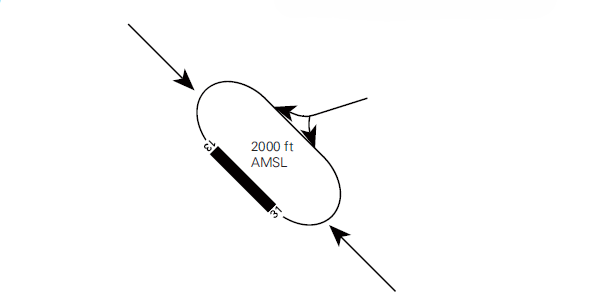
AD TRAFFIC CIRCUIT
ADDITIONAL INFORMATION
BIRD CONCENTRATION AND MOVEMENT AREAS
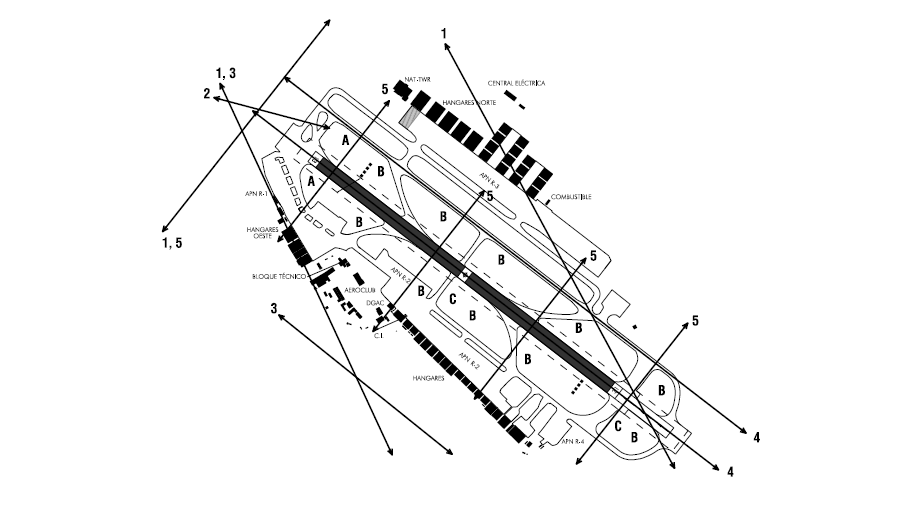
Area A: Cattle egrets, especially in rainy days.
Area B: Red-legged partridges and starlings.
Area C: Mallards, in adverse weather conditions.
Movement 1: Gulls.
Movement 2: Cattle egrets.
Movement 3: Mallards.
Movement 4: Swifts and swallows in spring and summer.
Movement 5: Doves and pigeons.
AERONAUTICAL CHARTS RELATED TO AN AERODROME
The list of charts related to the aerodrome can be found on the link below:
VISUAL SEGMENT SURFACE (VSS) PENETRATION
Not applicable.