LEMI AD 2 AERODROME DATA
AERODROME LOCATION INDICATOR AND NAME
LEMI - MURCIA/Aeropuerto de la Región de Murcia
AERODROME GEOGRAPHICAL AND ADMINISTRATIVE DATA
ARP | 374811N 0010729W. See AD 2-LEMI ADC. | |
Distance and direction from the city | 24 Km S. | |
Elevation | 196 m / 644 ft. | |
Geoid undulation | 50.24 m ± 0.02 m (1). | |
Reference temperature | 33º C. | |
Low average temperature | 11º C. | |
Magnetic variation | 0º (2020). | |
Annual change | 7.2'E. | |
AD administration | AENA SOCIEDAD CONCESIONARIA DEL AEROPUERTO DE LA REGIÓN DE MURCIA, S.M.E., S.A. | |
Address | Aeropuerto de la Región de Murcia – Avda. de España, 101, 30154 Valladolises, MURCIA. | |
TEL | +34-968 855 900 | |
FAX | No. | |
AFTN | LEMI | |
Approved traffic | IFR, VFR, VFRN. | |
Remarks | (1) For all AD points. |
OPERATIONAL HOURS
Airport | V: 0530-2030 (MON, TUE, WED, THU, FRI and public holidays no Sundays); 0630-2030 (SAT and SUN); PS 1 HR PPR. (1). I: 0630-2130 (MON, TUE, WED, THU, FRI and public holidays no Sundays); 0730-2130 (SAT and SUN); PS 1 HR PPR. (1). | |
Customs and Immigration | PPR. | |
Health and Sanitation | See GEN 1.4. | |
AIS/ARO | H24. (2) | |
MET briefing | HR AD PS 30 MIN BFR. | |
ATS | HR AD. | |
Fuelling | HR AD. | |
Handling | HR AD. | |
Security | H24. | |
De-icing | No. | |
Remarks | (1) See item 20. (2) Centralised AIO Office - International NOTAM Office.
|
HANDLING SERVICES AND FACILITIES
Cargo facilities | Forklift, baggage conveyor belt, pallet-lifter, container trailer and platforms. | |
Fuel types | JET A-1. | |
Oil types | No. | |
Refuelling | Information not available. | |
De-Icing facilities | No. | |
Hangar space | No. | |
Repair facilities | No. | |
Remarks | To hire ground handling services (Handling Agent) is compulsory for General or Commercial Aviation operations, except in case of State aircraft and aircraft pilot schools based at LEMI. For arrival operations, passengers and crews members must wait for the arrival of your handling agent. Ramp agents:
|
PASSENGER FACILITIES
Hotels | No. | |
Restaurant | Yes. | |
Transportation | Buses, taxis and hire cars. | |
Medical facilities | Not available. | |
Bank/Post Office | Cash dispenser / No. | |
Tourist information | Yes. | |
Remarks | None. |
RESCUE AND FIREFIGHTING SERVICES
Fire category | 7. | |
Rescue equipment | In accordance with the fire category published. | |
Removal of disabled aircraft | The Airport possesses the following equipment for recovering disabled aircraft:
The airport has agreements in place with external companies for local self-propelled cranes with a capacity of up to 450 TM. Airport contact details for removing disabled aircraft:
| |
Remarks | The external disabled aircraft removal company will be available 24 hours a day without interruption, including Saturdays, Sundays and holidays. The estimated maximum response time is 2 hours from the request. |
RUNWAY SURFACE CONDITION ASSESSMENT AND REPORTING, AND SNOW PLAN
Types of clearing equipment | Not applicable. | |
Clearance priorities | Not applicable. | |
Use of material for movement area surface treatment | Not applicable. | |
Specially prepared winter runways | Not applicable. | |
Remarks | Runway surface condition assessment and reporting in accordance with the Global Reporting Format (GRF) methodology described in AD 1.2.2. Aerodrome in service during all seasons of the year. |
APRONS, TAXIWAYS AND CHECK LOCATIONS/POSITIONS DATA
Apron | Surface: Concrete. Strength: PCN 58/R/A/W/T. | |
Taxiways | Width: 23 m. EXC F, G: 34 m; D1: 29 m. Surface: Asphalt. (1) Strength: PCN 89/F/A/W/T. | |
Check locations | Altimeter: Apron: ELEV 198 m / 650 ft. VOR: No. INS: See AD 2-LEMI PDC. | |
Remarks | (1) A1, A2, C1, C2, F, G: anti-fuel treatment. |
SURFACE MOVEMENT GUIDANCE AND CONTROL SYSTEM AND MARKINGS
Taxiing guidance system | Boards, runway-holding positions, stop bars, runway guard lights and stands. | |
RWY markings | Designators, threshold, centre line, aiming point, touchdown zone, side stripe. | |
TWY markings | Edge and centre line. | |
Remarks | None. |
AERODROME OBSTACLES
Obstacles which penetrate Approach, Take-Off Climb, Conical, Inner Horizontal, Transitional, Inner Transitional and Balked Landing Surfaces established in ICAO Annex 14; and the areas 2A and 3 established in ICAO Annex 15. Those penetrating these surfaces are identified in the CSV file as "Relevante_Relevant = Si/Yes". | See Item 10 and Data Set. | |
Remarks | See AD 2-LEMI AOC. |
METEOROLOGICAL INFORMATION PROVIDED
MET office | Murcia EMAe. | |
HR | HR AD PS 30 MIN BFR. Outside this schedule, a half-hourly METAR AUTO will be issued. | |
METAR | Half-hourly. | |
TAF | 24 HR. | |
TREND | No. | |
Briefing | In person and by telephone. | |
Flight documentation/Language | Charts and plain language / Spanish. | |
Charts | Significant forecasted and wind and temperature in altitude maps. | |
Supplementary equipment | Clouds image, lightnings and radar information display, Aeronautical meteorological self-service (AMA). | |
ATS unit served | TWR, APP. | |
Additional information | Sevilla OMAe (LESV): H24
Murcia EMAe: HR AD;
| |
Remarks | Aerodrome warnings available. |
RUNWAY PHYSICAL CHARACTERISTICS
RWY | Direction | DIM (m) | THR PSN | THR ELEV TDZ ELEV | SWY (m) | CWY (m) | Strip (m) | OFZ | RESA (m) | RWY/SWY SFC PCN |
|---|---|---|---|---|---|---|---|---|---|---|
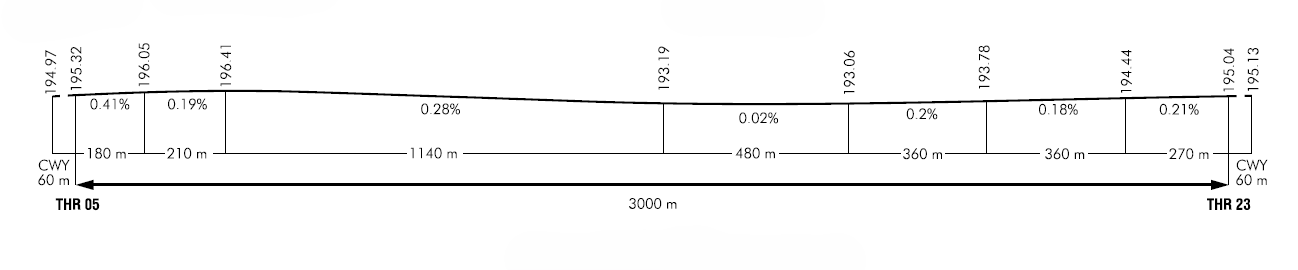
05 | 045.59° GEO 045° MAG | 3000 x 45 | 374737.45N 0010812.54W | THR: 195 m / 641 ft TDZ: No | No | 60 x 150 | 3120 x 280 | No | 240 x 150 | RWY: ASPH PCN 89/F/A/W/T SWY: No |
23 | 225.60° GEO 225° MAG | 3000 x 45 | 374845.55N 0010644.92W | THR: 195.0 m / 640 ft TDZ: 195.0 m / 640 ft | No | 60 x 150 | 3120 x 280 | Yes | 240 x 150 | RWY: ASPH PCN 89/F/A/W/T SWY: No |
Remarks: None. | ||||||||||
Profile
DECLARED DISTANCES
RWY | TORA (m) | TODA (m) | ASDA (m) | LDA (m) |
|---|---|---|---|---|
05 | 3000 | 3060 | 3000 | 3000 |
23 | 3000 | 3060 | 3000 | 3000 |
Remarks: None. | ||||
APPROACH AND RUNWAY LIGHTING
Runway | 05 | |
Approach | Precision CAT I, 900 m. LIH. | |
PAPI (MEHT) | 3° (22.76 m/75 ft). (1) | |
Threshold | Green, with wing bars. | |
Touchdown zone | No. | |
Runway centre line | 3000 m: 2100 m white + 600 white and red + 300 m red. LIH. Distance between lights: 15 m. | |
Runway edge | 3000 m: 2400 m white + 600 m yellow. LIH. Distance between lights: 60 m. | |
Runway end | Red. | |
Stopway | No. | |
Remarks | (1) Double PAPI system. |
Runway | 23 | |
Approach | Precision CAT I, 900 m. LIH. | |
PAPI (MEHT) | 3° (17.61 m/58 ft). (1) (2) | |
Threshold | Green, with wing bars. | |
Touchdown zone | No. | |
Runway centre line | 3000 m: 2100 m white + 600 m white and red + 300 m red. Distance between lights: 15 m. | |
Runway edge | 3000 m: 2400 m white + 600 m yellow. LIH. Distance between lights: 60 m. | |
Runway end | Red. | |
Stopway | No. | |
Remarks | The airport has rapid exit taxiway indicator lights (B). (1) Double PAPI system. (2) PAPI not usable for code letter E aircraft. |
OTHER LIGHTING, SECONDARY POWER SUPPLY
ABN/IBN | No. | |
WDI | 1 near THR 05, 1 near THR 23. LGTD. | |
TWY lighting | Centre line and edge. (1) | |
Apron lighting | Floodlighting poles. | |
Secondary power supply | Engine generators and static uninterruptible power supplies which provide a maximum switch-over time (light) of 1 second for all the visual aid systems of the airport. | |
Remarks | (1) The taxiway edge is marked by elevated, omnidirectional retro-reflective, non-electric beacons, blue in colour. |
HELICOPTER LANDING AREA
Position | Geoid undulation: See item 2. FATO: RWY 05/23. Coordinates THR 05 and THR 23, see item 12. Ground taxiing: TLOF coincides with RWY 05/23. Coordinates THR 05 and THR 23, see item 12. Air taxiing: TLOF coincides with PRKG 1H and 31H. | |
Elevation | FATO: RWY 05/23. Elevation THR 05 and THR 23, see item 12. Ground taxiing: TLOF coincides with RWY 05/23. Elevation coincides with THR 05 and THR 23, see item 12. Air taxiing: TLOF coincides with PRKG 1H and 31H, see AD 2-LEMI PDC. | |
Dimensions, surface, maximum weight, marking | FATO RWY 05/23, see item 12. Ground taxiing: TLOF coincides with RWY 05/23, see item 12. Air taxiing: TLOF coincides with PRKG 1H and 31H, see AD 2-LEMI PDC. | |
Direction | No. | |
Declared distances | No. | |
Lighting | See item 14. | |
Remarks | On operational missions, helicopters can operate in accordance with local procedures. |
AIR TRAFFIC SERVICES AIRSPACE
Designation | CTR MURCIA/REGIÓN DE MURCIA. | |
Lateral limits | 375409N 0010830W; arc of 6 NM radius centred on ARP to 374639N 0010010W; 374154N 0010522W; arc of 6.5 NM radius centred on ARP to 374737N 0011539W; 375409N 0010830W. | |
Vertical limits | SFC-2800 ft AMSL. | |
Airspace class | D. | |
Unit Language | MURCIA TWR. (1) ES/EN. | |
Transition altitude | 1850 m / 6000 ft. | |
Hours of applicability | -HR AD. | |
Remarks | (1) Call sign: Murcia TWR. HR ATS: see item 3. |
AIR TRAFFIC SERVICES COMMUNICATION FACILITIES
Service | Call sign | FREQ | HR | Remarks |
|---|---|---|---|---|
APP | San Javier APP | 130.300 MHz | HR AD | CIV/MIL |
125.025 MHz | HR AD | BACK-UP | ||
TWR | Murcia TWR | 121.330 C | HR AD | TWR |
121.755 C | HR AD | GMC | ||
121.500 MHz | HR AD | EMERG | ||
243.000 MHz | HR AD | EMERG |
RADIO NAVIGATION AND LANDING AIDS
Facility (VAR) | ID | FREQ | HR | Coordinates | DME ELEV | Remarks |
|---|---|---|---|---|---|---|
DVOR (0º) | MUR | 114.850 MHz | H24 | 374806.5N 0010715.4W | - | COV at 25 NM AVB BTN:
|
DME | MUR | CH 95Y | H24 | 374806.5N 0010715.4W | 210 m | COV at 25 NM AVB BTN:
|
LOC 23 (0º) | IRM | 111.750 MHz | H24 | 374730.2N 0010821.9W | - | 225º MAG / 319 m FM THR 05. ILS CAT I. COV 25 NM AVBL BTN ±10º FM RCL at 3500 ft AMSL or ABV. COV 17 NM AVBL BTN ±35º FM RCL at 3000 ft AMSL or ABV. |
GP 23 | - | 333.350 MHz | H24 | 374835.3N 0010651.2W | - | 3º, RDH 15 m; at 330 m FM THR 23 & 120 m FM RCL to the left on APCH direction. |
ILS/DME 23 | IRM | CH 54Y | H24 | 374835.3N 0010651.2W | 198 m | REF DME THR 23. COV 17 NM AVBL BTN +33º/-35º FM RCL at 3000 ft AMSL or ABV. |
LOCAL AERODROME REGULATIONS
Banner towing flights are prohibited.
FLIGHT PLANS
Due to the civil parking capacity, general aviation flights, training flights, air taxis and photo flights must request an airport SLOT before submitting the flight plan and at least 24 HR prior to departure from the airport of origin.
Estimated date and time of arrival and origin AD;
Date and time of departure and destination AD;
Type of aircraft.
The request shall be submitted to the CEOPS Office via E-mail: ceopsmurcia@aena.es
The CEOPS LEMI office will not accept flights origin or destination LEMI whose EOBT or ETA does not match the PPR slot previously assigned.
CEOPS LEMI will assign an airport slot locator to approved operations requested.
EXTENSION OF OPERATIONAL HOURS
Aircraft requesting extension of the hours up to 1 hour after the closure of the airport shall do so via the CEOPS of MURCIA/Aeropuerto de la Región de Murcia airport by E-mail: ceopsmurcia@aena.es, and await confirmation or denial of clearance by the same channel.
TAKE-OFFS FROM INTERSECTION
Take-offs from intersection are not permitted.
GENERAL TAXIING PROCEDURES
START-UP OF ENGINES/JETS
Before an aircraft starts up its engines, the handling agent or airline must check that both pedestrians and vehicles comply with the distances to the engines specified in the apron safety regulations.
Pilots shall request the beginning of the engine start-up to TWR. They shall request this on the Murcia TWR frequency, stating the aircraft designator and the stand occupied. The start-up manoeuvre shall not exceed 10 minutes of the moment at which clearance is received from TWR.
Clearance will be issued immediately unless delays of more than 15 minutes are expected, in which case TWR will indicate that the aircraft should remain in its position and at what time the manoeuvre may be performed.
GROUND MOVEMENT
TAXIING IN THE MANOEUVRING AREA
ATC clearances and instructions must be read back.
Aircraft that have landed shall report runway vacated and the exit taxiway used.
ATC will notify the taxiing route, apron access gate and stand to the aircraft.
Access to the parking apron, unless ATC should indicate otherwise, shall preferably be accomplished as follows:
With RWY 05 in service, entry via TWY G.
With RWY 23 in service, entry via TWY F.
The following cases are exceptions:
Code letter E aircraft shall access to apron solely via TWY F.
For departing aircraft, ATC shall notify the aircraft of the taxiing route up to the runway-holding position, which will be:
With RWY 05 in service: Runway-holding position A1 or A2.
With RWY 23 in service: Runway-holding position C1 or C2.
Code letter E aircraft may only exit/enter on runway:
With RWY 05 in service: oversteering, entry via TWY A1 and exit via TWY C2.
With RWY 23 in service: oversteering, entry via TWY C2 and exit via TWY A1.
TAXIING ON APRON
Avoidance of collisions with other aircraft or obstacles is the responsibility of the air operator during taxiing on the apron, and of the ground handling agent during the towing push-back, or stand exit manoeuvre.
In the event that for some reason, the power/thrust must be increased significantly, pilots must coordinate with ATC so that the manoeuvre can be supervised from the ground.
ATC clearances and instructions must be read back.
The stand will be notified to the crew by ATC.
For operations of entry into the parking apron, aircraft shall await the presence of the "FOLLOW ME" vehicle.
There is no visual docking guidance system.
Autonomous manoeuvres are permitted solely for PRKG: 8B, 9B, 10B, 11B, 12B, 13B, 30B, 31B, 32B. Access and exit for those stands shall preferably be accomplished via the taxiway closest to the stand (F or G).
PUSH-BACK MANOEUVRES
Pilots shall request permission to start push-back manoeuvre to TWR. They shall request this on the Murcia TWR frequency, stating the aircraft designator and the stand occupied. The push-back manoeuvre shall not exceed 10 minutes of the moment at which clearance is received from TWR.
The time between the end of push-back and the start of taxiing shall be 2 minutes at the most.
For safety reasons, simultaneous push-backs from adjoining stands will not be cleared.
LIMITATIONS
Exit from PRKG 1 to 7, 12, 23, 45 and 56, unless otherwise indicated by TWR, shall always be accomplished by nosing towards the threshold in use.
Aircraft parked at PRKG 30, 31 and 32, and irrespective of the runway in service, shall always perform the push-back manoeuvre, nosing the aircraft towards RWY 05.
Aircraft parked at PRKG 8, 9, 78 and 89, and irrespective of the runway in service, shall always perform the push-back manoeuvre, nosing the aircraft towards RWY 23.
LOCATION AND DESIGNATION OF STANDARD TAXIING ROUTES
There are no defined standard taxiing routes at Región de Murcia Airport.
OPERATION OF CODE LETTER F AIRCRAFT
Operations by aircraft of code letter higher than E are not permitted.
OPERATION OF HELICOPTERS
At MURCIA/Aeropuerto de la Región de Murcia airport, as no other specific zone to operate with helicopters is defined, they will be treated the same as fixed-wing aircraft and shall be cleared by ATC to take off and land from/on RWY 05/23.
Helicopters will be cleared to enter or leave RWY 05/23 via TWY C1 or TWY C2 if using RWY 05, and via TWY B, A2 or A1 if using RWY 23. Entry to the apron will take place via these standard taxiways (D1 and D3) up to the assigned stand.
Taxiing shall be carried out in any case via the taxiways which are also allocated for use by fixed-wing aircraft, and this may be air or ground taxiing, depending on the type of helicopter.
The operation of helicopters which hold a letter of exemption as provided for in the SERA article 4, sections 1 and 3, and RD 552/14 Chapter VIII, and in coordination with and subject to clearance by ATC, must satisfy and operate in accordance with the local procedure of the airport manager.
They may operate (approaches/take-offs) from the FATO defined on TWY E3, "FATO E3", from the E4 stop bar and the E2 stop bar, to avert risks or delays.
In the case of helicopters with wheel landing gear, these shall touch down on the FATO itself. Once they have landed, they shall ground taxi up to stand.
In the case of skids, rotary-wing aircraft shall approach the FATO and, once hovering, shall carry out air taxiing up to stand.
For departure operations, they must operate the same way.
The location of the TLOF coincides with the surface of FATO E3, fulfilling the dimensions required for the most restrictive helicopter, as well as the requirements in relation to obstacle limitations, slopes, pavement strengths against static/dynamic loads and resistance to downdraught.
ILS OPERATIONS OF CATEGORY I
RWY 23, subject to service availability of the appropriate approach and landing aids, is suitable for carrying out CAT I approach operations by those air operators whose operational minima have been approved by the civil aeronautical authority.
OPERATIONAL SAFETY REPORTING
Pilots/operator shall report to the airport as soon as possible about any accidents, incidents, occurrences or events which may have a potential operational impact and in which they have been involved or witnessed.
The aim of these reports is the compilation of the information in order to improve operational safety, independently of the compulsory report of the occurrence to the appropriate aeronautical authority. Data may be sent in any format, including at least the following information:
Date and time.
Place.
Parties (data identifying the vehicles, aircraft... involved).
Companies involved.
Description of what happened.
Any other information considered relevant (for instance: lighting, weather, phase of operation, pavement conditions...).
The email address of the airport for the reception of safety reports is the following: Seguridad_Operacional_RMU@aena.es
In addition to notifying the airport using the system indicated, it is necessary to send at least the basic data of the accident, incident, occurrence or event to the air traffic control services provider (ATC).
OPERATIONAL RESTRICTIONS
Only aircraft with MTOW greater than 10 TM, and pilot school aircraft based at LEMI, and State aircraft which have an approved flight plan specifying this operation at LEMI AD and are in coordination with TWR LEMI shall be cleared to make practice approaches or touch-and-go landings (IFR/VFR).
NOISE ABATEMENT PROCEDURES
ENGINE TESTING ON THE GROUND
Engine tests may be performed subject to clearance from the Operations Centre (CEOPS), which will notify the procedure and the zone approved for the tests, always in accordance with ATC instructions. Requests for engine testing clearance should be formalised in writing to CEOPS, e-mail: ceopsmurcia@aena.es, including the following information:
Time of the tests.
Estimated duration.
Type of aircraft.
Power regime to be applied.
FLIGHT PROCEDURES
ATS SURVEILLANCE SYSTEM
The air traffic controllers at the aerodrome shall maintain all the operations performed at it or in its vicinity under constant visual surveillance, with access to an ATS surveillance system to support that visual observation, as stipulated in article 4.5.1.3 of the Reglamento de la Circulación Aérea.
All of the foregoing shall depend on the limitations of the equipment.
LOW VISIBILITY PROCEDURES (LVP)
MURCIA/Aeropuerto de la Región de Murcia airport does not have Low Visibility Procedures (LVP).
STANDSTILL OF OPERATIONS IN THE MOVEMENT AREA PROCEDURE (PPOAM)
MURCIA/Aeropuerto de la Región de Murcia airport has a "Standstill of Operations in the Movement Area Procedure for RVR less than 550 m (PPOAM 550)" to maintain safety in the movement area in situations of low visibility, which consists of the following phases:
PHASE I. Warning: 800 m≥ RVR ≥ 550 m.
PHASE II. Standstill of operations: RVR < 550 m.
PHASE III. Resumption of operations: RVR ≥ 800 m.
INFORMATION FOR PILOTS
Uncertainty about the position of the aircraft in relation to the manoeuvring area:
If the pilot recognises that they are not on a runway, they must immediately halt the aircraft and report this circumstance to ATC (including the last known position).
If they recognise that the aircraft is on a runway, they must notify ATC (including the last known position), vacate the runway as soon as possible if they can locate an appropriate taxiway nearby, unless ATC should indicate otherwise, and then halt the aircraft.
In these situations of uncertainty, ATC will contact the "FOLLOW ME" vehicle for it to guide the aircraft.
Breakdown of aircraft:
It shall report the situation to ATC and await the arrival of assistance. Should it find itself on a runway, if possible and unless ATC should indicate otherwise, this shall be vacated.
Loss of visual contact between traffic:
In the event that one aircraft loses visual contact with another, or with a vehicle with which it is maintaining its own separation, ATC shall be informed immediately, and the aircraft halted.
Communications failure:
Departing aircraft: The aircraft shall continue by the designated route and halt at the limit of the ATC clearance, taking extreme care, where it shall hold and await the arrival of a "FOLLOW ME" vehicle.
Arriving aircraft: If the aircraft has just landed, it shall hold on vacating the runway and await the arrival of a "FOLLOW ME" vehicle.
If the aircraft already has ATC taxiing clearance, it shall continue by the assigned route and halt at the limit of that clearance, taking extreme care, where it shall hold and await the arrival of a "FOLLOW ME" vehicle.
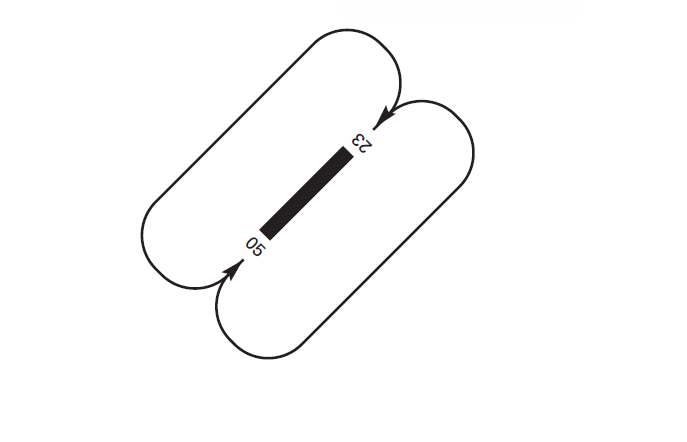
AD TRAFFIC CIRCUIT
ADDITIONAL INFORMATION
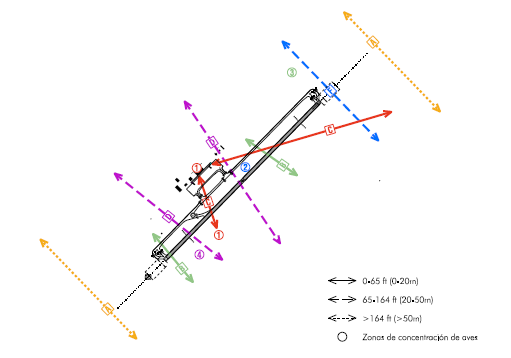
BIRD CONCENTRATION ZONES
Wildlife Control Service schedule from sunrise to sunset.
Presence of wildlife due to various wildlife hotspots, as described below:
Movement A: Passage of large birds of prey during the day (golden eagle, Bonelli's eagle and short-toed snake eagle).
Movement B: Flight of Eurasian stone-curlews, at sunset and at night.
Movement C: Flight of rock doves and starlings, increasing in winter.
Movement D: Flight of common wood pigeons, increasing in spring and summer.
Movement F: Flight of western jackdaws.
Zone 1: Concentration of rock doves and starlings, increasing in winter.
Zone 2: Concentration of common kestrels, increasing during migration (August-October).
Zone 3: Concentration of common swifts in summer.
Zone 4: Concentration of common wood pigeons, increasing in spring and summer.
AERONAUTICAL CHARTS RELATED TO AN AERODROME
The list of charts related to the aerodrome can be found on the link below:
VISUAL SEGMENT SURFACE (VSS) PENETRATION
The instrument approach procedures affected, can be found below:
IAC 1 VOR RWY 05: not applicable.
IAC 2 ILS RWY 23: direct approach.
IAC 3 LOC RWY 23: direct approach.
IAC 4 VOR RWY 23: direct approach.