LEMG AD 2 AERODROME DATA
AERODROME LOCATION INDICATOR AND NAME
LEMG - MÁLAGA/Costa del Sol
AERODROME GEOGRAPHICAL AND ADMINISTRATIVE DATA
ARP |
364030N 0042957W. See AD 2-LEMG ADC. |
|
Distance and direction from the city |
8 km SW. |
|
Elevation |
16 m / 52 ft. |
|
Geoid undulation |
47.5 m ± 0.05 m (1). |
|
Reference temperature |
31° C. |
|
Low average temperature |
12º C. |
|
Magnetic variation |
0° (2025). |
|
Annual change |
9.1'E. |
|
AD administration |
CIV: Aena. MIL: Ejército del Aire y del Espacio. |
|
Address |
CIV: Aeropuerto de MÁLAGA/Costa del Sol - Avda. Comandante García Morato s/n - 29004 - Málaga. MIL: Base Aérea de Málaga - Crtra. de Cádiz s/n. - 29071-Málaga. |
|
TEL |
CIV: +34-952 048 887 MIL: +34-952 176 900 |
|
FAX |
CIV: +34-952 048 862 MIL: +34-952 176 879 |
|
AFTN |
LEMG |
|
No. |
||
Approved traffic |
IFR/VFR. (2) |
|
Remarks |
General and Business Aviation Traffic (IFR / VFR) is dependent upon the capacity available. Prior to transmitting the FPL the airport slot must be requested. Slot requests made on the working day before the date of the flight and after the working hours of the Spanish Association for the Coordination and Provision of Time Slots (AECFA) (AIP GEN 1.2.2) or on the day of the operation, shall be made in the SSIM format, directly to the airport Operations Centre (CEOPS AGP):
This must include the aircraft type, the registration, the operator and ground handling agent, origin and destination aerodromes and date/time of ETA and ETD. Flights without an authorised slot will not be permitted. Aircraft with a cruising speed lower than 200 kt will incur possible delays, including aircraft with origin MÁLAGA/Costa del Sol. AD closed to aircraft with piston engine:
(1) For all AD points. (2) VFR traffic only permitted night ones from 0100-0500 (LT) (including Z and/or Y). School or training flights only permitted from 0100-0500 (LT). State aircraft, helicopters and medical/rescue operation flights will not be affected by any of the above restrictions. |
OPERATIONAL HOURS
Airport |
H24. |
|
Customs and Immigration |
H24. |
|
Health and Sanitation |
See GEN 1.4. |
|
AIS/ARO/OPV |
CIV: H24 (1). MIL: SR/SS. |
|
Apron Management Service (SDP) |
H24, provided by ATS. |
|
MET briefing |
H24. |
|
ATS |
CIV: H24. MIL: No. |
|
Fuelling |
CIV: H24. MIL: SR/SS. |
|
Handling |
CIV: H24. MIL: SR/SS. |
|
Security |
H24. |
|
De-icing |
No. |
|
Remarks |
MIL: Foreign State aircraft will request PPR at least 72 hours in advance, Monday to Friday from 0730 to 1400 (LT), from the AFTN address: LEMGYXYX. If this means is not available, it will be requested via FAX (+34-952 176 879). (1) Centralised ARO Office Geographical Area 13.
Centralised AIO Office - International NOTAM Office
|
HANDLING SERVICES AND FACILITIES
Cargo facilities |
CIV: Up to 5000 kg. MIL: Up to 8000 Kg. |
|
Fuel types |
CIV: 100LL, JET A-1. MIL: F-34, JET A-1. |
|
Oil types |
CIV: ESSO 120, SHELL W120, AEROSHELL W120, AEROSHELL MOBIL BAND. |
|
Refuelling capacity |
CIV: No limitations. MIL: Trucks 20000 L, 16.66 L/s. Trucks 5000 L, 18.33 L/s. |
|
De-Icing facilities |
No. |
|
Hangar space |
CIV: Aircraft up to 11 m wingspan. |
|
Repair facilities |
Yes. |
|
Remarks |
GPU: AC (up to 90 KVA) and DC (up to 2400 A) unit. FUEL SUPPLIERS CONTACT DETAILS: SKYTANKING
SLCA
Ramp agent may attend both commercial aviation and general aviation. For passengers and crew who opt to access through the General Aviation Terminal, the General and Business Aviation Managers (FBO) authorised by the airport are: FIXED BASE OPERATOR CONTACT DETAILS: AviaVIP (Aviapartner Málaga FBO S.A.)
MÁLAGA BUSINESS AVIATION FBO U.T.E.
GENERAL AVIATION HANDLING AGENTS CONTACT DETAILS: AIR TAXIS HANDLING SL
AviaVIP (Aviapartner Málaga FBO S.A.)
GENERAL AVIATION SERVICE
UNITED AVIATION SERVICES
JETEX EXECUTIVE AVIATION
SKY VALET SPAIN
ATLAS MAINTENANCE
UNIVERSAL AVIATION SPAIN
GENERAL AND COMMERCIAL AVIATION HANDLING AGENTS CONTACT DETAILS: AVIAPARTNER
Groundforce AGP
MENZIES AVIATION IBERICA
|
PASSENGER FACILITIES
Hotels |
MIL: Yes. |
|
Restaurant |
Yes. |
|
Transportation |
CIV: Train, buses, taxis and hire cars. MIL: Buses and light vehicles availables on request. |
|
Medical facilities |
First aid, 1 ambulance. |
|
Bank/Post Office |
Cash dispensers and post box. |
|
Tourist information |
Yes. |
|
Remarks |
None. |
RESCUE AND FIREFIGHTING SERVICES
Fire category |
CIV: 9. MIL: 4. |
|
Rescue equipment |
In accordance with the fire category published. |
|
Removal of disabled aircraft |
The airport has specific equipment for hoisting and towing aircraft, which are available to the owner or operator of the ACFT affected: (1)
External facilities: Cranes of different maximum capacity from 35 Tm to 300 Tm, platforms, truck crane and truck carrier vehicles (2). |
|
Remarks |
(1) Contact E-mail: ejecutivosagp@aena.es (Service Executive),
(2) Equipment availability and response time are subject to availability of external suppliers. |
RUNWAY SURFACE CONDITION ASSESSMENT AND REPORTING, AND SNOW PLAN
Types of clearing equipment |
Not applicable. |
|
Clearance priorities |
Not applicable. |
|
Use of material for movement area surface treatment |
Not applicable. |
|
Specially prepared winter runways |
Not applicable. |
|
Remarks |
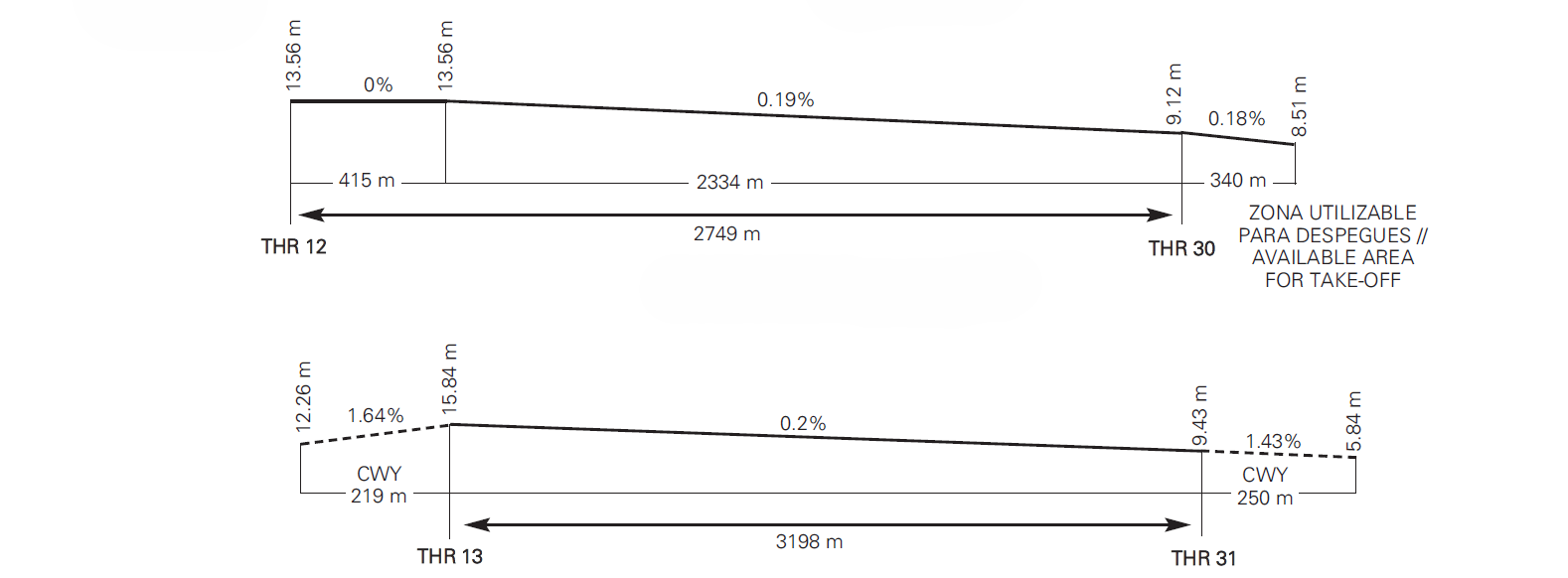
Runway surface condition assessment and reporting in accordance with the Global Reporting Format (GRF) methodology described in AD 1.2.2. Aerodrome in service during all seasons of the year. The 340 m of RWY 30 starter extension (zone only usable for take offs) are considered to form part of the final third of RWY 12 for the purposes of the RCR message. |
APRONS, TAXIWAYS AND CHECK LOCATIONS/POSITIONS DATA
Apron |
Surface:
Strength: CIV:
MIL: PCN 75/R/A/W/T. |
|
Taxiways |
Width: 23 m. Surface: Asphalt. EXC G-5, G-6, G-7, R3, R4, R5: Concrete. Strength: CIV:
MIL:
|
|
Air taxiway |
EH:
|
|
Check locations |
Altimeter: Apron:
VOR: No. INS: See AD 2-LEMG PDC. |
|
Remarks |
TWY centre line: see INSIGNIA and Data Set. |
SURFACE MOVEMENT GUIDANCE AND CONTROL SYSTEM AND MARKINGS
Taxiing guidance system |
Runway holding positions, intermediate holding positions, mandatory sing, LGTD no entry and information boards, stop bars, runway guard lights, anti-intrusion bars, stand marking, designation sign of stands (1), push-back points and pre-threshold area. |
|
RWY markings |
Designators, threshold, centre line, side stripe, touchdown zone (EXC RWY 30), aiming point (EXC RWY 30). |
|
TWY markings |
Centre line, side stripe and edge reflective markers. |
|
Remarks |
(1) Only at the contact stands. |
AERODROME OBSTACLES
Obstacles in Approach, Take-Off Climb, Conical, Inner Horizontal, Transitional, Inner Transitional and Balked Landing Surfaces established in ICAO Annex 14; and the areas 2A and 3 established in ICAO Annex 15. Those penetrating these surfaces are identified in the CSV file as "Relevante_Relevant = Si/Yes". |
See Item 10 and Data Set. |
|
Remarks |
See AD 2-LEMG AOC. |
METEOROLOGICAL INFORMATION PROVIDED
MET office |
Málaga EMAe. |
|
HR |
H24. |
|
METAR |
Half-hourly. |
|
TAF |
H24. |
|
TREND |
Yes. |
|
Briefing |
In person and by telephone. |
|
Flight documentation/Language |
Charts and plain language / Spanish. |
|
Charts |
Significant, forecast at altitude (wind and temperature). |
|
Supplementary equipment |
Cloud, lightning and radar information image display. |
|
ATS unit served |
TWR, APP. |
|
Additional information |
Sevilla OMAe (LESV): H24
Málaga EMAe: H24
|
|
Remarks |
Aerodrome climatological summary available. Aerodrome warnings available. Aerodrome MET guide available. |
RUNWAY PHYSICAL CHARACTERISTICS
RWY |
Direction |
DIM (m) |
THR PSN |
THR ELEV TDZ ELEV |
SWY (m) |
CWY (m) |
Strip (m) |
OFZ |
RESA (m) |
RWY/SWY SFC PCN |
|---|---|---|---|---|---|---|---|---|---|---|
12 (1) |
117.57° GEO 117° MAG |
2749 x 45 |
364127.79N 0043028.07W |
THR: 13.6 m/44 ft TDZ: 13.6 m/44 ft |
No |
No |
2869 x 280 |
Yes |
240 x 150 |
RWY: ASPH PCN 82/F/A/W/T SWY: No |
30 (2) |
297.58° GEO 297° MAG |
2749 x 45 (3) |
364046.49N 0042849.89W |
THR: 9.1 m/30 ft TDZ: No |
No |
No |
3149 x 150 |
No |
240 x 150 |
RWY: ASPH PCN 82/F/A/W/T SWY: No |
13 |
131.56° GEO 131° MAG |
3198 x 45 |
364104.35N 0043045.32W |
THR: 15.8 m/52 ft TDZ: 15.8 m/52 ft |
No |
250 x 150 |
3318 x 280 |
Yes |
200 x 150 |
RWY: ASPH PCN 75/F/A/W/T SWY: No |
31 |
311.58° GEO 311° MAG |
3198 x 45 |
363955.49N 0042908.94W |
THR: 9.4 m/31 ft TDZ: 11.3 m/37 ft |
No |
219 x 150 |
3318 x 280 |
Yes |
159 x 150 |
RWY: ASPH PCN 75/F/A/W/T SWY: No |
Remarks: (1) Not available for take-off. (2) Not available for landing. (3) RWY 30 has a preceding area to the threshold of 340 x 45 m, asphalt, PCN 82/F/A/W/T, available for take-off. |
||||||||||
Profile
DECLARED DISTANCES
RWY |
TORA (m) |
TODA (m) |
ASDA (m) |
LDA (m) |
|---|---|---|---|---|
12 |
NU |
NU |
NU |
2749 |
13 |
3198 |
3448 |
3198 |
3198 |
30 |
3089 |
3089 |
3089 |
NU |
31 |
3198 |
3417 |
3198 |
3198 |
13 INT HN-1L |
3089 |
3339 |
3089 |
NU |
13 INT E-6 |
2245 |
2495 |
2245 |
NU |
13 INT EM |
1131 |
1381 |
1131 |
NU |
30 INT HE-2 |
2996 |
2996 |
2996 |
NU |
30 INT HE-1 |
2801 |
2801 |
2801 |
NU |
31 INT E-1 |
2244 |
2463 |
2244 |
NU |
31 INT EM |
2086 |
2305 |
2086 |
NU |
Remarks: None. |
||||
APPROACH AND RUNWAY LIGHTING
Runway |
12 |
|
Approach |
Precision CAT I, 900 m. LIH. |
|
PAPI (MEHT) |
3° (17.72 m/58 ft). |
|
Threshold |
Green with wing bars. |
|
Touchdown zone |
No. |
|
Runway centre line |
2750 m: 1850 m white + 600 m white and red + 300 m red. LIH. Distance between lights: 15 m. |
|
Runway edge |
2750 m: 2150 m white + 600 m yellow. LIH. Distance between lights: 60 m. |
|
Runway end |
Red. |
|
Stopway |
No. |
|
Remarks |
Rapid exit taxiway indicator lights (E-8, E-9 and E-10). |
Runway |
30 |
|
Approach |
No. |
|
PAPI (MEHT) |
No. |
|
Threshold |
No. |
|
Touchdown zone |
No. |
|
Runway centre line |
2750 m: 1850 m white + 600 m white and red + 300 m red. LIH. Distance between lights 15 m. |
|
Runway edge |
2750 m: 2150 m white + 600 m yellow. LIH. Distance between lights: 60 m. |
|
Area preceding to threshold |
Edge 340 m red. LIH. Distance between lights: 60 m. Centre line 340 m white. LIH. Distance between lights: 15 m. |
|
Runway end |
Red. |
|
Stopway |
No. |
|
Remarks |
None. |
Runway |
13 |
|
Approach |
Precision CAT I, 720 m. LIH. (1) |
|
PAPI (MEHT) |
3.2° (17.08 m/56 ft). |
|
Threshold |
Green, with wing bars. (2) |
|
Touchdown zone |
No. |
|
Runway centre line |
3200 m: 2300 m white + 600 m white and red + 300 m red. LIH. (2) Distance between lights: 15 m. |
|
Runway edge |
3200 m: 2600 m white + 600 m yellow. LIH. (2) Distance between lights: 50 m. |
|
Runway end |
Red. (2) |
|
Stopway |
No. |
|
Remarks |
Rapid exit taxiway indicator LED lights (E-4, E-2 and E-1). (1) The spacing for the precision approach system is not standard. (2) LED lighting. |
Runway |
31 |
|
Approach |
Precision CAT I, 900 m. LIH. (1) |
|
PAPI (MEHT) |
3° (17.07 m/56 ft). |
|
Threshold |
Green, with wing bars. (2) |
|
Touchdown zone |
No. |
|
Runway centre line |
3200 m: 2300 m white + 600 m white and red + 300 m red. LIH. (2) Distance between lights: 15 m. |
|
Runway edge |
3200 m: 2600 m white + 600 m yellow. LIH. (2) Distance between lights 50 m. |
|
Runway end |
Red. (2) |
|
Stopway |
No. |
|
Remarks |
Rapid exit taxiway indicator LED lights (E-3, E-5 and E-6). (1) The spacing for the precision approach system is not standard. (2) LED lighting. |
OTHER LIGHTING, SECONDARY POWER SUPPLY
ABN/IBN |
No. |
|
WDI |
1 near THR 12, 1 near THR 13, 1 near THR 30, 1 near THR 31. LED lighting at devices near THR 13 and THR 31. Incandescent lighting at devices near THR 12 and THR 30. |
|
TWY lighting |
|
|
Apron lighting |
Floodlighting poles on all aprons. |
|
Secondary power supply |
Visual aid systems. Engine generators of continuity that provide a maximum switch-over time (light) lower than 1 second. |
|
Remarks |
None. |
HELICOPTER LANDING AREA
Position |
|
|
Elevation |
|
|
Dimensions, surface, maximum weight, marking |
|
|
Direction |
No. |
|
Declared distances |
(**) See table. |
|
Lighting |
No. |
|
Remarks |
Air Taxiing: Maximum dimension of helicopters on Taxiway E-H: 16.66 m. Maximum dimensions of helicopters on other taxiways: 22.20 m. See incompatibilities between aircraft stands in AD 2-LEMG PDC 1. Apron lighting. |
(*)
PRKG |
ELEV (m) |
|---|---|
02H |
8 |
03H |
8 |
05H |
8 |
06H |
8 |
465 |
7 |
466 |
7 |
467 |
7 |
(**) Declared distances:
RWY |
TORA (m) |
TODA (m) |
ASDA (m) |
LDA (m) |
|---|---|---|---|---|
13 |
3198 |
3448 |
3198 |
3198 |
31 |
3198 |
3417 |
3198 |
3198 |
13 INT HN-1L |
3089 |
3339 |
3089 |
NU |
13 INT E-1 (1) |
1008 |
1258 |
1008 |
NU |
13 INT E-3 (1) |
1236 |
1486 |
1236 |
NU |
13 INT E-6 |
2245 |
2495 |
2245 |
NU |
13 INT EH (2) |
388 |
638 |
388 |
NU |
31 INT E-1 |
2244 |
2463 |
2244 |
NU |
31 INT E-3 (1) |
1977 |
2196 |
1977 |
NU |
31 INT EH (2) |
2817 |
3036 |
2817 |
NU |
(1) Exclusive use from sunrise to sunset. (2) Exclusive use for helicopters with air taxiing. |
||||
AIR TRAFFIC SERVICES AIRSPACE
Designation |
CTR MÁLAGA (1). |
|
Lateral limits |
370820N 0044707W; 364958N 0042212W; 364743N 0042441W; 363439N 0040710W; 362313N 0041949W; 363602N 0043740W; 363454N 0043854W; 365304N 0050429W; 370820N 0044707W. |
|
Vertical limits |
SFC - 7500 ft AMSL. |
|
Airspace class |
D. |
|
Unit Language |
MÁLAGA APP. ES/EN. |
|
Transition altitude |
3962 m / 13000 ft. |
|
Hours of applicability |
- |
|
Remarks |
(1) VFR traffic is not permitted, except for State aircraft, helicopters and medical/rescue operation flights (see related restrictions in ENR 2.1 TMA Sevilla):
|
Designation |
ATZ MÁLAGA (1). |
|
Lateral limits |
Circle 8 km radius centred on ARP (2). |
|
Vertical limits |
SFC - 3000 ft HGT (3). |
|
Airspace class |
D. |
|
Unit Language |
MÁLAGA TWR. ES/EN. |
|
Transition altitude |
- |
|
Hours of applicability |
H24 |
|
Remarks |
(1) VFR traffic is not permitted, except for State aircraft, helicopters and medical/rescue operation flights (see related restrictions in ENR 2.1 TMA Sevilla):
(2) Or the ground visibility, whichever is lower. (3) Or up to the cloud ceiling, whichever is lower. |
AIR TRAFFIC SERVICES COMMUNICATION FACILITIES
Service |
Call sign |
FREQ |
HR |
Remarks |
|
|---|---|---|---|---|---|
APP |
Málaga APP |
118.455 C |
H24 |
ARR E - DEP |
|
121.025 MHz |
H24 |
BACK UP |
|||
123.855 C |
H24 |
ARR W |
|||
125.955 C |
H24 |
APP |
|||
245.600 MHz |
H24 |
MIL |
|||
TWR |
Málaga TWR |
118.155 C |
H24 |
TWR-W (RWY 13/31) |
|
118.780 C |
H24 |
TWR-E (RWY 12/30) |
|||
121.500 MHz |
H24 |
EMERG |
|||
122.100 MHz |
H24 |
MIL |
|||
124.780 C |
H24 |
BACK UP |
|||
243.000 MHz |
H24 |
EMERG |
|||
257.800 MHz |
H24 |
MIL |
|||
Málaga GMC |
121.705 C |
H24 |
GMC-W |
||
121.955 C |
H24 |
GMC-E |
|||
Málaga Clearance |
121.880 C |
H24 |
CLR. Also available via data link. |
||
ATIS |
Málaga Information Arrivals |
120.380 C |
H24 |
- |
|
Málaga Information Departures |
124.480 C |
H24 |
- |
||
D-ATIS |
Málaga Information Arrivals |
NIL
|
H24
|
Provision of ATIS information via data link. |
|
Málaga Information Departures |
|||||
RADIO NAVIGATION AND LANDING AIDS
Facility (VAR) |
ID |
FREQ |
HR |
Coordinates |
ELEV DME |
Remarks |
|---|---|---|---|---|---|---|
DVOR (0º) |
AGP |
117.150 MHz |
H24 |
364103.6N 0042914.4W |
- |
- |
DME |
AGP |
CH 118Y |
H24 |
364104.1N 0042914.1W |
0 m |
At 25 NM BTN R-219/R-234 & BLW FL090, possible signal fluctuation. |
DVOR (0º) |
MGA |
112.000 MHz |
H24 |
364851.6N 0042210.5W |
- |
COV 40 NM U/S BTN:
R-045 BLW FL080 BTN 09-14 NM, signal oscillations greater than ± 5º. R-089 BLW FL120 BTN 20-30 NM, signal oscillations greater than ± 5º. R-297 BLW FL120 BTN 10-20 NM, possible guidance lost. |
DME |
MGA |
CH 57X |
H24 |
364851.1N 0042210.6W |
1020 m |
COV 40 NM U/S BTN:
|
DVOR (0º) |
MAR |
112.600 MHz |
H24 |
370319.1N 0045623.6W |
- |
R-117 BTN 10 NM & 20 NM, signal oscilations. R-043 BTN 30 NM & 50 NM, signal oscillations. |
DME |
MAR |
CH 73X |
H24 |
370318.8N 0045623.2W |
690 m |
- |
DVOR (0º) |
MLG |
113.550 MHz |
H24 |
364043.5N 0043023.9W |
- |
COV 40 NM AVBL BTN:
|
DME |
MLG |
CH 82Y |
H24 |
364043.2N 0043024.3W |
30 m |
COV 40 NM AVBL BTN:
|
LOC 12 (0º) |
IMG |
110.550 MHz |
H24 |
364038.9N 0042831.8W |
- |
117º MAG/506 m FM THR 30. COV 25 NM AVBL at 5500 ft AMSL or ABV. COV 17 NM AVBL at 5000 ft AMSL or ABV. |
ILS CAT I GP 12 |
329.450 MHz |
H24 |
364126.5N 0043014.6W |
- |
3º; RDH 16.50 m; at 315 m FM THR 12 & 120 FM RCL to the left in direction APCH. |
|
ILS/DME 12 |
IMG |
CH 42Y |
H24 |
364126.5N 0043014.6W |
21 m |
REF DME THR 12. |
LOC 13 (0º) |
GMM |
109.500 MHz |
H24 |
363949.7N 0042900.9W |
- |
131° MAG/268 m FM THR 31. COV 17 NM AVBL at 5000 ft AMSL or ABV. COV 25 NM AVBL at 5000 ft AMSL or ABV. |
ILS CAT I GP 13 |
332.600 MHz |
H24 |
364054.7N 0043039.3W |
- |
3.2°; RDH 16.75 m; at 309 m FM THR 13 & 123 m FM RCL to the right in direction APCH; COV 12NM AVBL BTN 8º to the right and 6º to the left FM RCL at 2200 ft AMSL or ABV. |
|
ILS/DME 13 |
GMM |
CH 32X |
H24 |
364054.7N 0043039.3W |
21 m |
REF DME THR 13. |
LOC 31 (0º) |
GAA |
109.900 MHz |
H24 |
364109.2N 0043052.1W |
- |
311° MAG/226 m FM THR 13; |
ILS CAT I GP 31 |
333.800 MHz |
H24 |
363958.9N 0042920.6W |
- |
3°; RDH 16.00 m; at 285 m FM THR 31 & 114 m FM RCL to the left in direction APCH. |
|
ILS/DME 31 |
GAA |
CH 36X |
H24 |
363958.9N 0042920.6W |
15 m |
REF DME THR 31. COV 17 NM at 2100 ft AMSL AVBL BTN 28º to the left and 34º to the right FM RCL. |
GBAS GBAS CAT I |
LEMG |
115.150 MHz CH 20697 & 21519 |
H24 |
364113.5N 0043044.9W |
- |
RWY 12: CH 21519; U/S BTN 17 & 19 NM at 10000 ft AMSL; U/S BTN 10 & 11 NM at 5500 ft AMSL. RWY 13: CH 20697; COV 18 NM at 10000 ft AMSL. |
LOCAL AERODROME REGULATIONS
RESTRICTIONS TO OPERATIONS
-
AD closed to aircraft without radiocommunication.
-
AD not available for A35K (A350-1000) aircraft.
-
Availability of frequencies named Málaga TWR/APP in item 18 is mandatory for aircraft using this AD.
-
Contact phone numbers to be used with TWR in case of communications failure:
-
TEL: +34-952 048 627; +34-952 235 115.
-
-
Operation of code letter F aircraft, see item 3.
-
Operation of helicopters, see item 11.4.
POINT OF ENTRY FOR PASSENGERS WITH PET ANIMALS FROM THIRD COUNTRIES
To ensure compliance with the Regulation (EU) no. 576/2013 of the European Parliament and of the Council of 12 June 2013 on the non-commercial movement of pet animals and repealing Regulation (EC) no. 998/2003, any Air Carrier wishing to operate at the Airport and transport animals (pets) in the cabin as part of passenger hand luggage, of the types set out in Annex I to the cited Regulation, must have engaged a handling agent which shall be responsible for managing the animals in those cases where, during inspections by the Guardia Civil Fiscal Patrol and Customs Personnel at the Passenger Terminals of MÁLAGA/Costa del Sol Airport, some breach of the animal health requirements set out in the cited Regulation which would prompt their rejection at the border is detected. The management for animals rejected at the border shall include, at least, transport to the facilities designated for its temporary stay in the airport, their subsistence, veterinary care and animal welfare, and even their return to origin within the periods stipulated by the public health authorities.
FLIGHT PLANS
All flights wishing to operate at MÁLAGA/Costa del Sol must hold the appropriate airport slot. Centralised ARO Office has authority to reject Flight Plans whose EOBT or ETA do not match the airport slot previously assigned to the flight (see GEN 1.2 section 3).
GENERAL AVIATION
Flight plans filed more than 15 days in advance of the operation date will not be accepted.
All General and Business Aviation aircraft must engage ground handling services, by virtue of the provisions of section AD 1.1 in the AIP-España.
For General and business Aviation and business flights wishing to operate at the airport, the following information must be included in the airport slot request and in the item 18 "Other information" of the flight plan:
-
Flight Handling agent,
-
General and business aviation manager engaged (if applicable).
For contact data for FBO or General Aviation Handling Agents, see item 4.
RUNWAY CONFIGURATION
At MÁLAGA/Costa del Sol airport there are the following possible runway configurations:
North configuration:
Two RWY:
-
Arrivals RWY 31.
-
Departures RWY 30.
One RWY:
-
Arrivals RWY 31.
-
Departures RWY 31.
South configuration (preferent):
Two RWY:
-
Arrivals RWY 12.
-
Departures RWY 13.
One RWY:
-
Arrivals RWY 13.
-
Departures RWY 13.
ATC will maintain the preferential configuration described for wind components, including gusts, of up to 10 kt tailwind and/or 20 kt crosswind, and changing may be considered from a tailwind of 7 kt.
PROCEDURES TO VACATE THE RUNWAY
-
Landing on RWY 12: only TWY E-8, E-9, E-10, E-11 and HE-1 are available.
-
Landing on RWY 13: only TWY E-4, E-2 and E-1 or TWY HS-3 are available for aircraft vacating by runway end.
-
Landing on RWY 31: only TWY E-3, E-5 and E-6 or TWY HN-3 are available for aircraft vacating by runway end.
MINIMUM RUNWAY OCCUPANCY TIME
ARRIVALS
To minimize the runway occupancy time and the possibility of "go-around", pilots are reminded:
-
Whenever the conditions of the runway so allow, they should use the following or earlier RET, unless otherwise instructed by ATC. Otherwise, they must notify ATC in the first communication with TWR.
-
Attention to restrictions on the use of TWY E-3, E-4 and E-8. They may only be used by light aircraft.
AIRCRAFT CATEGORY DUE TO WAKE TURBULENCE |
RWY 12 DIST THR-RET |
RWY 13 DIST THR-RET |
RWY 31 DIST THR-RET |
|||
|---|---|---|---|---|---|---|
LEFT |
RIGHT |
LEFT |
RIGHT |
LEFT |
RIGHT |
|
HEAVY |
–
|
E-10 2036 m |
E-1 2126 m |
EM 1969 m |
– |
E-6 2160 m |
MEDIUM |
E-9 1664 m |
E-2 1796 m |
E-5 1812 m |
|||
LIGHT |
E-8 (1) 1225 m |
E-4 (1) 1226 m |
E-3 (1) 1143 m |
|||
(1) Not usable by aircraft of higher category than that indicated. |
||||||
-
To vacate runway expeditiously at the fastest speed commensurate with safety.
-
To adjust taxi speed after touchdown when it is evident that the aircraft will miss the planned RET, avoiding low speeds on the runway.
The following RET are available:
RWY |
ACFT |
DIST THR-RET (m) |
RET |
|---|---|---|---|
12 |
Light |
1225 |
E-8 |
12 |
All |
1664 |
E-9 |
12 |
All |
2036 |
E-10 |
13 |
Light |
1226 |
E-4 |
13 |
All |
1796 |
E-2 |
13 |
All |
1969 |
EM |
13 |
All |
2126 |
E-1 |
31 |
Light |
1143 |
E-3 |
31 |
All |
1812 |
E-5 |
31 |
All |
2160 |
E-6 |
DEPARTURES
Pilots should be ready for departure when reaching the runway-holding position.
On receipt of line-up clearance pilots should ensure that they are able to taxi and line-up on the runway as soon as the preceding aircraft has commenced either its take-off run or landing roll.
Pilots who require additional separations (due to wake turbulence or other reason), shall notify ATC as soon as possible and before crossing the runway holding point.
Pilots should be able to commence the take-off run immediately when takeoff clearance is issued. Pilots unable to comply with this requirement shall notify ATC as soon as possible and await instructions. When appropriate, ATC could cancel the clearance and instruct the aircraft to vacate runway.
AENERGY SAVING POLICY, SHUTDOWN OF SURFACE AERONAUTICAL LIGHTS AT NIGHT
MÁLAGA/Costa del Sol airport, from sunset to sunrise when there is no probability that regular or emergency operations will occur, applies energy saving procedures that involve the shutdown of the following Surface Aeronautical Lights (LAS): runway, approach light system, approach visual gradient indicator system, and TWY centre line and edge lights.
PUSH AND HOLD PROCEDURE
The handling agents of flights parked at the boarding bridge stands affected by regulations, may request clearance from the Operations Center of the airport to wait for the CTOT in a remote stand provided that the crew has notified that is ready and has made a start-up or READY request and:
-
The Push and Hold request is made no earlier than TOBT-5.
-
Phase III of the LVP is not activated.
When there are two or more parked aircraft whose reversals are incompatible, the aircraft requesting a standard push-back shall have priority over the one requesting a Push and Hold one.
ATC PROCEDURES
TAKE-OFF FROM INTERSECTION FOR FIXED WING AIRCRAFT
Take-off operations from RWY 13 intersection with TWY HN-1L, E-6 or EM, RWY 31 with TWY E-1 or EM and from RWY 30 intersections with TWY HE-1 or HE-2 or HE-3 are allowed. See declared distances at item 13.
These operations from TWY EM shall only take place from sunrise to sunset, because there are no lit stop bar on this runway access.
Aircraft requesting this procedure shall notify this, preferably, when requesting clearance to start up.
VISUAL DEPARTURE PROCEDURES FOR IFR FLIGHTS
In certain circumstances in which the published SID cannot be used, IFR flights may request a "visual departure" (heading after take-off) from ATC under the following conditions:
-
Between sunrise and sunset.
-
Weather conditions in the direction of the take-off and subsequent initial climb that permit the visual flight up to the Minimum Radar Altitude.
-
Once lined up, the pilot shall propose a heading to ATC, to enable the departure to be safe. Should it be subsequently necessary to deviate from the approved heading, the pilot shall inform ATC.
-
The pilot shall be responsible for maintaining obstacle clearance up to the Minimum Radar Altitude.
STANDARD TAXIING PROCEDURES
ENGINE/TURBINE START-UP REQUEST PROCEDURES
DEFINITIONS
-
A-CDM: Airport Collaborative Decision Making.
-
TOBT: Target Off-Block Time. Time at which the air carrier or the ground handling agent expects to be ready, with the doors closed, airbridge disconnected and aircraft push-back equipment connected.
-
TSAT: Target Start-up Approval Time. Estimated start-up time calculated based on the TOBT, taxi time from the stand, the CTOT (if subject to regulation) and the airport operational capacity.
-
SOBT: Scheduled Off-Block Time.
GENERAL
MÁLAGA/Costa del Sol airport applies A-CDM processes in the aircraft departure sequence. The A-CDM processes start three hours prior to the estimated off-block time (EOBT) and end with aircraft take-off. Throughout the process, all flight-related information must be kept up-to-date. The information will be sent automatically to the Network Manager Operations Centre (NMOC) at Eurocontrol and will be used to improve management in assigning calculated take-off time (CTOT).
MÁLAGA/Costa del Sol airport applies the FAM (Flight Activation Monitoring) system managed by Eurocontrol. To prevent flight plans from being suspended automatically, the EOBT and TOBT must be kept up-to-date until the request for start-up, following the TSAT, so that the traffic flow enables departure to occur as close to TTOT as possible.
PROCESS
-
AIRPORT SLOT AND FLIGHT PLAN VALIDATION
Three hours prior to EOBT, the flight plan (FPL) information filed in the A-CDM system will be validated with respect to the airport slot, and the flight destination and the type of aircraft must coincide with the EOBT of the FPL initially filed in both the SOBT. If the information does not match, the system will generate an alarm and an automatic message sent to the airline and ground handling agent, who will have to update the information.
-
TOBT ALLOCATION
As soon as the air carrier or the ground handling agent has the information on the target off-block time, the TOBT shall be allocated in the A-CDM system. Throughout the process, the TOBT must be updated based on the flight information available to the airline or the ground handling agent.
The EOBT must be in line with the TOBT at all times. If there is more than a 15 minute difference between the two, the system will generate an alarm and an automatic message will be sent to the air carrier and ground handling agent, who must update the TOBT and/or EOBT with a DLA delay message.
-
TSAT PUBLICATION
Thirty minutes prior to the TOBT, the system will generate a TSAT. This time will be updated (automatically) successively based on the actual start-up sequence, the operational situation and the volume of regulated flights in the sequence. For regulated flights, the TSAT will be generated based on the CTOT as soon as it is published. Regulated flights must keep the TOBT and EOBT updated, until start-up clearance is requested from ATC.
-
ENGINE/TURBINE START-UP REQUEST
Aircraft may request ATC authorization from 30 minutes prior to their TOBT.
The aircraft on first call must provide:
-
Report the type and series of aircraft, aircraft stand and the ATIS message received, pilot shall report that it is code letter E or F aircraft in case of an aircraft with wingspan 52 m or over.
-
Communicate the need to perform a cross-bleed start if required.
-
Report any possible restrictions in complying with local regulations (RNAV equipment, take-off performance, etc.).
The pilot shall contact Málaga Clearance at the designated frequency to indicate readiness for start-up:
-
from 5 minutes before their TOBT until TOBT for CTOT flights.
-
from 5 minutes before TOBT until 5 minutes after TOBT, for other flights.
ATC Authorization will only be issued between TOBT -30 minutes and TOBT -5 minutes.
In case of non-compliance with A-CDM parameters, the pilot should contact his flight coordinator to correct A-CDM parameters. Malaga Clearance will not provide information about non-compliance of the A-CDM process to avoid frequency overload.
If not within TSAT range, in order to avoid saturating the CLR frequency, pilots will refrain from making successive calls before receiving the call from Malaga clearance.
If Malaga Clearance does not receive a start-up request within 5 minutes after TOBT has been given, the flight will lose its TSAT and its request will not be authorized. It will be required to receive a new updated TOBT and EOBT so that the flight can be sequenced again and receive a new TSAT. The TOBT and/or EOBT update can only be done by the airline or its ground handling agent, so pilots will refrain from making requests to ATC in this regard.
Once transferred by Málaga Clearance, the pilot shall contact the corresponding GMC frequency within the next 5 minutes. Start-up and push-back clearance can only be granted by GMC and shall imply start-up clearance at idling speed. At all aircraft stands in contact with the terminal building, it is prohibited to start engines at a rate above idle until the aircraft has completed the pushback and has been expressly authorized to do so.
During the start-up manoeuvre with GPU or external APU, aircraft shall report the performance of cross-bleed start together with the push-back request on the taxiing frequency and subsequently start up one engine, perform the pushback manoeuvre maintaining idle engine power until positioned on the apron taxiway, and then the power can be increased in order to start up the rest of the engines, strictly as necessary.
ATC AUTHORIZATION REQUEST VIA DATA LINK
Data Link (DCL) departure procedures are applied at MÁLAGA/Costa del Sol airport in the provision of ATC clearance services. For more information on the DCL service, see AIP ENR 1.5, section 3. DEPARTING FLIGHTS, ATC and startup clearance via data link (DCL). In case of discrepancies, voice communications will always prevail over data link.
The pilot may request the ATC clearance by DCL in accordance with the start-up procedures (see AD 2, item 20, 1.3.4) with a maximum of 30 minutes before the TOBT (CDM mode) or EOBT (without CDM).
-
The pilot must request ATC and S/U clearance together via RCD. The RCD message (Departure Clearance Request) must contain the following information:
-
Aircraft callsign in accordance with the filed flight plan (FPL).
-
Aerodrome of origin.
-
Aircraft stand.
-
Destination aerodrome.
-
Letter corresponding to the ATIS information received.
-
ICAO aircraft type designator.
-
Any free text sent via the RCD by the pilot will not be considered by the ATC.
Special requests will always be made via voice communications.
-
The pilot will receive a message acceptance “RCD RECEIVED” or cancellation "RCD REJECTED".
-
When communicating approval, Malaga Clearance will issue a CLD message with the following fields:
-
Aircraft callsign.
-
Destination aerodrome.
-
Assigned runway for departure.
-
Take-off procedure (SID).
Note: The initial altitude will correspond to the published SID.
-
SSR code mode A (SQUAWK).
-
ADT (Approved Departure Time).
Note: ADT = CTOT of the flight, if applicable.
-
Next frequency.
-
Current ATIS information letter.
-
Additional information, including instructions to contact Málaga clearance to indicate readiness for start-up or instructions to request said clearance in the event that the start-up clearance parameters indicated in AD 2, Item 20, 1.3.4 are not fulfilled.
-
-
When a CLD message is sent within the valid TOBT and TSAT range, ATC clearance and the instruction to contact GMC will be given. If not ready for start-up, the pilot shall not accept the frequency change and shall send a new message or contact the CLR controller by voice when ready.
-
When an FSM message of the type “REVERT TO VOICE PROCEDURES” is received, communication via data link will be terminated and must be reverted to voice procedures.
-
When a CLD message is received, the pilot:
-
If any inconsistencies in the received message are detected, the pilot must revert to voice procedures and request a new authorization.
-
If the pilot considers the authorization CLD message to be correct, he/she must respond via data link with a CDA message (Departure Clearance Echoback).
-
-
If a CDA message is not received by the pilot within the waiting time, or a CDA that is inconsistent with the previous CLD message is received, communication via data link will be terminated and a “CDA REJECTED” message will be received in the FMS.
-
When the correct CDA message is received, the ATC system will send the aircraft a “CLEARANCE CONFIRMED” message in the FMS and will terminate the communication via data link.
The notification of readiness to start up must be requested on the designated Málaga Clearance frequency. After being transferred, the pilot shall contact the GMC frequency within the next 5 minutes and GMC shall then give the start-up and/or push-back clearance, which will implicitly include clearance for start-up at idling speed.
REVERT TO VOICE PROCEDURES
Upon receiving a message of the type “REVERT TO VOICE PROCEDURES”, or in the event of any inconsistency in the authorization received, the pilot will contact via voice communications with the controller and request a new authorization.
GROUND MOVEMENT
Traffic in apron and manoeuvring area.
-
Aircraft entering will have priority over those exiting, except in cases where push-back has already started, when the departing aircraft shall have priority.
-
Once the push-back manoeuvre has started, this aircraft shall have priority over entering aircraft, except by TWY G-10.
-
The taxiways called R are apron taxiways and ATC does not provide control for them. In particular, while taxiing along TWY L in either direction, before accomplishing the entry turn for Ramp 8, pilots must pay special attention to ensure there is no aircraft pushing back that would block passage to their stand, in which case they must allow that other aircraft to exit Ramp 8 first.
-
Collision avoidance with other aircraft or obstacles is the responsibility of:
-
Pilots taxiing in the apron and taxiway segments not visible from TWR (see AD 2-LEMG GMC).
-
Handling companies during towing.
-
-
Except for rescue and fire fighting vehicles engaged in their specific missions, all surface movements of aircraft, towed aircraft, personnel and vehicles on the manoeuvring area are subject to previous ATC clearance.
-
To avoid incidents due to jet blast, pilots must take into account that the areas and spaces defined on the aprons are designed considering that aircraft manoeuvre using powers similar to the idling. When for some reason, an aircraft requires increased power in the apron, pilots must request ATC to send a signalman to check and report to ATC the viability of the manoeuvre and supervise it, if appropriate.
-
Aircraft shall approach as closely as possible to the runway and intermediate holding positions, because no free space behind them is guaranteed (see AD 1.1), and it is the responsibility of the pilot in command to monitor the surroundings and take measures to avert collisions with other aircraft, and likewise to inform ATC when it is not possible to comply with a clearance. In the event there is any doubt about whether an aircraft at the runway holding position or intermediate holding position can be passed safely, the taxiing aircraft must halt, notify ATC and request alternative instructions.
-
TWY R1 is one way, counter-clockwise direction. The numbering of the parking stands increases with the direction of taxiing of TWY R1.
Ground Control is responsible for:
-
The control of every movement of aircraft, personnel and vehicles on the manoeuvring area except for the runway.
-
Issuing clearances for towed push-back and taxiing of aircraft on the basis of the TTOT alone.
-
Reporting the stand assigned to the aircraft by the Operation Center (CEOPS).
-
The same TWR ATC personnel will provide SDP, in accordance with the procedures established by the airport.
-
In their role as SDP agents, it will be the responsibility of ATC personnel to:
-
Manage aircraft movement on the apron in order to integrate them in the air traffic flow, applying the established procedures,
-
Issue clearance for push-back and taxiing on the apron,
-
Transmit to aircraft all known and relevant operational information which has not been previously transmitted by other aeronautical information media, and to report to the Airport Operations Coordination Centre (CEOPS) known accidents and material damage that occur on the apron.
-
-
For the above purposes, the responsibility for avoiding collisions with other aircraft or obstacles is defined in Section 2.1.4.
Departing aircraft
-
Pilots shall contact with Málaga Ground to request clearance for towed push-back and/or taxiing of aircraft when they are completely ready to begin the manoeuvre and within 5 minutes of the transfer to the GMC frequency time, in compliance with Section 1.3.4. In the event that they can not cumply, pilots shall notify ATC.
-
Aircraft shall start the towed push-back or taxiing, just after the aircraft is cleared to do so. If they can not comply, they must notify to Málaga Ground.
-
Bearing in mind the incompatibilities of the holding bay of RWY 13/31, all aircraft proceeding to this runway shall initially taxi up to the corresponding intermediate holding position as per the RWY in service, named A3 (RWY 13) and A1 (RWY 31).
-
Unless ATC advises otherwise, all aircraft that shall proceed to RWY 30 shall taxi, initially, up to the intermediate holding position C-2/D-2 (RWY 30).
-
From Ramp 1, aircraft which must gain access to the main taxiway via G-1, shall initially taxi up to the intermediate holding position located at that GATE.
-
In all stands with autonomous exit, the exit manoeuvre shall be carried out at minimum regime to initiate taxiing.
-
Push-back manoeuvres shall be accomplished as stipulated in AD 2-LEMG PDC 1.3/4/5/6/7, unless otherwise instructed by Ground Control.
Arriving aircraft.
-
Except for ramps 7, 8 and 9, in general, taxiing between the apron GATE and the stand shall be made with the "FOLLOW ME" vehicle, supervision by the same for docking or parking being indispensable.
-
On ramp 8, guidance service by means of a "FOLLOW ME" vehicle shall only be provided at stands with the U/S visual docking guidance system. On ramps 7, 8 and 9, the guidance service will also be provided, both on request from TWR, and as required by the pilot, or in exceptional cases (works that affect the ramps, activation of LVP procedures, activation of adverse weather procedures, etc.).
Taxiing restrictions.
-
General.
-
Aircraft classification according to chapter 1 of Annex 14 ICAO:
-
Code letter F: wingspan 65 m or above, and below 80 m.
-
Code letter E: wingspan 52 m or above, and below 65 m.
-
Code letter D: wingspan 36 m or above, and below 52 m.
-
Code letter C: wingspan 24 m or above, and below 36 m.
-
Code letter B or below: wingspan below 24 m.
-
1. Holding positions RWY 13/31.
Unless otherwise advised by ATC, access to RWY 13/31 shall be carried out preferably via HN-3 or HS-3, whenever only one aircraft is operating, according to the RWY in use. HN-1R closed.
The access towards HS-1 shall be carried out by the first access to the taxiway from TWY A.
Restrictions on maximum aircraft permitted to enter HN and HS, according to the RWY in use:
TWY |
HN-1L HS-1 |
HN-2 HS-2 |
HN-3 HS-3 |
|---|---|---|---|
MAX ACFT |
D |
C |
D |
C |
(X) |
E |
|
C |
E |
(X) |
|
(X) Holding positions unoccupied.
There are incompatibilities between aircraft situated at holding positions for access to RWY located on E-1, E-3 and E-6 and taxiing by TWY A.
ACFT E-1 / E-6 |
MAX ACFT BYPASS |
|---|---|
A-B-C |
E |
D |
(X) |
E |
(X) |
ACFT E-3 |
MAX ACFT BYPASS |
|---|---|
B |
E |
C |
D |
D |
(X) |
E |
(X) |
-
2. Holding positions RWY 30
Access taxiways to RWY 30 will not have limitations by aircraft type as long as they are allocated from South to North (HE-3, HE-2, HE-1).
There are incompatibilities between aircraft sitated at holding positions HE-2 and HE-1 and taxiing via TWY D and its access from TWY F, so that access to holding position HE-3 shall be carried out according to the following table:
ACFT HE-1 / HE-2 |
MAX ACFT BYPASS VÍA TWY D |
|---|---|
E |
(X) |
D |
B |
C |
D |
-
Apron
TWY |
MAX SPAN |
|---|---|
B (BTN TWY R6A & L) |
52 m |
G-1 |
24 m |
G-2 |
29 m (FM Gate G-2 TO PRKG 461) 24 m (FM PRKG 461) |
R1 |
24 m |
R3 |
52 m |
R4 |
65 m (FM Gate G-4 TO PRKG 16) 52 m (FM PRKG 16) |
R5 |
47.5 m (FM Gate G-5/G-6 TO PRKG 25) 41 m (FM PRKG 25 TO 23) 36 m (FM PRKG 23) |
R6A |
52 m (FM Gate G-7 TO PRKG 35) 41 m (FM PRKG 35 TO 33) 36 m (FM PRKG 33) |
R6B |
52 m |
R6C |
52 m |
R8 |
38.1 m (FM TWY L TO PRKG 66) 36 m (FM PRKG 66) |
Given that the distance between the outer wheel of the main landing gear and the taxiway edge is less than 4.5 m, "oversteering" manoeuvres must be performed by the indicated aircraft when turning as described in the table below:
GIRO/TURN |
OVERSTEERING TWY |
ACFT |
|---|---|---|
TWY E-2 > G-5 |
E-2 |
Letter code E ACFT |
TWY A NB > Q1 |
Q |
Letter code E ACFT |
TWY A NB > G-7 > B NB |
G-7 |
B764-ER |
TWY A NB > G-4 > B SB |
G-4 |
B764-ER, Letter code E ACFT |
TWY A SB > G-4 > B SB |
G-4 |
Letter code D and E ACFT |
TWY A SB > G-3 > B NB |
G-3 |
Letter code D and E ACFT |
TWY A NB > G-3 > B NB |
G-3 |
Letter code D and E ACFT |
APN > B NB > G-3 > A SB |
G-3 |
Letter code D and E ACFT |
APN > B NB > G-3 > A NB |
G-3 |
Letter code D and E ACFT |
TWY G-2 > A NB |
G-2 |
DH8D, B737-MAX 10 |
TWY A NB > G-2 |
G-2 |
DH8D, B737-MAX 10 |
APN > L > D NB |
L |
A346 |
APN > C > R9B > D SB |
R9B |
Letter code E ACFT |
TWY D SB > R9B > C |
R9B |
Letter code E ACFT |
APN > C NB > F > D NB |
F |
Letter code E ACFT |
TWY D NB > F > C NB |
F |
Letter code E ACFT |
Communications failure.
Whenever an aircraft, operating in the manoeuvring area, experiences a communications failure, it must continue by the assigned route to its clearance limit taking extreme caution to avoid detours. Aircraft must hold position at this point and wait for the arrival of a "FOLLOW ME" vehicle in order to be guided to the aircraft stand.
OPERATION BY AIRCRAFT EXCEEDING THE CERTIFIED DESIGN CHARACTERISTICS OF THE AERODROME
-
For aircraft exceeding the certified design characteristics of the aerodrome (wingspan greater than 65 m), the AD is available only to the models AN124, C5M, B748 and A388, subject to the following requirements:
-
Arrivals, departures and stay, are not allowed without the airport clearance.
-
For the aircraft to be able to operate, prior request from the Air Carrier or Handling Agent and explicit clearance from the Operational Centre of the Airport are mandatory. The request must be made at least 7 days in advance to the e-mail address ceopsagp@aena.es, including at least the following information:
-
Type of aircraft.
-
Date and time of arrival.
-
Date and time of departure.
-
-
The operation of this type of aircraft might be subject to restrictions. They will be published by NOTAM. As a result, Málaga-Costa del Sol Airport cannot be designated as an alternative airport for operating this type of aircraft.
Stand
-
PRKG 09 (exclusively for B747-8).
-
PRKG V5 (exclusively for AN-124, C5 Galaxy and A380).
-
PRKG W5 (exclusively for AN-124, C5 Galaxy and A380).
-
PRKG 90F (exclusively for B747-8).
Taxiing routes
-
Arrivals
Prior to the arrival of the aircraft, the Handling Agent shall verify that no equipment or persons could be affected by the parking manoeuvre at the stand, by checking for the presence of the same.
As determined by the stand, the zones to be inspected are:
-
PRKG 09: Service road adjoining PRKG 05 and 07 and striped area between PRKG 05 and 07.
-
PRKG V5: Service road next to PRKG V2 and V3, service road next to PRKG W2 and W3 and overlap areas between the PRKG V1 and V2.
-
PRKG W5: Service road next to PRKG W1, service road sourrounding Ramp 7 to the North and all vacant W standsoverlap area between PRKG W1 and W2.
-
PRKG 90F: Service road next to PRKG 90 and 92 and equipment areas EPA K, EPA L, EPA M, ESA AM, ESA AN, next to PRKG 90 and 92.
As determined by the landing runway, the taxiing route will be:
-
Landing via RWY 12:
-
PRKG 09: E-11 / D / L / G-10 / A / G-3 / 09.
-
PRKG V5: E-11 / D / Q / B / R7C / V5.
-
PRKG W5: E-11 / D / Q / B / R7D / W5.
-
PRKG 90F: E-11 / F / C / R9-C (or D / R9B) / 90F.
-
-
Landing via RWY 13:
-
PRKG 09: HS-3 / A / G-3 / 09.
-
PRKG V5: HS-3 / A / G-13 / B / R7C / V5.
-
PRKG W5: HS-3 / A / G-13 / B / R7D / W5.
-
PRKG 90F: HS-3 / A / G-10 / L / D / R9B (or F / C / R9C) / 90F.
-
-
Landing via RWY 31:
-
PRKG 09: HN-3 / A / G-3 / 09.
-
PRKG V5: HN-3 / A / Q / B / R7C / V5.
-
PRKG W5: HN-3 / A / Q / B / R7D / W5.
-
PRKG 90F: HN-3 / A / Q / D / R9B (or F / C / R9C) / 90F.
-
-
Departures
Before start-up, the Handling Agent shall verify that no equipment or persons are present in the safety area behind the aircraft and also inspecting, as determined by the stand selected:
-
PRKG 09: Service road next to ramp 2 and striped areas between PRKG 03 and 05.
-
PRKG V5: Service road next to the PRKG V and overlap areas between the PRKG V.
-
PRKG W5: Service road next to the PRKG W and overlap areas between the PRKG W and PRKG W1 unoccupied.
-
PRKG 90F: Service roads next to the PRKG 88, 90 and 92, service road crossing PRKG 95 and 97 and equipment areas EPA K, EPA L, EPA M, ESA AM, ESA AN, next to PRKG 90 and 92 as well as the service road crossing Stands 95 and 97..
Depending on the take-off runway, the taxiing route will be:
-
Take-offs from RWY 13 from the selected stand:
-
PRKG 09: 09 / G-3 / A / HN-3.
-
PRKG V5: V5 / B / G-13 / A / HN-3.
-
PRKG W5: W5 / B / G-13 / A / HN-3.
-
PRKG 90F: 90F / R9C / L / D / Q / A / HN-3.
-
-
Take-offs from RWY 31 from the selected stand:
-
PRKG 09: 09 / G-3 / A / HS-1.
-
PRKG V5: V5 / B / G-12 / A / HS-1.
-
PRKG W5: W5 / B / G-13 / A / HS-1.
-
PRKG 90F: 90F / R9C / L / G-10 / A / HS-1.
-
Operational restrictions
-
The current PAPI are not suitable for use by aircraft exceeding the certified design characteristics of the aerodrome.
-
Given the characteristics of these aircraft, both in departure and in arrival, code letter F aircraft must perform taxiing at reduced speed, with engines set to idling and, whenever possible, with the outer engines switched off.
-
At the airport of MÁLAGA/Costa del Sol, take-off operations of aircraft exceeding the certified design characteristics of the aerodrome are permitted under conditions of low visibility.
-
Aircraft exceeding the certified design characteristics of the aerodrome shall always take off by RWY 13/31, depending on the prevailing wind.
-
In IMC conditions, while an aircraft exceeding the certified design characteristics of the aerodrome is on final approach by RWY 13/31, or is on the ground after touchdown, ATC shall not authorize the taxiing of any aircraft on TWY A. However, holding of aircraft at holding positions HN-3 (RWY 13), HS-2 or HS-3 (RWY 31) will be permitted.
-
In IMC conditions, while an aircraft exceeding the certified design characteristics of the aerodrome is on final approach by RWY 12, taxiing via TWY D parallel to the RWY, shall not be permitted, and nor shall be the presence of aircraft at the holding positions of that RWY.
Taxiing restrictions.
-
In IMC conditions, during the taxiing of an aircraft exceeding the certified design characteristics of the aerodrome via TWY A instrument landings by RWY 13/31 shall not be authorized. Similarly, during the taxiing of an aircraft via TWY D, instrument landings by RWY 12 shall not be accepted. However, those visual operations compatible with the prevailing weather may be authorized.
-
In IMC conditions, while an aircraft is on final approach or on the RWY after touchdown by RWY 13/31, the presence of an aircraft exceeding the certified design characteristics of the aerodrome on TWY A parallel to the runway shall not be permitted. However, the presence of these aircraft at holding positions HN-3 or HS-1 is permitted.
-
In IMC conditions, while an aircraft is on final approach or on the runway after touchdown by RWY 12, the presence of an aircraft exceeding the certified design characteristics of the aerodrome on TWY D parallel to the runway shall not be permitted.
-
During the taxiing of an aircraft exceeding the certified design characteristics of the aerodrome via TWY A, and until it reaches HN-3 or HS-1, crossing with code letter F aircraft, taxiing via TWY B shall not be permitted and vice versa.
-
The presence of other aircraft at the holding bays of THR 13 or 31 during the operation of an aircraft exceeding the certified design characteristics of the aerodrome on those runways shall not be permitted.
-
During operations by aircraft exceeding the certified design characteristics of the aerodrome to enter/exit the selected stand, the following stands must be clear:
-
PRKG 09: 03,03H,05, 05H, 07.
-
PRKG V5: V2, V3, V4.
-
PRKG W5: W1, W2, W3, W4.
-
PRKG 90F: 90, 92.
-
-
As there is less than 4 m between the outer wheel of the main landing gear of aircraft exceeding the certified design characteristics of the aerodrome and the taxiway edge, movement of this type of aircraft must be performed with the oversteering manoeuvre to the extent possible:
-
For the B747-8: At the turn from TWY D to TWY F.
-
For the A380: At the turn from E-11 to TWY D, on exiting RWY 13/31 via HN-3 or HS-3, at the turn from HN-3 to TWY A, at the turn from TWY B to R7D, at the internal turn of HS-1 and accessing RWY 13/31 via HN-3 or HS-1.
-
-
Taxiing of aircraft exceeding the certified design characteristics of the aerodrome shall be accomplished at all times with the guidance of the "FOLLOW ME" vehicle, from/to the stop bar on HN-3 or HS-3, or on TWY D at the junction with E-11, depending on whether the landing runway is 31, 13 or 12, respectively, all the way to/from the stand.
-
Any taxiing route not included in this procedure is considered to be prohibited for aircraft exceeding the certified design characteristics of the aerodrome.
OPERATION OF HELICOPTERS
This item defines, exclusively, operation by helicopters with parking position allocated on the ramps for civil use in MÁLAGA/Costa del Sol AD and which do not hold a letter of exemption under the terms prescribed in RD. 552/2014, Articles 24 to 31, and Article 4 of Reglamento del Aire (SERA).
RWY 13/31 has been defined as FATO, therefore helicopters shall be cleared by ATC to lift off and land from RWY 13/31 exclusively and independently of the runway configuration in use.
TAXIING ROUTES
This item defines, exclusively, operation by helicopters with parking position allocated on the ramps for civil use in MÁLAGA/Costa del Sol AD and which do not hold a letter of exemption under the terms prescribed in RD. 552/2014, Articles 24 to 31, and Article 4 of Reglamento del Aire (SERA).
In accordance with the foregoing, and given that there is no defined zone at Málaga/Costa del Sol Airport for helicopter operations, they are treated as fixed-wing aircraft. The only runway defined as FATO is RWY 13/31, therefore helicopters shall be cleared by ATC to lift off and land from RWY 13/31 exclusively and independently of the runway configuration in use.
ARRIVALS
Arriving helicopters may use, according to the runway in service, any of the rapid exit taxiways provided for fixed-wing aircraft on RWY 13/31 (E-1, E-2, E-3, E-4, E-5 or E-6) as well as those at the end of the runway (HN-3 or HS-3) or Taxiway EH, intended solely for air taxiing helicopters, although they shall preferably use E-1, E-3 or E-H.
They shall hold short of TWY A, until they are cleared by ATC to taxi via TWY A to the corresponding GATE (G-2 for Apron 2 and G-3 for Apron 3) where they shall follow the instructions of the "FOLLOW ME" vehicle for guidance to the parking stand.
DEPARTURES
Preferably, departing helicopters shall be cleared by ATC to taxi from the parking stand of the corresponding GATE (G-2 for Ramp 2; R3 – G-3 for Apron 3).
For runway access via the E-1 (1) or E-3 (1) rapid exit taxiways, they shall await clearance for taxiing to TWY A northbound to one of the intermediate holding positions, 'AH' or 'A2' where, respectively, they shall await instructions from ATC to enter and take-off from the runway in service.
For runway access via Taxiway E-H (air taxiing only), clearance for access to RWY13/31 via EH shall be provided whenever possible from G2 or G3; if not possible, they shall proceed to the EH runway access point, where they shall await instructions from ATC to enter RWY 13/31.
For operational reasons, the remaining access taxiways to runway 13/31 provided for fixed-wing aircraft (E-6, HN-1L, HN-1R, HN-2, HN-3, HS-1, HS-2 and HS-3) may also be used, with taxiing and runway access being the same as for fixed-wing aircraft.
(1) NIGHT-TIME DEPARTURES
Between sunset and sunrise, runway access via TWY E-3 is not available and TWY E-1 is only available with RWY 31 in service. Accordingly, when RWY 31 in service, preferably TWY E-1 or EH (air taxiing only) will be used, and when RWY13 in service, preferably TWY E-6 or EH (air taxiing only) will be used.
RESTRICTIONS TO STANDS
There are fixed 400 Hz power supply installations and fixed air conditioning (A/C) units at terminal contact stands. The use of these services is mandatory whenever they are operational.
It is prohibited to use the Auxiliary Power Unit (APU) at terminal contact stands from 5 minutes after the AIBT (off-block time) until 10 minutes before the TOBT (target off-block time).
Exceptions within this period (The APU may be used exclusively under any of the following circumstances):
-
Ground power: the 400 Hz fixed installation is not operational and no mobile units are available or operational.
-
Air-conditioning: it is necessary to use the A/C and:
-
the fixed A/C units are not operational, or
-
these units do not provide sufficient air-conditioning for this type of aircraft.
-
In any of these cases, the Airport Operations Coordination Centre (CEOPS) must be contacted prior to starting up or keeping the APU on, indicating the reason why.
CARRYING OUT CROSS-BLEED START
-
Carrying out cross-bleed is only allowed for aircraft with inoperative APU.
-
It is necessary to inform the Airport Operations Center of the need to perform this manoeuvre:
-
If the aircraft type is not A318, A319, A320, A321, A330 and derivatives, or B737 and derivatives.
-
-
Aircraft parked on a remote stand may carry out the manoeuvre in the same stand.
-
Aircraft parked on a contact stand shall carry out the manoeuvre at the pushback point when the push-back has been completed.
OPERATIONAL SAFETY REPORTS
Pilots/operator shall report to the airport as soon as possible about any accidents, incidents, occurrences or events which may have a potential operational impact and in which they have been involved or witnessed.
The aim of these reports is the compilation of the information in order to improve operational safety, independently of the compulsory report of the occurrence to the appropriate aeronautical authority.
Data may be sent in any format, including at least the following information:
-
Date and time.
-
Site.
-
Parties involved (data used to identify vehicles, aircraft, people involved).
-
Companies implicated.
-
Description of the facts.
-
Any other data considered relevant (e.g. lighting conditions, weather, phase of the operation such as take-off/landing/stopover, pavement conditions …).
Contact e-mail address of the airport, for the reception of operational safety reports, is the following:seguridad_operacional_agp@aena.es
In addition to notifying the airport using the system indicated, in the specific case of safety reporting related to the air traffic control services provider (manoeuvring area, flight stages and ATS airspace), it is necessary to send at least the basic data of the accident, incident, occurrence or event to the air traffic control services provider (ATC), remitting them to the email address: lecs.seg@enaire.es
MODE S TRANSPONDER OPERATION WHEN THE AIRCRAFT IS ON GROUND
The ATC unit at MÁLAGA/Costa del Sol airport has, among others, information from the multi-lateration-based ATS surveillance system.
In order to cooperate with such ATS surveillance system, aircraft operators intending to use MÁLAGA/Costa del Sol airport shall ensure that the Mode S transponder is available for operating, as well as in the air, when the aircraft is on the ground.
Pilots shall:
-
Select AUTO mode and assigned Mode A code.
-
If AUTO mode is not available, select ON (e.g.: XPDR) and assigned Mode A code after landing:
-
From the start up request.
-
After landing, and uninterruptedly, until the aircraft is fully parked at its stand.
-
When the aircraft is parked, select STBY.
-
Whenever the aircraft is capable of reporting Aircraft Identification (i.e. call sign used in flight), the Aircraft's Identification should also be entered (through the FMS or the Transponder Control Panel) from the request for towed pushback or taxi, whichever is earlier.
Air crew must use the ICAO defined format for entry of the Aircraft Identification (e.g. BAW123, AFR6380, ...).
In order to ensure that the operation of SSR frequency-based systems (including TCAS equipment and SSR radars) is not adversely affected, TCAS should not be selected before receiving clearance to enter and hold, and should be deselected once vacating the runway.
Aircraft taxiing without a flight plan should select code 2000 in Mode A.
USE OF ENGLISH LANGUAGE IN RADIO COMMUNICATIONS
Whenever there is a pilot on the frequency/frequencies in use in the manoeuvring area who does not speak Spanish, the use of English in ground-air communications between aircraft and the ATS unit shall be mandatory; without prejudice to the application of the provisions in SERA.2010 under 'Responsibilities of the pilot in command', and the decisions which may be taken by the pilot in command in such circumstances, and likewise in the emergency situations which could arise on board the aircraft, and in the adoption by the air traffic controller of the measures it may deem necessary to maintain safety.
This is applicable, as appropriate, in the operational scenarios described in Annex IV to the Real Decreto 1180/2018:
-
The following operations of landing and take-off:
-
Clearances to land with traffic in the holding position.
-
Clearances to take off with traffic on final approach.
-
Clearances to enter and line up from congested holding positions.
-
-
Operations in which there are aircraft entering the active runway, but which are neither going to land or to take off. Typically, these operations are taxiing along the active runway or crossing the active runway.
-
Operations with Low Visibility Procedures (LVP), visibility conditions 3 (VIS3), activated.
In the foregoing operational scenarios, Spanish may be used in ground-air communications between the aerodrome traffic control units and flights operating under visual flight rules (VFR), always provided that the pilots do not possess appropriate English language proficiency.
Special operations, in the foregoing operational scenarios, are exempt from applying what is indicated in this section in relation to ground-air communication between aircraft and ATS unit.
AIRPORT EMERGENCY PLAN
See AD 1.1 Emergency management.
NOISE ABATEMENT PROCEDURES
NOISE CONTROL PROCEDURES
-
In order to improve the quality of the airport environment, a procedure has been established to control the level of noise generated by aircraft operating at the airport of MÁLAGA/Costa del Sol.
-
To carry out this procedure, 9 noise monitoring terminals have been installed around MÁLAGA/Costa del Sol airport comprising the system SIRAGP.
-
Permanent radar monitoring of the exit and entry paths of the airport, and measurement of the sound level of operation shall be conducted. The location of the sensors of the noise measuring system SIRAGP is indicated on the corresponding general chart. This system shall be operating automatically 24 hours a day and, for aircraft identification purposes, it has access to radar data and flight plans, as well as the position of the aircraft at each moment.
-
Those deviations detected over preset paths of exit and entry to the airport shall be notified to the air company of the aircraft registration for its awareness, so that it can establish corrective measures and appropriate improvement.
ENVIRONMENTAL IMPACT
Except for safety reasons or ATC instructions based on the same reasons, aircraft shall follow the nominal track of SIDs JRZ2L, JRZ3P, PIMOS1L and PIMOS3P until they have cleared 6000 ft altitude.
LOCATION OF NOISE SENSOR SYSTEM

Name |
Location |
Latitude |
Longitude |
|---|---|---|---|
TMR1 |
Churriana |
363957N |
0043005W |
TMR2 |
Barriada Zapata |
364128N |
0043127W |
TMR3 |
Las Castañetas |
364231N |
0043300W |
TMR4 |
Campanillas |
364324N |
0043220W |
TMR5 |
Sta. Rosalía |
364354N |
0043404W |
TMR6 |
San Julián |
364005N |
0042819W |
TMR7 |
Cártama Estación |
364411N |
0043645W |
TMR8 |
ATC VOR |
364043N |
0043025W |
TMR9 |
Los Álamos |
363844N |
0042917W |
REVERSE THRUST
During the following hours, except for safety reasons, the reverse thrust may only be used when idling:
-
V: 2000 - 0400
-
I: 2100 - 0500
GROUND ENGINE TESTING
Engine performance testing above idling is forbidden at any stand in the apron.
For all engine tests at any speed, a request must be made by telephone or email to the Airport Operations Coordination Centre CEOPS (CENTRO DE OPERACIONES):
-
TEL: +34-952 048 884; +34-952 048 887
-
Email: ceopsagp@aena.es
who will indicate whether the test may be conducted.
FLIGHT PROCEDURES
ATS SURVEILLANCE SYSTEMS
These systems may be used in the aerodrome control service to perform the following functions:
-
Supervision of the flight path of aircraft on final approach;
-
Supervision of the flight path of other aircraft in the vicinity of the aerodrome;
-
Establishment of the separation required by RCA-4.6.7.3 between successive departing aircraft; and
-
Provision of navigation assistance to VFR flights.
The provision of functions b) and d) is not guaranteed in the ATZ below 800 ft AMSL, nor for those special operations which fly close to the mountainous area between Torremolinos and Alhaurín de la Torre, below 2000 ft AMSL.
Depending on the availability of the ATS surveillance systems, the altitude from which the foregoing functions (namely a), b), c) and d)) can be provided may be affected, or they may even be suspended, in which case aircraft will be notified using the means of aeronautical communication available.
LOW VISIBILITY PROCEDURES (LVP)
GENERAL
Both RWY 13/31 and RWY 30 are authorized for take-off in low visibility conditions.
If RVR is below 125 m, no take-offs will be cleared. If the take-off run has commenced, the manoeuvre will be permitted to continue.
Low Visibility Procedures (LVP) shall be applied while these operations are carried out. In such circumstances, pilots shall be informed by ATIS or by RTF. The LVP shall be activated in any case whenever the RVR measurement at any transmissometer is 550 m or below (or visibility equal to or less than 800 m when all the transmissometers are out of service).
When LVP are in force, the RVR value of all transmissometers must be equal to or greater than 750 m for 5 consecutive minutes in order to cancel operational restrictions. In the event that the transmissometers are out of service, the VIS must be equal to or greater than 800 m and METAR TREND (2 hours) must indicate a visibility forecast equal to or greater than 1000 m.
GROUND MOVEMENT
Normally, while low visibility procedures are in force, the number of aircraft in the manoeuvring area shall be limited.
The following measures shall be taken:
-
Taxiways: the segment of TWY B between L and Q is not usable as an apron taxiway, but it is usable as an access taxiway to the stand. Ramp 1 will be closed to traffic, so aircraft are not allowed to taxi via TWY R1.
-
Stands: All entries and exits to/from all stands shall be carried out with the guidance of the "FOLLOW ME" vehicle.
-
Taxiing by departing traffic from the apron to the points indicated in the section "Departures", and by arriving traffic taxiing from the points indicated in the section "Arrivals" up to the stand, shall be carried out with the guidance of a "FOLLOW ME" vehicle. Within these segments, taxiing may only commence or continue once the "FOLLOW ME" vehicle is in sight and the corresponding clearance has been received.
Departures:
-
In order to optimise the traffic sequence, crews shall avoid requesting clearance for start-up, push-back or taxiing when the meteorological conditions are below their operational minimum.
-
ATC shall be notified of the stand the aircraft is occupying the moment of requesting clearance for start-up.
-
All taxiing shall be guided by a "FOLLOW ME" vehicle up to:
-
RWY 13 in use: TWY A intersection with TWY Q, where the "FOLLOW ME" lights of the vehicle will be switched off and it will leave TWY A, via TWY Q/B/apron. The aircraft shall continue taxiing up to TWY HN-3.
-
RWY 31 in use: TWY A intersection with TWY HS-1, where the "FOLLOW ME" lights of the vehicle will be switched off and it will leave the holding bay to the right via TWY HS-1/A/apron. The aircraft shall continue taxiing up to TWY HS-3.
-
RWY 30 in use: TWY D2, where the "FOLLOW ME" lights of the vehicle will be switched off and it will leave to the right via TWY F/C/apron. The aircraft shall continue taxiing up to TWY HE-3.
-
-
In the event that a departing aircraft has to return to the apron, crew shall inform ATC and wait for new taxiing instructions guided by a "FOLLOW ME" vehicle.
-
Preferential taxiing routes for departures:
DEPARTURES RWY 13/31 |
|||
|---|---|---|---|
RAMP |
PRKG |
RWY 13 |
RWY 31 |
2 |
461, 462, 463, 464 |
A, A3, HN-3 |
A, A1, HS-3 |
465, 466, 467 |
G-2, A, A3, HN-3 |
G-2, A, A1, HS-3 |
|
3 |
02H, 03, 03H, 05, 05H, 06H |
R3, G-3, A, A3, HN-3 |
R3, G-3, A, A1, HS-3 |
07, 09 |
G-3, A, A3, HN-3 |
G-3, A, A1, HS-3 |
|
02, 04, 06, 08, 10 |
R4, G-4, A, A3, HN-3 |
R4, G-4, A, A1, HS-3 |
|
12 |
G-4, A, A3, HN-3 |
G-4, A, A1, HS-3 |
|
4 |
ALL |
R4, G-4, A, A3, HN-3 |
R4, G-4, A, A1, HS-3 |
5 |
ALL |
R5, G-5 or G-6, A, A3, HN-3 |
R5, G-5 or G-6, A, A1, HS-3 |
6 |
31, 33, 35 |
R6A, G-8, A, A3, HN-3 |
R6A, G-8, A, A1, HS-3 |
37 |
G-7, A, A3, HN-3 |
G-7, A, A1, HS-3 |
|
42, 44, 45, 46, 48, 49, 50, 52 |
R6B, G-8 or G-9 or G-10 (the nearest), A, A3, HN-3 |
R6B, G-8 or G-9 or G-10 (the nearest), A, A1, HS-3 |
|
54 |
L, G-10, A, A3, HN-3 |
L, G-10, A, A1, HS-3 |
|
7 |
ALL |
R7 (A-B-C-D), G-12 or G-13 (the nearest), A, A3, HN-3 |
R7 (A-B-C-D), G-12 or G-13 (the nearest), A, A1, HS-3 |
8 |
ALL |
R8, L, D, Q, Q1, A, A3, HN-3 or L, G-10, A, A3, HN-3 |
R8, L, G-10, A, A1, HS-3 |
9 |
71 to 99 |
D, Q, Q1, A, A3, HN-3 |
D, L, G-10, A, A1, HS-3 |
70 to 92 |
R9C, R9A or R9B (the nearest), D, Q, Q1, A, A3, HN-3 |
R9C, L, G-10, A, A1, HS-3 |
|
DEPARTURES RWY 30 |
||
|---|---|---|
RAMP |
PRKG |
RWY 30 |
2 |
461, 462, 463, 464 |
A, G-10, L, D, D2, HE-3 |
465, 466, 467 |
G-2, A, G-10, L, D, D2, HE-3 |
|
3 |
02H, 03, 03H, 05, 05H, 06H |
R3, G-3, A, G-10, L, D, D2, HE-3 |
07, 09 |
G-3, A, G-10, L, D, D2, HE-3 |
|
02, 04, 06, 08, 10 |
R4, G-4, A, G-10, L, D, D2, HE-3 |
|
12 |
G-4, A, G-10, L, D, D2, HE-3 |
|
4 |
ALL |
R4, G-4, A, G-10, L, D, D2, HE-3 |
5 |
ALL |
R5, G-5 or G-6, A, G-10, L, D, D2, HE-3 |
6 |
42 to 52 |
B, L, D, D2, HE-3 |
31, 33, 35, 37 |
G-7, A, G-10, L, D, D2, HE-3 |
|
54 |
L, D, D2, HE-3 |
|
7 |
ALL |
R7 (A-B-C-D), B, L, D, D2, HE-3 |
8 |
ALL |
R8, L, D, D2, HE-3 |
9 |
71 to 99 |
D, D2, HE-3 |
70 to 92 |
R9C, R9B, D, D2, HE-3 |
|
Arrivals:
-
Málaga/Costa del Sol airport has GLS and/or ILS CAT I serving the runway 13, 31 and 12 thresholds. However, in accordance with current regulations, the crew shall inform ATC whether they wish to attempt the approach.
-
Aircraft that have already landed, shall vacate the runway via:
-
RWY 13: TWY HS-3.
-
RWY 31: TWY HN-3.
-
RWY 12: TWY E-11.
-
-
They shall also report to ATC that the runway is vacated once the alternate green and yellow lights of the TWY centre line have been passed.
-
All taxiing up to the stand shall be conducted with the guidance of a "FOLLOW ME" vehicle. To do so, aircraft shall await the "FOLLOW ME" vehicle at the following points (equipped with stop bar):
-
RWY 13: A1.
-
RWY 31: A3.
-
RWY 12: D2.
-
-
When the crew has the "FOLLOW ME" vehicle in sight, they shall inform ATC ("FOLLOW ME IN SIGHT") and shall not continue taxiing until they receive clearance from ATC.
-
Preferential taxiing routes for arrivals:
ARRIVALS RWY 13/31 |
|||
|---|---|---|---|
RAMP |
PRKG |
RWY 13 |
RWY 31 |
2 |
ALL |
HS-3, A1, A, G-2 |
HN-3, A3, A, G-2 |
3 |
02, 02H, 03, 03H, 04, 05, 05H, 06, 06H, 08, 10 |
HS-3, A1, A, G-3, R3 |
HN-3, A3, A, G-3, R3 |
07, 09, 12 |
HS-3, A1, A, G-3 |
HN-3, A3, A, G-3 |
|
4 |
ALL |
HS-3, A1, A, G-4, R4 |
HN-3, A3, A, G-4, R4 |
5 |
ALL |
HS-3, A1, A, G-5, R5 |
HN-3, A3, A, G-5, R5 |
6 |
31, 33, 35 |
HS-3, A1, A, G-8, R6A |
HN-3, A3, A, G-8, R6A |
37 |
HS-3, A1, A, G-7 |
HN-3, A3, A, G-7 |
|
42, 44, 45, 46, 48, 49, 50, 52 |
HS-3, A1, A, G-8 or G-9 or G-10 (the nearest), B |
HN-3, A3, A, G-8 or G-9 or G-10 (the nearest), B |
|
54 |
HS-3, A1, A, G-10, L |
HN-3, A3, A, G-10, L |
|
7 |
ALL |
HS-3, A1, A, G-12 or G-13 (the nearest), R7 (A-B-C-D) |
HN-3, A3, A, G-12 or G-13 (the nearest), R7 (A-B-C-D) |
8 |
ALL |
HS-3, A1, A, G-10, L, R8 |
HN-3, A3, A, Q, D, L, R8 or HN-3, A3, A, G-10, L, R8 |
9 |
ALL |
HS-3, A1, A, G-10, L, R9C |
HN-3, A3, A, Q, D, L, R9C or D, R9A or R9B (the nearest), R9C |
ARRIVALS RWY 12 |
||
|---|---|---|
RAMP |
PRKG |
RWY 12 |
2 |
ALL |
E-11, D2, D, L, G-10, A, G-2 |
3 |
02, 02H, 03, 03H, 04, 05, 05H, 06, 06H, 08, 10 |
E-11, D2, D, L, G-10, A, G-3, R3 |
07, 09, 12 |
E-11, D2, D. L, G-10, A, G-3 |
|
4 |
ALL |
E-11, D2, D, L, G-10, A, G-4, R4 |
5 |
ALL |
E-11, D2, D, L, G-10, A, G-5, R5 |
6 |
ALL |
E-11, D2, D, L, B |
7 |
ALL |
E-11, D2, D, L, B, R7 (A-B-C-D) |
8 |
ALL |
E-11, D2, D, L, R8 |
9 |
ALL |
E-11, D2, D, R9B, R9C |
ABNORMAL SITUATIONS IN THE MANOEUVRING AREA
Communications failure
-
Departures:
-
The aircraft shall continue taxiing up to the ATC clearance limit and await the arrival of assistance.
-
-
Arrivals:
-
If the aircraft has just landed, it shall vacate the runway via the appropriate TWY (HS-3, HN-3 or E-11, according to the runway in use) and shall hold at the corresponding point equipped with stop bar (A1, A3 or D2) to await the arrival of assistance.
-
If the aircraft already holds ATC taxiing clearance, it will continue taxiing behind the "FOLLOW ME" vehicle.
-
Uncertainty about position in the manoeuvring area
-
Except as provided in the paragraph below, if a pilot is unsure of the position of the aircraft in relation to the manoeuvring area, they shall halt the aircraft immediately and notify ATC of this circumstance (including the last known position).
-
In situations where the pilot is unsure of the position of the aircraft in relation to the manoeuvring area, but recognises that it is on a runway, they shall notify ATC immediately (including the last known position), vacating the runway as soon as possible if they are able to locate a suitable TWY nearby, unless otherwise instructed by ATC; and will then halt the aircraft.
Loss of visual contact between mobile elements
-
In the event of loss of visual contact with another aircraft or with a vehicle with which it is maintaining own separation, ATC will be informed immediately and the aircraft will halt. ATC will take the measures it deems appropriate.
Aircraft breakdown
-
Aircraft will notify ATC of the situation and await the arrival of assistance. If it is on a runway, if possible and unless indicated otherwise by ATC, the aircraft shall vacate it.
AUTOSWITCH TWR-APP
IFR traffic: unless otherwise instructed by MÁLAGA TWR, after take-off and before reaching 2000 ft, contact MÁLAGA DEP at the corresponding frequency. In the event that contact cannot be established with MÁLAGA DEP, contact back MÁLAGA TWR.
ATC CLEARANCES FOR VFR FLIGHTS
Under the conditions indicated in the applicable regulations in force, MÁLAGA TWR may provide clearance for local VFR flights, provided permission from the airport authority was previously obtained.
During unrestricted periods, MÁLAGA TWR may provide clearance for transponder equipped VFR flights to enter and leave CTR MÁLAGA, always using specially enabled corridors and sectors. See AD 2-LEMG VAC 1.1.
ARRIVAL PROCEDURES
Arriving aircraft with RNAV1 operational approval shall be cleared to proceed via one of the published standard arrivals (STAR) RNAV1.
Arriving aircraft without RNAV1 operational approval shall report this to MÁLAGA APP at first communication, assuming possible delays holding in published conventional holding patterns. They will be sequenced by ATC via a conventional fix or radio navigation aid, to a sequence of both or via radar vectoring.
Standard arrivals (STAR) RNAV1 VULPE1X, VIBAS3X and VIBAS1Y can only be planned from 2300 to 0600. Outside this period, they are subject to ATC clearance.
-
CLEARANCE LIMIT
Arriving aircraft proceeding via standard arrival (STAR) RNAV1, shall consider the corresponding IAF as clearance limit. If no further ATC clearance is received, join IAF holding pattern.
-
ATS SURVEILLANCE DURING APPROACH
The standard arrival (STAR) RNAV1 and/or the initial approach segment may be partially or completely omitted by a "direct" ATC clearance to one of the STAR fixes, to the IAF, to an intermediate approach fix or to the IF, or radar vectoring may be provided to redirect the aircraft to the final approach trajectory or to a position from which a visual approach may be completed.
Changes in heading or flight level/altitude shall be carried out when instructed by ATC, except in the case of radio communications failure.
-
SPEED CONTROL
Aircraft spacing aims to achieve maximum runway utilization within separation parameters. In order to guarantee separation and the application of standard approach procedures, maximum speeds have been published at every fix of the instrument arrivals (STAR). Additionally, aircraft shall maintain MAX IAS 250 kt below 10000 ft. All speed restrictions must be followed as accurately as possible.
Aircraft unable to comply with published speed restrictions due to meteorological conditions, aircraft performance or other operational reasons, shall inform ATC at first communication, indicating the speeds that can be maintained by the aircraft. Failure to comply with speed control instructions may lead an aircraft to be excluded from the planned approach sequence.
In the event of a new (non-speed-related) ATC clearance is issued, pilots are still required to maintain a previously allocated speed.
-
UNINTENDED CROSSING OF FINAL APPROACH COURSE
In order to avoid unintended crossing of the final approach course when radio contact cannot be established, if an aircraft has received a radar vector leading to the final approach course at an angle of 50 degrees or less, or if the aircraft has been cleared to a fix located on the final approach course, the pilot shall turn to the final approach of the previously assigned runway and shall maintain the last cleared altitude, unless instructed by ATC to cross the final approach course.
-
APPROACH DELAY INFORMATION
ATC shall not provide EAT (Expected Approach Time) information to aircraft holding on approach if the expected delay does not exceed 10 minutes.
-
RADIO COMMUNICATIONS FAILURE PROCEDURE
In the event that an aircraft experiences a radio communications failure, it shall immediately squawk 7600 on the SSR mode. Procedures according to the position of the aircraft at the time of the failure:
-
During a STAR procedure before the IAF:
Maintain last cleared flight level/altitude and join IAF holding. Start descending after one complete holding pattern or after the EAT if received, whichever is later, complete a published IFR approach to the active runway for arrivals, and land within the next 30 minutes.
-
Aircraft without RNAV1 operational approval: Maintain last cleared flight level/altitude, proceed directly to DVOR/DME MLG or DVOR/DME AGP (according to runway in use for arrivals) and join the holding pattern. Start descending after one complete holding pattern or after the EAT if received, whichever is later, complete published VOR approach to the active runway for arrivals, and land within the next 30 minutes.
-
Radar vectoring before the IAF: Maintain last cleared flight level/altitude, proceed directly to the suitable IAF and follow procedure stated in item a).
-
Radar vectoring or "direct to" instructions after the IAF: Maintain last cleared flight level/altitude, proceed to final approach course in order to complete the approach procedure and land. If unable, execute the missed approach with radio communications failure procedure stated in item e).
-
During missed approach: Follow missed approach procedure, join the holding pattern, fly one complete holding pattern, execute new approach procedure and land.
-
CONTINUOUS DESCENT OPERATIONS
Depending on traffic conditions, and provided that it is not envisaged that it will be necessary to interrupt a descent, aircraft shall be cleared to proceed by a standard arrival (STAR) or by means of a "direct" type clearance to an intermediate fix of the STAR, to the IAF, to an intermediate approach fix or the IF, at the minimum altitude of the IAF or the IF of the instrument procedure (IAC) or the minimum ATC surveillance altitude of the sectors through which the direct route passes, whichever is the higher, so that the descent operation may be accomplished continuously.
DEPARTURE PROCEDURES
Departing aircraft with RNAV1 operational approval shall be cleared via one of the published standard instrument departures (SID) RNAV1.
Aircraft without RNAV1 operational approval shall be cleared via contingency departure and further radar assistance or radar vectoring shall be provided so they may join to their assigned ATS route.
-
SPEED CONTROL
In order to optimize the departure flow and maintain separation between successive departing aircraft, aircraft shall comply with the speed restrictions of the SID fixes. Additionally, aircraft shall maintain MAX IAS 250 kt at altitudes below 10000 ft. ATC may remove the speed restriction by using the instruction 'No speed restriction'.
-
RADIO COMMUNICATIONS FAILURE PROCEDURE
In the event that an aircraft experiences a radio communications failure, it shall immediately squawk 7600 on the SSR mode. Procedures according to the position of the aircraft at the time of the failure:
-
During a SID procedure:
Follow the SID to the TMA exit point, climbing to the last cleared altitude/flight level, or the minimum safe altitude, whichever is higher; maintain that level or altitude for 7 minutes, then continue climbing according to the updated FPL.
-
During a departure with radar vectoring:
Take the most direct route to intercept the last SID procedure given by ATC and continue the communications failure procedure stated in item a).
If SID clearance has not been received, proceed to intercept the appropriate SID to the TMA exit point in accordance with the FPL.
-
Aircraft without RNAV1 operational approval during a contingency departure or with radar vectoring:
Take the most direct route to the TMA exit point according to the communications failure procedure stated in item a) and join the corresponding ATS route.
AD TRAFFIC CIRCUIT
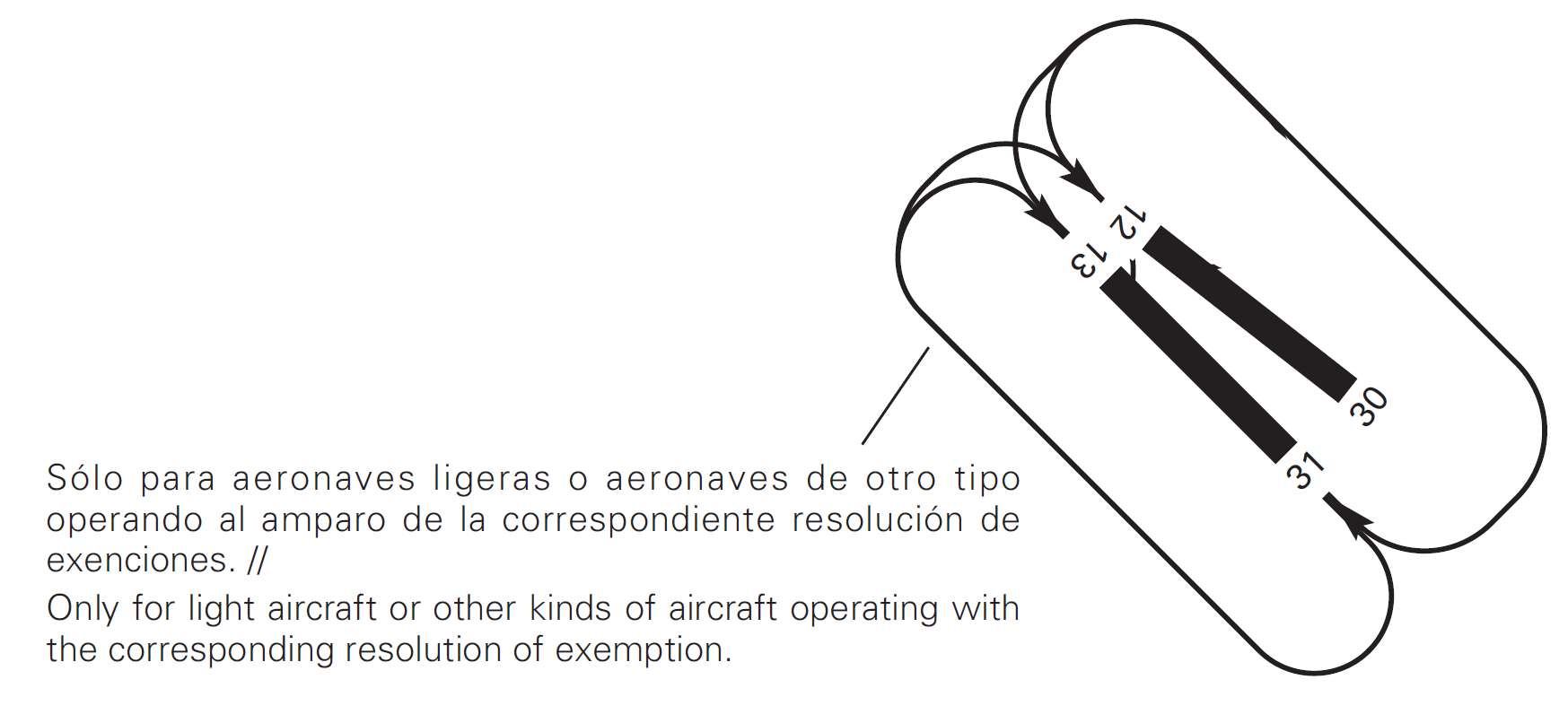
ADDITIONAL INFORMATION
Notification to aircraft equipped with TCAS, prior version to version 7, operating in the vicinity of MÁLAGA/Costa del Sol airport:
For permanent radar performance checking of MÁLAGA/Costa del Sol airport radar, a fixed radar transponder is installed at MGA VOR with the following characteristics:
-
Location: 364851.4087N; 0042211.4019W
-
Alpha Mode Code: 7777
-
Antenna altitude: 3382 ft.
Aircraft equipped with TCAS, prior version to version 7, overflying at low altitude close to these coordinates, may receive TCAS traffic advisories corresponding to this fixed transponder. These do not identify real traffic and should be ignored.
GENERAL RECOMMENDATIONS ABOUT THE PRESENCE OF BIRDS
Take special care because of the presence of birds at dawn and dusk.
It is advised to avoid flying low over the coastline whenever possible to avoid meeting shorebirds.
The risk is higher in spring and autumn.
In spring, the aircraft should be inspected before the flight, because birds may build nests on its surfaces.
In the case of helicopters, follow the specific recommendations for mitigating operational risks.
Presence of white stork within a radius of 5 Km and at a height of 0-1300 ft to the NW of the airport, from August to November.
Presence of vultures in "Desfiladero de los Gaitanes" Parque Natural at 35 Km NW of the airport (318 °) and at height over terrain of 0-2000 ft.
Possible presence of vultures near airport during November, with strong winds from W and NW.
BIRD MOVEMENTS
The line thickness indicates the importance of the movements.
The line pattern indicates the altitude of flight (AGL):
-
Dotted line: 0-65 ft (0-20 m)

-
Dashed line: 65-328 ft (20-100 m)

-
Continuous line: >328 ft (>100 m)

Movement A: Displacements of kites and storks (August - October).
Movement B: Displacements of ducks, gulls, cormorants and herons.
Movement C: Displacements of starlings.
Movement D: Displacements of gulls.
Movement E: Displacements of pigeons, kestrels and nocturnal birds of prey (at night).
BIRD CONCENTRATION ZONES
Zone 1: Concentration of starlings.
Zone 2: Concentration of pigeons.
Zone 3: Concentration of swifts (March-September).
Zone 4: Concentration of gulls (days with storms or strong winds).
Zone 5: Concentration of small birds (goldfinches, serins and greenfinches).
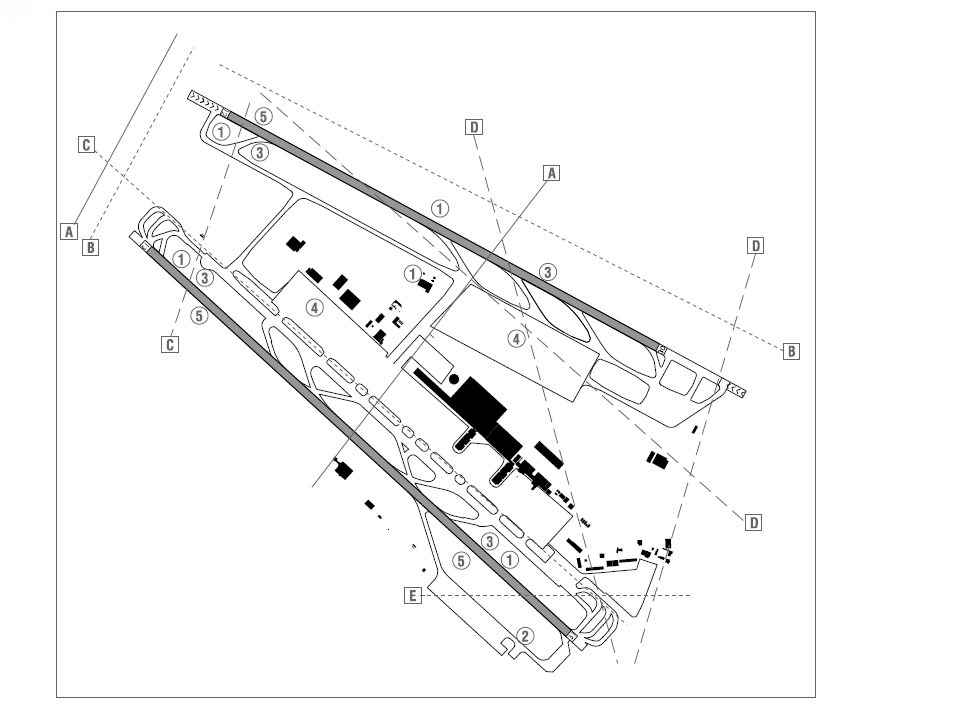
AERONAUTICAL CHARTS RELATED TO AN AERODROME
The list of charts related to the aerodrome can be found on the link below:
VISUAL SEGMENT SURFACE (VSS) PENETRATION
The instrument approach procedures affected can be found below:
IAC 7 VOR RWY 12: direct approach.
IAC 11 ILS Z RWY 13: direct approach.
IAC 12 ILS Y RWY 13: direct approach.
IAC 13 LOC RWY 13: direct approach.
IAC 14 VOR RWY 13: direct approach.
IAC 20 VOR RWY 31: direct approach.